 MineArchive
Fourstones Colliery
| Also known as | First Pit |
|---|---|
| Location | Fourstones, near Hexham, Northumberland — 55.0042, -2.1774 (exact) |
| Commodity | Coal |
| Type | Coal |
| Worked | 1805–April 1927 |
| Maximum depth | The First Pit was sunk 222 feet, to the foot of a coal 3 feet 10 inches thick. |
| Operators | William Benson and Sons (1860–1927) |
Overview
A small colliery at Fourstones on the South Tyne, four miles north-west of Hexham, listed from 1805 to 1927, which worked the Little Limestone Coal for the Benson family and stood beside a bank of lime kilns.
History
Fourstones Colliery lay in Warden parish, four miles north-west of Hexham, and is recorded as open from 1805. A plan of the Main seam at Fourstones East or Engine pit was deposited as abandoned in 1834. The colliery appears in the Mineral Statistics from 1855, and in the 1860s it belonged to William Benson; by the 1920s the owners were William Benson and Sons Ltd. Another record of the colliery dates it from 1855 to 1925, the years of its first and last full returns, with William Benson as owner from 1870 to 1910 and the limited company from 1915.
It was never large. Forty-eight people worked there in 1894, forty of them below ground, and the same in 1900; the number rose to 81 in 1910 and to 120 in 1925, raising manufacturing coal and, in the last years, household coal as well. From 1905 to 1925 the seam worked is given as the Little Limestone Coal. A bank of lime kilns was built next to the colliery in the nineteenth century.
The plan of the Main or Little Limestone seam was deposited as abandoned on 30 November 1926. In 1927 only eight people were employed, in the Prudham seam, and the colliery was abandoned on 23 April 1927.
Geology
The Little Limestone Coal, also called the Main seam here, and the Prudham seam. In the First Pit, sunk from about 180 feet above sea level, a limestone nearly 15 feet thick lay at 144 to 159 feet and the coal, 3 feet 10 inches thick, from 218 to 222 feet, under 58 feet of white post.
Geological setting: Sedimentary Beds and Seams (well documented example)
Workings
Two shafts, the First Pit and No. 2 Pit, with an earlier Fourstones East or Engine pit whose Main seam plan dates from 1834.
Closure
The Main or Little Limestone seam plan was deposited as abandoned on 30 November 1926. Eight people worked the Prudham seam in 1927 before the colliery was abandoned on 23 April; the Prudham plan is dated 30 April 1927.
What remains
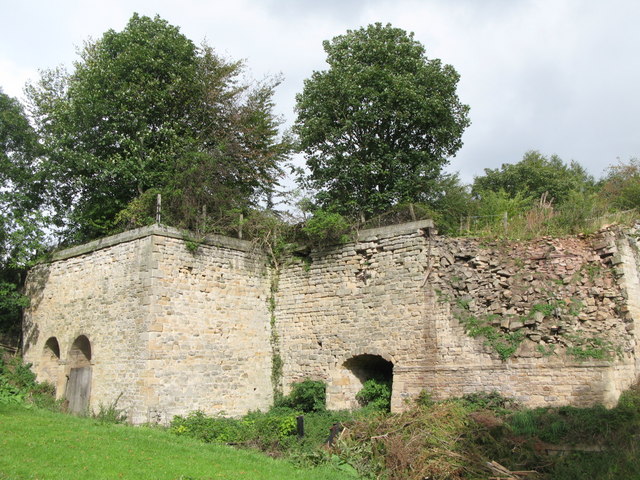
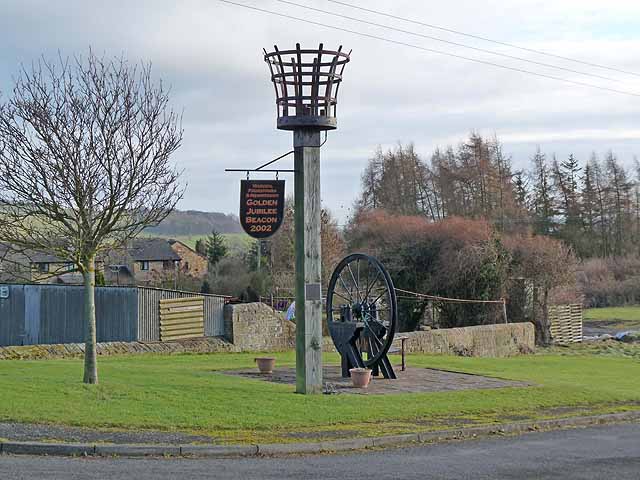
The nineteenth-century lime kilns beside the colliery site still stand, a stone bank with at least three arched draw holes. A colliery sheave wheel is mounted beside the Golden Jubilee beacon of 2002 on a green in the village.
The lime kilns next to the colliery site, and a sheave wheel set up in the village.
Nearby mines
- Stonecroft and Greyside Mine — 2.2 miles (3.6 km) W
- Settlingstones Mine — 2.4 miles (3.9 km) SW
- Acomb Colliery — 2.8 miles (4.6 km) SE
- Brunton Bank Quarry — 2.9 miles (4.7 km) NE
- Fallowfield Mine — 3.1 miles (4.9 km) E
Straight-line distance, within 9 miles (15 km). Show on the map.
What's uncertain
Points where sources disagree or the record could not be settled; both accounts are kept. All open questions in the archive.
- The colliery opened in 1855 and closed in 1925; a Benson owned it in 1860-65, William Benson from 1870 to 1910 and William Benson and Son Ltd from 1915 to 1925. (disputed) 7
Recorded claims
Individual factual claims, each attached to the source(s) that support it below. Where sources disagree, both are kept.
- The colliery is recorded as opened in 1805 and closed in 1927, owned by William Benson in the 1860s and by Wm. Benson and Sons Ltd in the 1920s. 1
- Employment was 48 in 1894, 81 in 1910, 108 in 1921 and 120 in 1925, falling to 8 in 1927. 1
- The Little Limestone Coal was worked from 1905 to 1925 and the Prudham seam in 1927, when the colliery was abandoned on 23 April. 1
- Plans of the Main or Little Limestone seam and the Prudham seam were deposited as abandoned on 30 November 1926 and 30 April 1927. 2,3
- The First Pit, from a surface about 180 feet above sea level, was sunk 222 feet to the foot of a coal 3 feet 10 inches thick. 4
- A bank of nineteenth-century lime kilns was built next to the colliery and still stands. 5
- A sheave wheel from an old colliery nearby stands beside the Golden Jubilee beacon in Fourstones. 6
- The colliery opened in 1855 and closed in 1925; a Benson owned it in 1860-65, William Benson from 1870 to 1910 and William Benson and Son Ltd from 1915 to 1925. (disputed) 7
Photographs & further reading
Owners, employment and seams by year, with the shaft section and those killed.
View sourceLocality record with the owners by year and its own opening and closing dates.
View sourceSources
- (primary) Durham Mining Museum: Fourstones Colliery — Durham Mining Museum
- (primary) BGS mine plans catalogue: Fourstones, Main or Little Limestone seam, abandoned 1926 — Mining Remediation Authority / BGS mine plans catalogue
- (primary) BGS mine plans catalogue: Fourstones, Prudham seam, abandoned 1927 — Mining Remediation Authority / BGS mine plans catalogue
- (primary) Durham Mining Museum: Fourstones Colliery, First Pit shaft details — Durham Mining Museum
- (observational) Fourstones lime kilns (NY8867), 2010 — Geograph (Mike Quinn)
- (observational) Golden Jubilee Beacon, Fourstones (NY8867), 2011 — Geograph (Oliver Dixon)
- (secondary) Fourstones Colliery, Warden, Northumberland, England, UK — Mindat
Record created: 4 October 2026 · Last researched: 5 October 2026