 MineArchive
Stublick Colliery
| Also known as | Stublick Colliery, Langley |
|---|---|
| Location | Stublick, near Langley, Haydon Bridge, Northumberland — 54.9369, -2.2622 (approximate) |
| Commodities | Coal, Fireclay |
| Type | Coal |
| Worked | By the 18th century–1926 |
| Maximum depth | No depth figure has yet been located. |
| Operators | Joseph Dinning (?–1890), M. Stobart (1890–1900), Langley Barony Coal and Fireclay Co. Ltd (1910–1926) |
Overview
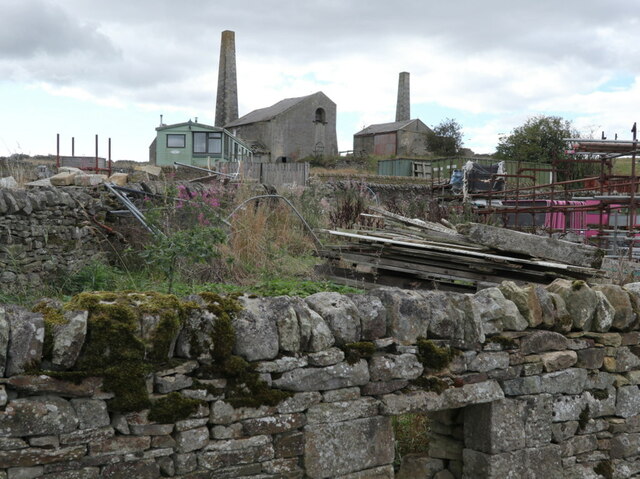
A small colliery on an upland outlier of the Northumberland coalfield, worked for thin and poor coal that was nonetheless good enough to fire the Greenwich Hospital's lead smelt mills at Langley and Blaghill below it. Its engine house, boiler house, chimney and workshops of the late 1830s are reckoned the finest early 19th-century colliery group in the region.
History
The Stublick coalfield is an outlier lying above the main north-east coalfield, its seams thin and its coal of poor quality, worked on a far smaller scale than the pits of the Tyne; what it produced was adequate for lead smelting, and through the 18th and 19th centuries the collieries at Stublick supplied the adjacent Langley and Blaghill mills. The remains on the ground date from 1838, when deeper coal called for better drainage and the records note the building of a new engine house and the provision of a steam engine, but earlier workings are also thought to survive on the site. The colliery was small by any measure: the lists of mines record six people in 1894 and four in 1896, rising to 42 in 1910 and settling at about twenty in the 1920s, selling coal by landsale and, later, as household coal with some fireclay. It passed from the executors of Joseph Dinning in the 1880s to M. Stobart in the 1890s and to the Langley Barony Coal and Fireclay Company by the 1910s, working the Bounder, Little, Main, Three Quarters, Yard and Stone Coal seams from several drifts — the Dene, Water Level and Yard Coal drifts and the West Pit. The Stone Coal was abandoned in 1900 as exhausted, most of the other seams in 1919, and the colliery closed in 1926; the last seams were formally abandoned that year. A year after the closure John William Stobart, aged 67, recorded as the manager, was killed at the colliery by a fall.
Geology
The Stublick coalfield is an upland outlier of Coal Measures preserved beside the great fault known as the Stublick Dyke. Its seams — Bounder, Little, Main, Three Quarters, Yard and Stone Coal — are thin and the coal is of poor quality, adequate for burning under a smelting hearth rather than for sale as steam or coking coal; fireclay was raised with it.
Workings
Two shafts and a set of drifts. The main shaft, used for pumping water from the deeper workings, survives as a roughly circular opening within a stone-revetted terrace, with the beam engine house, boiler house and chimney standing immediately to its south and a single-storey range of workshops, including a smithy, attached to the east side of the engine house. A second engine house with its own detached chimney stands south-west of the shaft and is thought to have held a winding engine, with a second, now infilled, shaft immediately south of it. Spoil heaps lie beside both chimneys, and a larger mound west of the pumping shaft is thought to belong to earlier workings.
Closure
Seam by seam the colliery ran out: the Stone Coal was abandoned in 1900 with the coal exhausted, the Bounder, Three Quarter, Main and Little in 1919, and the remaining seams in 1926 when the colliery closed. The lead mills it had supplied had themselves stopped in the 1860s and 1887.
What remains
The earthworks and buried remains are a scheduled monument and the standing buildings are listed at Grade II*. A visitor's account of December 2008 found the buildings roofless but structurally fairly sound and in need of attention, with contractors' huts about the site and work apparently under way; the smaller building beside the engine house was said locally to have held a steam sawmill.
The beam engine house, boiler house and chimney; the attached workshop range; the second engine house and its chimney; the revetted terrace and the open pumping shaft; spoil heaps; and the flue chimney of the Langley smelt mills on the skyline beyond.
Redevelopment
None. The buildings stand beside Stublick farm and its yard.
Nearby mines
- Langley Barony Mine — 1.3 km N
- Morallee Fell Mine — 2.6 km N
- Blackett Level — 4.3 km S
- Water House Mine — 4.9 km NW
- Settlingstones Mine — 5.4 km NE
Straight-line distance, within 15 km. Show on the map.
Recorded claims
Individual factual claims, each attached to the source(s) that support it below. Where sources disagree, both are kept.
- The colliery passed from the executors of Joseph Dinning in the 1880s to M. Stobart in the 1890s and to the Langley Barony Coal and Fireclay Co. Ltd by the 1910s. 1
- The lists of mines record six people at Stublick in 1894 and four in 1896, 42 in 1910 and 18 in 1925. 1
- The present remains date from 1838, when documents record the construction of a new engine house and the provision of a steam engine to drain the deeper coal. 2
- The colliery's thin, poor coal was adequate for lead smelting and supplied the adjacent Langley and Blaghill smelt mills. 2,3
- The Stone Coal seam was abandoned in 1900 as exhausted, several more seams in 1919, and the colliery closed in 1926. 1,3
Photographs & further reading
Owners, drifts, seams worked and the year-by-year employment and output returns from the official lists of mines.
View sourceNewcastle University's community page gathering photographs and list entries for the colliery buildings and the neighbouring smelt mills.
View sourceSources
- (secondary) Stublick Colliery — Durham Mining Museum
- (primary) Earthwork and buried remains of Stublick Colliery, immediately south east of Stublick, Haydon (List entry 1021259) — Historic England
- (secondary) Stublick Colliery — Co-Curate, Newcastle University
- (observational) Stublick Colliery, Northumberland, December 2008 — Derelict Places
- (primary) Abandoned mine plan catalogue entry: STUBLICK /BOUNDER/ ENGINE /QUARRY/ WET /YARD — British Geological Survey
Record created: 22 September 2026 · Last researched: 22 September 2026