 MineArchive
Langley Barony Mine
| Also known as | Langley Barony Lead Mine |
|---|---|
| Location | Langley, near Haydon Bridge, South Tyne, Northumberland — 54.9478, -2.2678 (exact) |
| Commodities | Lead, Barite, Whinstone |
| Type | Metal |
| Worked | 1868–1893 |
| Maximum depth | Unknown. |
| Operators | Bewick and Partners (1868–1893) |
Overview
Langley Barony was a lead mine on the South Tyne near Haydon Bridge, worked over a wide area by several adits and shafts and reckoned the largest of the mines in that district. Its ground was part of the Greenwich Hospital estate — land forfeited to the Crown by the Earl of Derwentwater after the Jacobite rising of 1715 — and the 1888 List of Mines returns it working lead ore, barytes and whinstone from the one sett, under Bewick and Partners of Haydon Bridge.
History
The land here has a particular history. The estates of the Earl of Derwentwater were forfeited to the Crown after his part in the Jacobite rebellion of 1715, and in 1735 they were assigned to the Greenwich Hospital — the naval charity that thereby became one of the great mineral landlords of the north, holding among much else the mineral-rich ground of Alston Moor. The London Lead Company took most of the mineral leases and paid the Hospital a rent in the form of duty ore.
At first that ore was sold back to the London Lead Company, who smelted it at their mill at Nenthead, but in 1768 the Greenwich Hospital built its own smeltmill at Langley and began smelting on its own account. The mill was expanded in the 1770s; besides its ore hearths it had two refining furnaces for extracting the silver from the lead, a reducing furnace to turn the litharge left after the silver had been taken into metallic lead, and a slag hearth for resmelting the waste from the ore hearths. In the 1780s the Hospital built a second mill next to and downhill from the first, leased to one of the smaller mining companies; known as Blagill Mill, it used Langley Mill's tailrace water and later shared the same flue system.
The mine itself belongs to the last phase of that landscape. In 1868 Thomas Bewick obtained a lease of the minerals in Langley Barony, part of the Greenwich Hospital estate and extending over several square miles, and prospected and developed the ground for some years before local businessmen joined him to form Bewick and Partners. The 1888 List of Mines returns Langley Barony at Haydon Bridge working lead ore, barytes and whinstone, under Bewick and Partners of Haydon Bridge — three products from one sett, which is unusual enough in the returns to be worth noticing.
The workings were run hard. Output rose from 30 tons in 1873 to 4,760 tons by 1882, then fell away to 230 tons by 1893, when the mine closed.
Geology
This is the northern edge of the North Pennine orefield, where lead is carried in near-vertical veins cutting a Carboniferous sequence of limestones, sandstones and shales. Two things about the ground explain the mine's three products. Barytes occurs in the same veins as the galena, the gangue that in an earlier generation would have gone on the tips; and the Whin Sill, the great sheet of quartz-dolerite intruded through the Carboniferous rocks of the north, outcrops in this district and gives the whinstone that the 1888 return lists alongside the ore. The lead here was argentiferous, which is why the Greenwich Hospital's mill at Langley had refining furnaces for taking the silver out of it.
Geological setting: Veins and Lodes (well documented example)
Workings
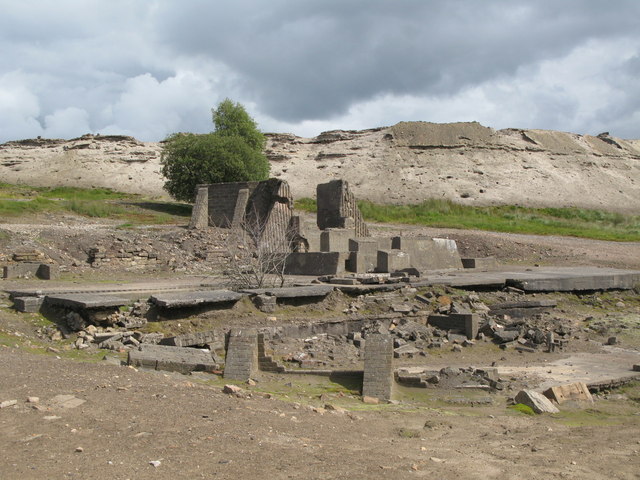
A mine of several adits and shafts covering a wide geographical area — described as perhaps the largest of the several lead mines around Haydon Bridge. A reservoir survives among the remains, and old mine shafts and spoil heaps have been photographed on the ground. The smelting was done separately and downhill, at the Greenwich Hospital's Langley mill and the Blagill mill beside it, whose shared flue climbs the hillside to an intact chimney.
Closure
The mine closed in 1893, output having fallen from a peak of 4,760 tons in 1882 to 230 tons in that year. The collapse of the lead price against cheap imported ore through the 1880s and 1890s is the ordinary explanation for a curve of that shape, though no source states it of Langley Barony.
What remains
The mine remains survive over a wide area and are a scheduled monument; old spoil heaps, a reservoir and old mine shafts have been photographed on the ground in recent years. Downhill, the paired Langley and Blagill smeltmills survive as buried remains with the standing and earthwork remains of their shared flue system, leading to an intact chimney; that group has been scheduled since 2 April 1975, amended in January 1998.
Adits, old mine shafts, spoil heaps and a reservoir spread over a wide area of the mine ground. Separately, and downhill towards the South Tyne, the buried remains of the Langley and Blagill smeltmills with their shared flue and its intact chimney.
Related mines
- Morallee Fell Mine — Both were returned in the 1888 Northumberland list at Haydon Bridge, on the same lead-bearing ground of the old Greenwich Hospital estate — Langley Barony under Bewick and Partners and within a few years of its peak output, Morallee Fell still only exploring.
Nearby mines
- Morallee Fell Mine — 0.6 miles (0.9 km) NE
- Stublick Colliery — 0.7 miles (1.1 km) S
- Water House Mine — 2.3 miles (3.6 km) NW
- Settlingstones Mine — 2.9 miles (4.7 km) NE
- Blackett Level — 3.4 miles (5.5 km) S
Straight-line distance, within 9 miles (15 km). Show on the map.
What's uncertain
Points where sources disagree or the record could not be settled; both accounts are kept. All open questions in the archive.
- Thomas Bewick obtained a lease of the minerals in Langley Barony in 1868 and was later joined by local businessmen to form Bewick and Partners; output rose from 30 tons in 1873 to 4,760 tons by 1882, then declined to 230 tons by 1893 when the mine closed. (uncertain) 1
- The BGS mine-plans catalogue holds a Mining Remediation Authority abandonment plan titled 'Langley Barony' (catalogue OM15348, Lead Ores, dated 1943); the catalogue gives no location and the plan's details do not clearly tie it to this working, so it may belong to another of the same name. (uncertain) 4
Recorded claims
Individual factual claims, each attached to the source(s) that support it below. Where sources disagree, both are kept.
- The 1888 List of Mines records Langley Barony at Haydon Bridge working lead ore, barytes and whinstone, owned by Bewick and Partners of Haydon Bridge, Northumberland. 1
- The estates of the Earl of Derwentwater were forfeited to the Crown after his part in the 1715 Jacobite Rebellion and were assigned to the Greenwich Hospital in 1735; the London Lead Company took most of the mineral leases and paid the Hospital a rent in the form of duty ore. 2
- Ore was initially sold back to the London Lead Company, who smelted it at Nenthead, but in 1768 the Greenwich Hospital built its own smeltmill at Langley; expanded in the 1770s, it included two refining furnaces for extracting silver from the lead ore, a reducing furnace to convert the litharge into metallic lead, and a slag hearth for resmelting the waste slag. 2
- In the 1780s the Greenwich Hospital built a second smeltmill next to and downhill from Langley Mill, leased to one of the smaller mining companies; known as Blagill Mill, it used the tailrace water from Langley Mill and later shared the same flue system. 2
- Thomas Bewick obtained a lease of the minerals in Langley Barony in 1868 and was later joined by local businessmen to form Bewick and Partners; output rose from 30 tons in 1873 to 4,760 tons by 1882, then declined to 230 tons by 1893 when the mine closed. (uncertain) 1
- Old spoil heaps, a reservoir and old mine shafts survive on the Langley Barony mine ground and have been photographed. 3
- The BGS mine-plans catalogue holds a Mining Remediation Authority abandonment plan titled 'Langley Barony' (catalogue OM15348, Lead Ores, dated 1943); the catalogue gives no location and the plan's details do not clearly tie it to this working, so it may belong to another of the same name. (uncertain) 4
Photographs & further reading
The scheduling for the smelting end of this operation — the paired mills the Greenwich Hospital built from 1768, their shared flue and its intact chimney — with the estate history that explains how a naval charity came to own the ground.
View sourceSources
- (primary) 1888 List of Mines under the Metalliferous Mines Act: Lead Ore, Barytes, and Whinstone Mines in Northumberland — Mines Department, via the Durham Mining Museum
- (primary) Langley and Blagill lead smeltmills, flue and chimney, Haydon (scheduled monument 1018211) — Historic England, via Ancient Monuments UK
- (observational) Langley Barony Lead Mine (photograph) — Geograph Britain and Ireland
- (primary) BGS / Mining Remediation Authority mine plans: LANGLEY BARONY — British Geological Survey / Mining Remediation Authority
Record created: 5 September 2026 · Last researched: 5 September 2026