 MineArchive
Ore Hearth
| Also known as | Ore Hearths (Plural form, for auto-linking mine/disaster prose.) |
|---|---|
| Category | Ore Processing |
A simple, low, open (or part-enclosed) furnace used from the 16th to the late 19th century to smelt lead ore directly, without first roasting it, using a bellows-driven air blast and fuel of peat, wood or coal.
Historical usage
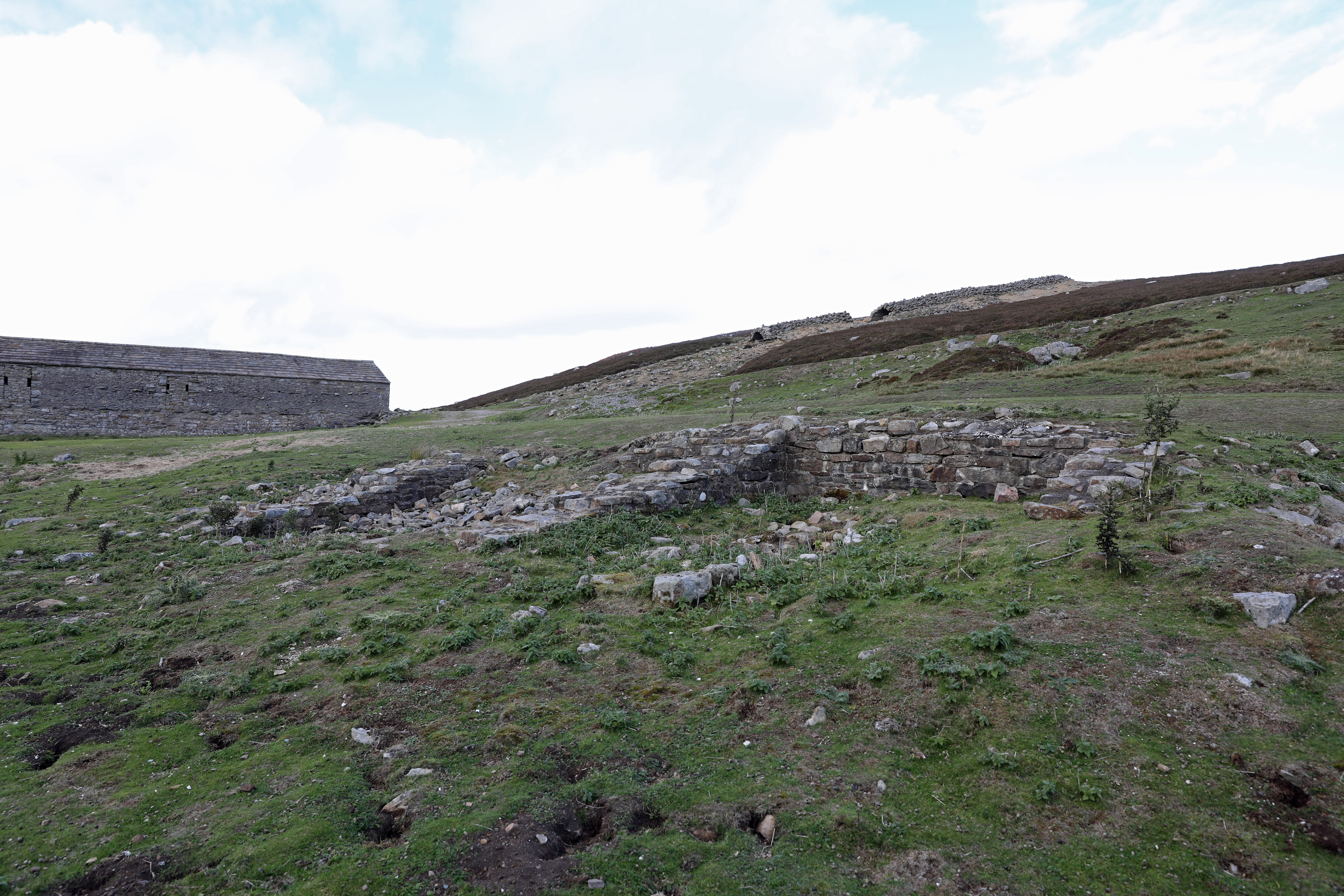
The ore hearth was introduced to England from the Mendips around 1577 by William Humfrey and became the standard method of lead smelting by the 18th century, remaining the dominant technology on the Northern Pennine orefield — Wensleydale, Swaledale, Alston Moor and neighbouring dales — well into the 19th century, even as the more efficient reverberatory furnace began to displace it elsewhere from the mid-18th century onward. Surviving ore-hearth smeltmill remains, including their long fume-collecting flues, are concentrated almost entirely in the Pennines, especially North Yorkshire.
How it worked
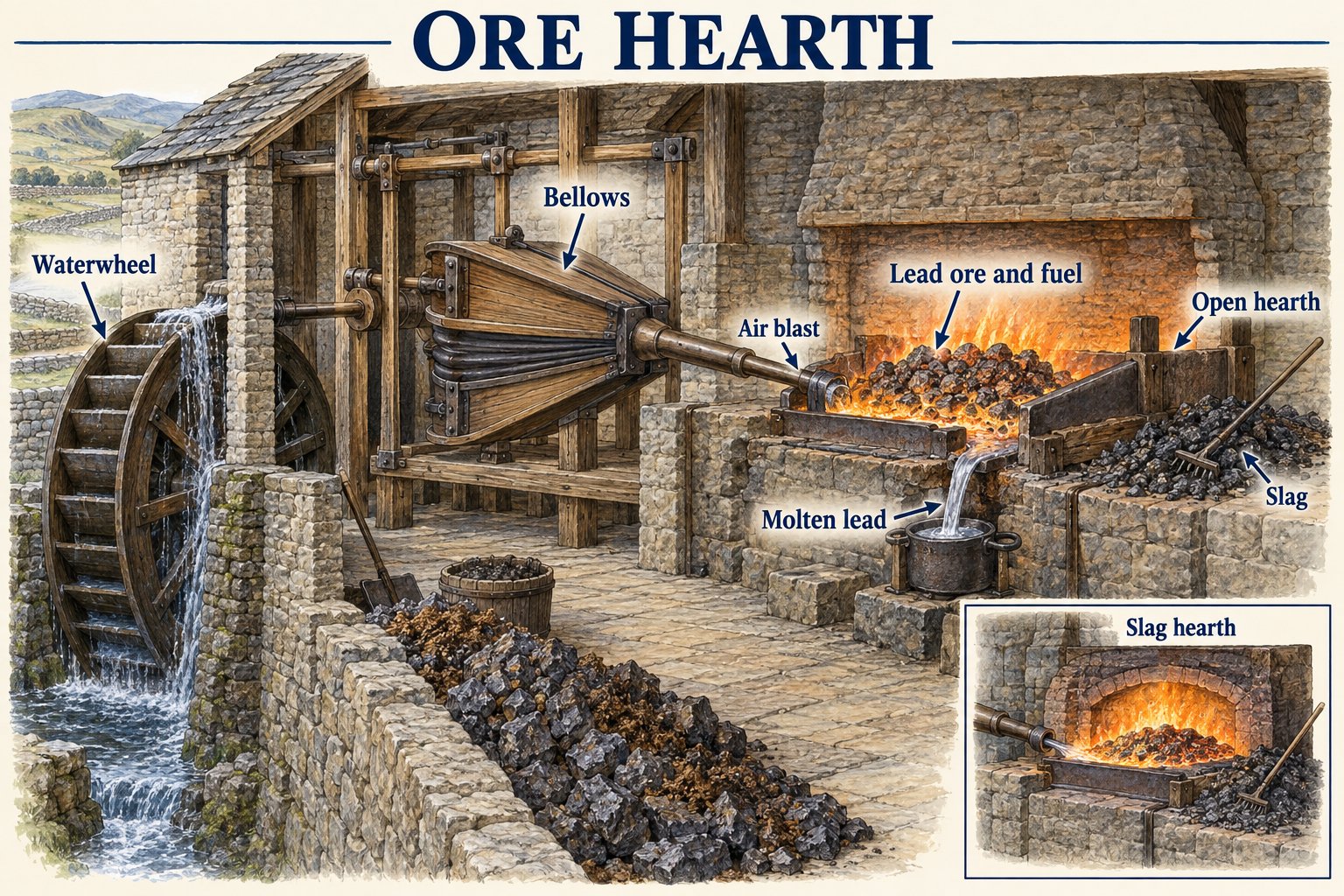
Lead ore (galena) was mixed with fuel and loaded into a shallow open hearth; an air blast, supplied by bellows and from the 17th century onward normally driven by a waterwheel, was directed into the hearth to raise the fire to smelting temperature. Molten lead ran off from the hearth, while the residual slag, which still contained a useful proportion of lead, was often reworked in a separate, hotter slag hearth fired with charcoal or coke to recover more metal. From the 1670s onward, Pennine smelters increasingly burned peat in their ore hearths in place of the more expensive wood or coal.
Why it was used
The ore hearth was simple and comparatively cheap to build and run, worked well with the water power and locally available peat fuel abundant in the Pennine dales, and could smelt ore directly rather than requiring a separate roasting stage — well suited to smaller-scale, dispersed lead-mining operations rather than the larger integrated works that reverberatory smelting favoured.
Risks & limitations
A significant proportion of the lead was lost from the ore hearth as fume rather than recovered as metal, both wasting a valuable commodity and creating a serious pollution hazard: the escaping lead-laden fume was drawn off through long stone flues, sometimes running for hundreds of metres up a hillside to a chimney, and was notorious for poisoning grazing animals and vegetation along its route. This inefficiency was the main reason the ore hearth was gradually superseded by the reverberatory furnace, which could recover a much higher proportion of the lead.
Regional variation
The ore hearth was specific to lead smelting and largely confined to the Pennine lead orefields; it is distinct from the reverberatory 'cupola' furnaces used more widely for tin and copper smelting in Cornwall and Devon.
Related terminology
Slag Hearth, Smelt Mill, Smelt Mill Flue
Mines associated with this term
5 examples chosen from 15 linked records — the term page is not an index.
- Augill Mine — Cumbria (well documented example)
Named in this record’s workings: “…its north wall. Four bays along the inside of the east wall held the ore hearths, each with two square-headed openings at the back: the lower…” - Bar Brook Lead Mill — Derbyshire (well documented example)
Named 3 times in this record, first in the history: “…this mill instead reworked slag from the upstream 17th/18th-century ore hearth mill. The Bar Brook site was scheduled as a nationally important…” - Beldi Hill Mine — North Yorkshire (well documented example)
Named in this record’s history: “…one at Beldi Hill in Swinner Gill in 1771, initially with a single ore hearth; later lessees, Thompson & Company, added a second hearth and a…” - Blakethwaite Mine — North Yorkshire (well documented example)
Named in this record’s workings: “…Lownathwaite workings and processed at the 1821 smelt mill using two ore-hearths fired with locally cut peat and small amounts of coal, with fumes…” - Froggatt Wood Smelt Mill — Derbyshire (well documented example)
Named 3 times in this record, first in the history: “…stone wood-drying kiln, used to dry wood for fuelling the mill's ore hearth -- a feature unique within the English lead industry. Remarkably,…”
Sources
- (primary) Grinton ore hearth lead smelt mill, flue, fuel store and associated earthworks, Grinton — Historic England (Scheduled Monument record)
- (secondary) Smelting — Northern Mine Research Society
Record created: 23 August 2026 · Last researched: 23 August 2026