 MineArchive
Blakethwaite Mine
| Location | Gunnerside Gill, Swaledale, North Yorkshire — 54.3958, -2.0208 (approximate) |
|---|---|
| Commodity | Lead |
| Type | Metal |
| Worked | 1819 (mine)–1878 |
| Operators | Thomas Chippendale and Company (1819–1873), A.D. Mining Company Ltd (1873–1878) |
Overview
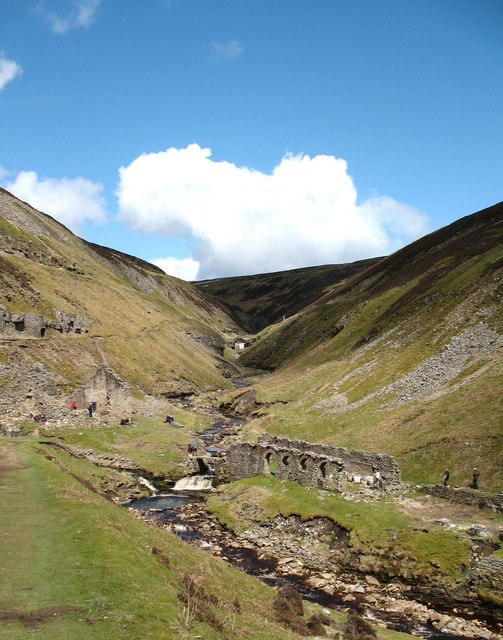
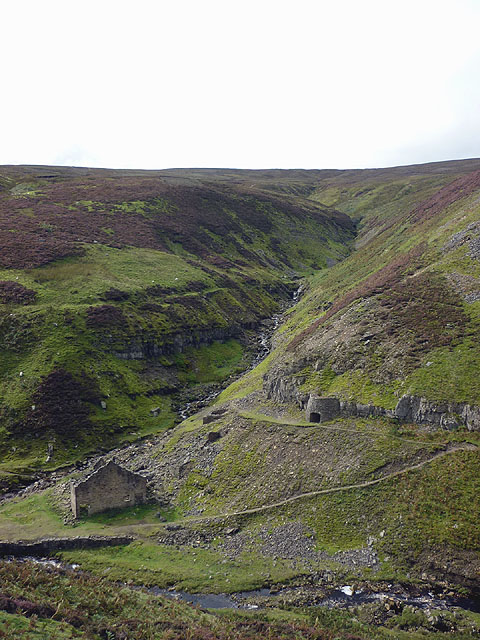
Blakethwaite, at the head of Gunnerside Gill, was built to process the surging output of Swaledale's upper lead mines in the 1820s — its smelt mill and dams remain among the best-known ruins in the whole of the Yorkshire Dales.
History
Lead had been worked in Gunnerside Gill since at least the 15th century, but output from the mines in the upper part of the gill increased sharply from 1819, prompting the construction of a new smelting mill at Blakethwaite. The mill began smelting in 1821, initially taking ore only from the Blakethwaite and Lownathwaite mines nearby; Thomas Chippendale and Company, who leased Blakethwaite Mine, are thought to have built the large peat house supplying the mill's fuel around 1820. The A.D. Mining Company Ltd later smelted ore from its own mines on the west side of Gunnerside Gill at Blakethwaite from 1873, but transferred all smelting to its Surrender Mill, elsewhere in Swaledale, in early 1878, ending Blakethwaite's working life as a smelting site; the buildings were maintained into the late 19th century even after smelting ceased.
Geology
The mine worked lead-bearing veins in the Carboniferous rocks of the northern Pennine orefield, the same broad mineralised belt worked throughout Swaledale, including at the neighbouring Old Gang and Surrender mines.
Geological setting: Hydrothermal Deposits (well documented example), Veins and Lodes (well documented example)
Workings
Ore was raised from the Blakethwaite and Lownathwaite workings and processed at the 1821 smelt mill using two ore-hearths fired with locally cut peat and small amounts of coal, with fumes carried up a flue to a chimney on the crag above. A series of dams on Gunnerside Beck supplied water power to the mill.
Closure
Smelting at Blakethwaite ended in 1878, when the A.D. Mining Company transferred the process to its Surrender Mill; the buildings continued to be maintained for some years afterwards even without active smelting.
What remains
The mill and its dressing floors are a Scheduled Monument; the collapsed mill building itself survives only in ruin, though the arched peat store remains relatively intact, and the National Park has carried out consolidation work on the structures, including bringing in materials by helicopter.
The line of the old flue running up the fellside to its chimney, along with the Blakethwaite dams on Gunnerside Beck, survive as visible features across the site.
Related mines
- Sir Francis Level (Lownathwaite Mine) — Both worked by Sir George Denys's A.D. Mining Company, which drove the Sir Francis Level and smelted at Blakethwaite.
- Surrender Mine — The A.D. Mining Company smelted Blakethwaite's ore at Blakethwaite mill until 1878, then moved the smelting to its Surrender Mill.
Nearby mines
- Sir Francis Level (Lownathwaite Mine) — 1.3 miles (2.1 km) E
- Old Gang Mines — 1.4 miles (2.2 km) SE
- Whaw Mine — 1.4 miles (2.3 km) NE
- Hungry Chert Quarries — 1.5 miles (2.4 km) N
- Booze Mine — 1.8 miles (2.8 km) NE
Straight-line distance, within 9 miles (15 km). Show on the map.
Recorded claims
Individual factual claims, each attached to the source(s) that support it below. Where sources disagree, both are kept.
- The A.D. Mining Company smelted ore from its west Gunnerside Gill mines at Blakethwaite from 1873 until early 1878, when it transferred all smelting to its Surrender Mill. 1
- The smelt mill began work in 1821, at first taking ore only from the Blakethwaite and Lownathwaite mines; Thomas Chippendale and Company, who leased Blakethwaite Mine, are thought to have built its large peat house about 1820. 2
- A longitudinal section along the Blakethwaite and Stonesdale veins, showing the levels and the geology, was compiled and drawn by K. C. Dunham in 1941 and is held by the British Geological Survey (SP2147). 3
Photographs & further reading
The Geological Survey's 1941 section along the veins, showing the levels and geology, viewable online.
View sourceSources
- (secondary) Gunnerside Gill lead mines — Out of Oblivion
- (primary) Blakethwaite Smelt Mill and dressing floors, Melbecks — Historic England (Scheduled Monument List Entry 1015857)
- (primary) BLAKETHWAITE AND STONESDALE MINES (Survey plan - Land Survey Plans held at Murchison House SP2147, BGS mine plans catalogue) — British Geological Survey / Mining Remediation Authority
- (primary) Blakethwaite Mine Plan (BGS Mine Plans Catalogue) — British Geological Survey
Record created: 22 August 2026 · Last researched: 24 September 2026