 MineArchive
Hyndford Quarry
| Location | Lanark, South Lanarkshire — 55.6574, -3.7455 (exact) |
|---|---|
| Commodity | Sand and Gravel |
| Type | Quarry |
| Worked | 1960s–Still active |
| Maximum depth | An open sand and gravel working; no depth is recorded. |
| Operators | Cemex UK Operations Ltd |
Overview
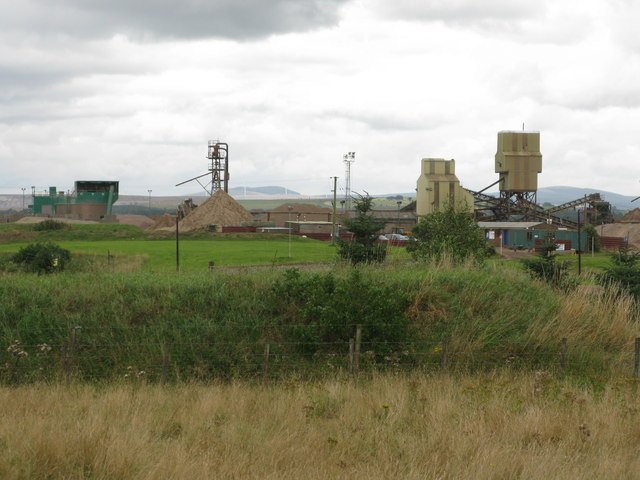
Hyndford Quarry is a working aggregates quarry beside the River Clyde at Lanark, operated by Cemex UK and in production since the 1960s. It takes its name from the neighbouring village of Hyndford and is bounded by the Clyde to the south, Lanark Racecourse to the north and Robiesland Farm to the west. Its significance to the archive is less geological than administrative: a proposal to extend it westward into the buffer zone of the New Lanark World Heritage Site drew 11,500 objection letters, was approved by South Lanarkshire Council and recommended for approval by the government's own reporters, and was then refused by Scottish Ministers in a decision published in January 2017.
History
The quarry has worked sand and gravel on the haugh land beside the Clyde since the 1960s and carries an entry on the register of the Royal Commission on the Ancient and Historical Monuments of Scotland. In 2010 its operators announced plans to extend it into the buffer zone of the New Lanark World Heritage Site and the Falls of Clyde Designed Landscape. The application went to South Lanarkshire Council in November 2012 and proposed two extensions: a southern one outside the buffer zone and a western one within it.
Opposition to the western extension was led by a local group, Save Our Landscapes, which gathered a petition of 7,000 names and more than 11,500 objection letters before the decision reached the planning committee. It was also opposed by the New Lanark Trust, the Royal Burgh of Lanark Community Council, the New Lanark Community Council, the Lanark and District Civic Trust, the Garden History Society in Scotland, the UK committee of ICOMOS and the Scottish Wildlife Trust, which manages the Falls of Clyde reserve. It was not opposed by Historic Scotland, the government's own heritage agency — a position that generated considerable controversy. The council's planning committee approved the application in December 2013, and a campaign then persuaded Scottish Ministers to call it in.
The decision took eighteen months to issue and was published in January 2017. Ministers refused permission for the western extension while granting the southern. They disagreed with their own reporters, who had found the scheme consistent with national and local planning policy and recommended approval, holding instead that up to eight years of landscape disturbance before restoration was unacceptable and was not outweighed by a need for minerals that was only marginally short. They also noted that the western extension would not have brought any significant increase in employment. Cemex announced that it had taken legal advice and saw grounds to challenge the adequacy of the Ministers' reasons.
Geology
The quarry works sand and gravel from the fluvial deposits of the Clyde valley — the loose, water-laid material of the river's own haughs rather than solid rock. It is that setting, low ground immediately beside the river and within sight of the gorge at New Lanark, that made the westward extension so contentious: the workable resource and the protected landscape occupy the same ground.
Geological setting: Placer Deposits (historical documentary reference)
Workings
An open sand and gravel working, restricted to the operator and not publicly accessible, though it can be seen from the road to New Lanark through Robbiesland Farm which runs parallel to its western boundary. Restoration is worked progressively as extraction advances; the eight-year period of disturbance that Ministers found unacceptable was the interval before restoration would have caught up in the proposed western extension.
Closure
The quarry remains in production. The southern extension was permitted; the western extension into the World Heritage buffer zone was refused.
What remains
Working, operated by Cemex UK, and a restricted site. The refusal of the western extension in January 2017 fixed the limit of the workings on that side, leaving the New Lanark buffer zone and the Falls of Clyde Designed Landscape unquarried.
An active quarry rather than a remain; the ground worked out to date is progressively restored as extraction moves on.
Nearby mines
- Waterland Colliery — 6.4 miles (10.3 km) NW
- East Law Colliery — 6.5 miles (10.5 km) NW
- Bellfield Colliery — 6.8 miles (10.9 km) SW
- Douglas Castle Colliery — 7.2 miles (11.6 km) SW
- Castlehill Colliery — 7.5 miles (12.1 km) NW
Straight-line distance, within 9 miles (15 km). Show on the map.
Recorded claims
Individual factual claims, each attached to the source(s) that support it below. Where sources disagree, both are kept.
- Hyndford Quarry is an aggregates quarry at Lanark operated by Cemex UK, in operation since the 1960s, bordered by the River Clyde to the south, Robiesland Farm to the west, Lanark Racecourse to the north and the village of Hyndford to the east. 1
- The application submitted to South Lanarkshire Council in November 2012 proposed a southern extension outside the New Lanark World Heritage Site buffer zone and a western extension that would have entered it. 1
- Opposition to the western extension was led by Save Our Landscapes, which gathered a petition of 7,000 names and more than 11,500 objection letters; the New Lanark Trust, two community councils, the Lanark and District Civic Trust, the Garden History Society in Scotland, ICOMOS-UK and the Scottish Wildlife Trust also objected. Historic Scotland did not. 1
- Scottish Ministers refused permission for the western extension and granted it for the southern. They disagreed with the reporters' conclusion that the development would not adversely affect the conservation interest or integrity of the World Heritage Site or its setting, holding that up to eight years of landscape disturbance before restoration was unacceptable and not outweighed by a need for minerals that was only marginally short. 2
- The decision took eighteen months to issue after the Notice of Intention and was published in January 2017. Ministers also noted that the western extension would not have resulted in a significant increase in employment. 2
Photographs & further reading
Quotes the Ministers' reasoning in full and sets out the oddity of the case — that the council, Historic Scotland and the government's own reporters all found the western extension acceptable, and Ministers then refused it.
View sourceSources
- (secondary) Hyndford Quarry — Wikipedia
- (secondary) Hyndford Quarry Decision: Update (5 January 2017) — Built Environment Forum Scotland
Record created: 4 September 2026 · Last researched: 4 September 2026