 MineArchive
Ham Hill Quarries
| Also known as | Ham Hill Stone Quarries, Hamdon Hill Quarries |
|---|---|
| Location | Ham Hill, above Stoke-sub-Hamdon, west of Yeovil, Somerset — 50.9517, -2.7450 (approximate) |
| Commodity | Limestone |
| Type | Stone |
| Worked | Roman period–Still active |
| Maximum depth | Surface quarrying; the working southern quarry takes stone from some 20 to 30 m below the surface. |
| Operators | Duchy of Cornwall, Harvey Stone |
Overview
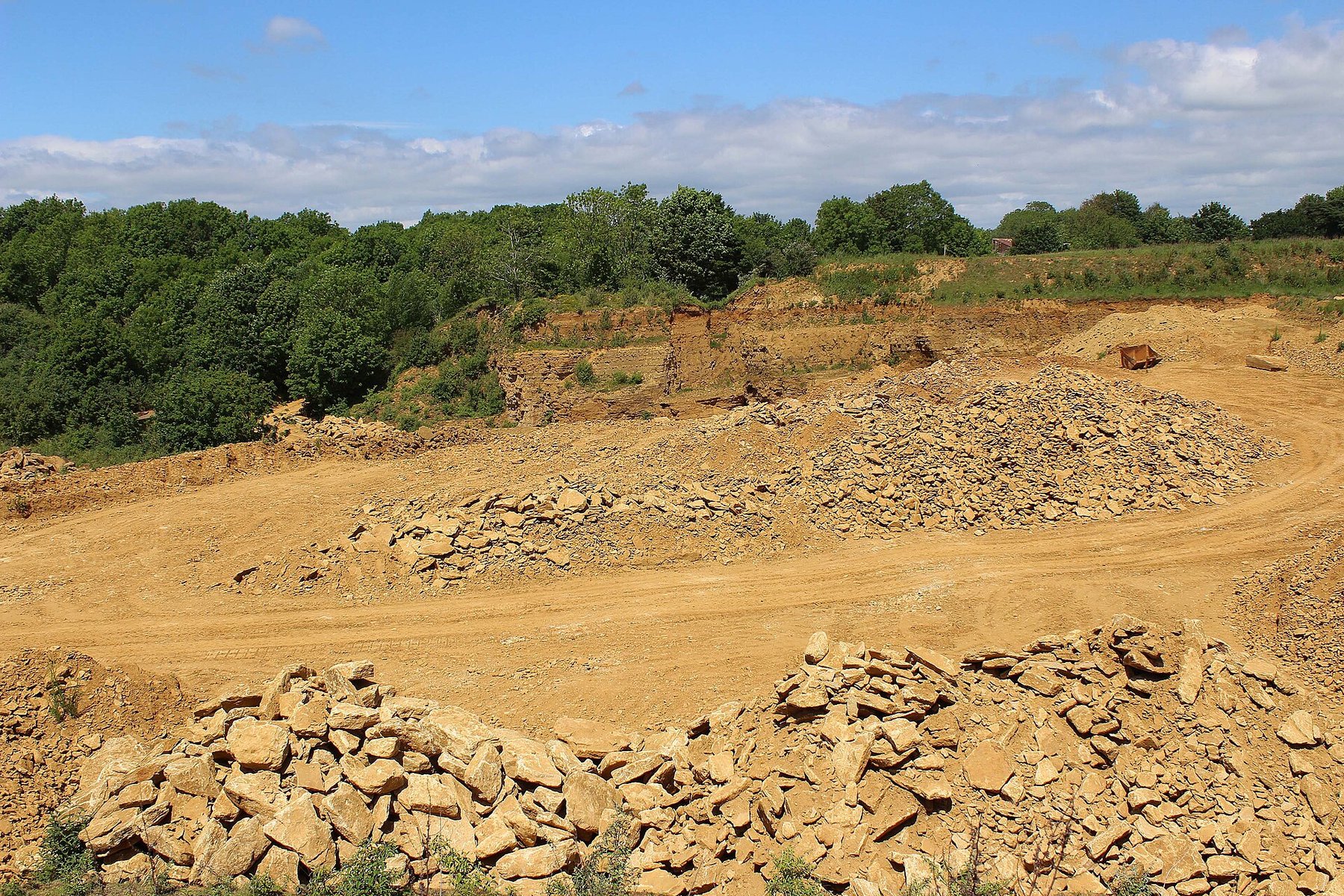
The quarries on Ham Hill near Yeovil, source of the warm honey-coloured hamstone that built much of south Somerset — Montacute House, Sherborne Abbey, the church at Martock and whole villages besides. Stone has been taken from the hill since at least the Roman period, and quarrying has so reworked the summit that the Iron Age hillfort on it now sits in a warren of stony ridges and grassy hollows. Two quarries are still worked.
History
Hamstone has been quarried on the hill since at least Roman times, and examples of its use survive from both the Roman and Norman periods. In the medieval period the stone went by horse and cart to the River Parrett and then by boat to Taunton, and from there to churches across Devon, Dorset and west Somerset; the quarries were at their most prosperous between the 15th and 17th centuries. The Victorians moved it very much further by rail.
By the 1800s there were 24 small quarries on the hill employing some 200 men, and in later Victorian times the industry expanded to upwards of 200 small family-run quarries and masonry businesses. Most of these had stopped working by 1910.
Today the stone is worked in only two places at the top of the hill. The North quarry, near the modern stone circle and the war memorial, is the longest continuously running hamstone quarry in existence. The southern or Norton quarry, worked by Harvey Stone, takes its stone from some 20 to 30 metres below the surface; it had been abandoned in the 1930s on the masons' verdict that there was no good quality stone left, and was reopened around fifteen years ago. Both are owned by the Duchy of Cornwall.
Geology
Hamstone comes from a rock unit formerly called the Ham Hill Limestone Member, now treated as part of the Bridport Sand Formation, laid down between roughly 183 and 174 million years ago in the Toarcian stage of the Early Jurassic. The sediments accumulated in a shallow, warm carbonate sea, and the rock is largely made of coral and shell fragments built up into beds and reefs. It is mainly a well-cemented, medium- to coarse-grained shelly limestone with thin beds and inclusions of claystone, and it is golden because of the iron compounds in it — a colour that deepens as it weathers, the weathering also picking out the weaker, less well-cemented layers and the cross-bedding. Fresh from the quarry it can be readily sawn, split and dressed, which is what makes it useful for blocks, ashlar and door and window surrounds.
Geological setting: Sedimentary Beds and Seams (well documented example)
Workings
Open quarrying across the hilltop rather than any underground working, cut in a great many small faces rather than one large pit — the reason the summit is now a warren of ridges and hollows. Quarrymen worked the vertical fractures in the rock, which they called 'gulls', using them to break the stone away from the faces. Deep Quarry, now a geological SSSI exposure, shows the typical bedding, distinctive cross-bedding and thin clay layers in faces about 3 m high. The surviving southern quarry works its stone from 20 to 30 m below the surface.
Closure
Never fully closed. The great majority of the hill's quarries had ceased working by 1910, and the southern quarry was abandoned in the 1930s before being reopened about fifteen years ago; two quarries are in production today.
What remains
The hill is a country park and local nature reserve, and the old workings are used for picnicking, walking and mountain biking. 11.1 hectares are notified as a geological Site of Special Scientific Interest (1971) for its fossil assemblages, its sedimentary features and its relationship to rocks of the same age nearby; it is also a Local Geological Site with a marked geological trail from the Ham Hill Centre. The quarry faces are loose and overhanging in places, and hammering the rock or collecting fossils is illegal on the SSSI.
Extensive disused workings across the hilltop — ridges, hollows and quarry faces, Deep Quarry among them — alongside the two quarries still in production.
Redevelopment
The worked-out ground is now Ham Hill Country Park, which also takes in an Iron Age hillfort, a Roman site and a Scheduled Ancient Monument; quarrying continues alongside it in two places.
Recorded claims
Individual factual claims, each attached to the source(s) that support it below. Where sources disagree, both are kept.
- Hamstone has been quarried on Ham Hill since at least the Roman period, with surviving examples of its use from Roman and Norman times. 1
- In the medieval period the stone went by horse and cart to the River Parrett and then by boat to Taunton, from where it was distributed to churches across Devon, Dorset and west Somerset. 1
- In the 1800s 24 small quarries on the hill employed some 200 men, expanding in later Victorian times to upwards of 200 small family-run quarries and masonry businesses; most had ceased working by 1910. 2,3
- The stone comes from the former Ham Hill Limestone Member, now part of the Bridport Sand Formation, formed roughly 183 to 174 million years ago in the Toarcian stage of the Jurassic from coral and shell fragments in a shallow carbonate sea. 1
- Quarrymen worked to vertical fractures in the rock which they called 'gulls', using them to break stone away from the faces. 1
- Hamstone is still quarried in two places at the top of the hill: the North quarry, the longest continuously running hamstone quarry in existence, and the southern Norton quarry worked by Harvey Stone from 20 to 30 m below the surface. Both are owned by the Duchy of Cornwall. 2,3
- 11.1 hectares of the hill were notified as a geological SSSI in 1971 for its fossil assemblages, sedimentary features and relationship to rocks of equivalent age nearby. 1,2
- Quarrying has unearthed many important historical artefacts but has also destroyed much of the archaeological context on the hill. 2
Photographs & further reading
The Survey's own account of the stone — how it formed, why it is golden, how it behaves when worked and weathered — with historic photographs of the quarries in 1911 and a geological trail.
View sourceBackground on the building stone itself and where it was used, from village cottages to Montacute House and Sherborne Abbey.
View sourceSources
- (primary) Ham Hill, Somerset (Postcard geology) — British Geological Survey
- (secondary) Ham Hill, Somerset — Wikipedia
- (secondary) Hamstone — Wikipedia
Record created: 3 September 2026 · Last researched: 3 September 2026