 MineArchive
Blairmuckhill Colliery
| Also known as | Blairmuckill Colliery, Barblues Colliery Pit No. 10, Blairmuckhole Colliery |
|---|---|
| Location | North-west of Harthill, Shotts parish, Lanarkshire, North Lanarkshire — 55.8647, -3.7744 (approximate) |
| Commodities | Coal, Ironstone |
| Type | Coal |
| Worked | 1905 to 1910–1959 |
| Operators | A. and G. Anderson (1905–1947), National Coal Board (1947–1959) |
Overview
A. and G. Anderson's colliery north-west of Harthill, on the Lanarkshire side of the Shotts and West Lothian border, sunk about 1905 to 1910 and worked by the National Coal Board until 1959. Two pits, Nos. 10 and 11, worked the Drumgray, Mill, Ball and Main coals by longwall for a workforce of about 320; an explosion of gas in March 1915 killed the under-manager and a contractor who had walked into an uninspected section with naked lights in their caps.
History
The Durham Mining Museum returns Blairmuckhill under A. and G. Anderson from 1905, with 140 employed in the Upper Drumgray, and dates its opening to 1910; the register compiled after nationalisation also gives 1910 for the start of sinking and production. By 1910 it employed 283 and by 1920 394, raising household, manufacturing and steam coal, with ironstone in 1920. The 1910 housing inquiry found 177 employed, living mostly in rented houses at Harthill, Benhar, Eastfield and Blackridge, with three company houses at Eastfield built about 1872 by Robert Addie and Sons. Coal-cutting machines were at work by 1913, when a fireman was killed by a stone from the roof waiting for a cutter to finish. The pit was worked for the most part with naked lights though gas was not unknown, and on 27 March 1915 the under-manager, James Hawson, took two contractors into a section the fireman had not yet inspected, all three with naked lamps in their caps; the gas exploded, Hawson died the next day and Richard Sommerville a week later, and the Court of Session refused Hawson's widow compensation because he had brought the peril on himself. Later deaths recorded in the newspapers include John Wright under a fall on the main haulage road in 1925 and David Gemmell after firing a shot in the Upper Drumgray in 1936. Employment held between 255 and 350 through the 1930s and 1940s. The National Coal Board took it over in 1947 with 349 employed and 80,000 tons a year; in 1948 it was raising 300 tons a day by longwall from No. 11 pit, 112 metres deep, with No. 10 at 37 metres for ventilation, two bar tables for grading and an obsolete Norton-Harty washer, no baths but a full-meal canteen. The peak workforce was 347 in 1952 and the colliery closed and was abandoned in 1959.
Geology
Lanarkshire coalfield, Shotts district: Upper and Lower Drumgray, Mill, Ball and Main coals, with ironstone returned in 1920.
Geological setting: Sedimentary Beds and Seams (historical documentary reference)
Workings
Two shafts: No. 11, 112 metres deep, and No. 10, 37 metres, for ventilation; the colliery was also known as Barblues Colliery Pit No. 10. Longwall working with coal-cutting machines from before 1913; 300 tons a day and 86,000 tons a year in 1948. Employment from the Lists of Mines: 140 in 1905, 283 in 1910, 394 in 1920, 284 in 1923, 255 in 1933, 350 in 1940, 349 in 1947, 322 in 1954; peak 347 in 1952.
Closure
Closed and abandoned in 1959 by the National Coal Board; the reason is not given in the sources read.
What remains
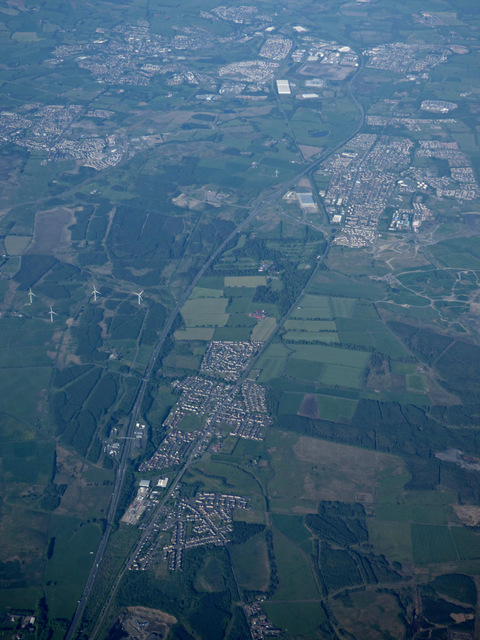
The site lies in the fields north-west of Harthill beside the M8; nothing of the pit is reported to survive.
None reported in the sources read.
Related mines
- Greenrigg Colliery — Neighbouring pits either side of the Lanarkshire and West Lothian border at Harthill.
- Polkemmet Colliery — Neighbouring pits of the Harthill and Whitburn district.
- Southrigg Colliery — Neighbouring Harthill pits.
Nearby mines
- Greenrigg Colliery — 3.5 km SE, West Lothian
- Southrigg Colliery — 4.0 km E, West Lothian
- Fallahill Colliery — 4.2 km SE, West Lothian
- Polkemmet Colliery — 4.5 km E, West Lothian
- Shotts Iron Works — 5.2 km S
Straight-line distance, within 15 km. Show on the map.
Disasters & major incidents
-
Blairmuckhill Colliery explosion, 1915
27 March 1915 · Explosion · 2 fatalities
On 27 March 1915 the under-manager of Blairmuckhill, James Hawson, took two mining contractors below to show them a stretch of face they might tender for. At the pit bottom the fireman told him the section had not yet been inspected as the statute required; Hawson said he would inspect it himself and led the two men down the dook, a safety lamp in his hand and a naked lamp burning in his cap, the contractors with naked lights too. A short way in the gas fired, putting out every lamp and burning all three. Hawson died the next day and Richard Sommerville a week later; Charles Stewart was badly burned. The Court of Session refused Hawson's widow compensation on the ground that he had brought the peril on himself.
Recorded claims
Individual factual claims, each attached to the source(s) that support it below. Where sources disagree, both are kept.
- The museum and the NCB register date the colliery from 1910 to 1959, though the museum's 1905 list already returns 140 employed there. 1,2
- A. and G. Anderson, then the National Coal Board from 1947. 1,2
- No. 11 was 112 metres deep and No. 10, 37 metres, for ventilation. 2
- 283 employed in 1910, 394 in 1920, 349 in 1947 and a peak of 347 in 1952. 1,2
- On 27 March 1915 an explosion of gas in an uninspected section killed the under-manager and a mining contractor, both of whom had entered with naked lights. 3
Photographs & further reading
Owners, seams, output and employment from 1905 to 1954 and four named deaths.
View sourceHistoric Environment Scotland's record with the 1948 National Coal Board register entry on shafts, output and surface plant.
View sourceNewspaper reports of the 1915 explosion and the later deaths at Blairmuckhill.
View sourceSources
- (primary) Blairmuckhill Colliery — Durham Mining Museum — Durham Mining Museum
- (primary) Blairmuckill Colliery — trove.scot (Canmore record with the 1948 NCB register entry) — Historic Environment Scotland
- (primary) Shotts parish accidents post 1900 — Scottish Mining Website — Scottish Mining Website
- (primary) Shotts parish housing conditions of miners, 1910 — Scottish Mining Website — Scottish Mining Website
- (secondary) Harthill, Scotland — Wikipedia
Record created: 12 September 2026 · Last researched: 12 September 2026