 MineArchive
Chatterley Whitfield Colliery
| Location | Stoke-on-Trent, Staffordshire — 53.0758, -2.1753 (exact) |
|---|---|
| Commodity | Coal |
| Type | Coal |
| Worked | 1750–1976 |
| Maximum depth | nearly 2,000 ft (610 m) at the Hesketh shaft |
| Operators | Hugh Henshall Williamson (?–1867), Whitfield Colliery Company Limited (1867–1872), Chatterley Iron Company Limited (1873–1890), Chatterley Whitfield Collieries Limited (1890–1947), National Coal Board (1947–1976) |
Overview
Chatterley Whitfield was the largest colliery in North Staffordshire and, in 1937, the first colliery in Britain to mine over a million tons of saleable coal in a single year. It closed in 1976, later reopened briefly as a mining museum, and today survives as one of the most complete groups of traditional colliery buildings in the country — a Scheduled Monument, though a deteriorating one.
History
Coal may have been worked here as early as the 14th century by the Cistercian monks of Hulton Abbey, though the first firmly recorded activity dates from 1750, when a coal merchant from Burslem worked the site. Development accelerated in the 1850s under the local businessman Hugh Henshall Williamson, who sank the Bellringer, Ten Foot and Engine Pit shafts; the Biddulph Valley railway branch, completed in 1860, gave the colliery a direct route to market and drove further expansion.
Ownership passed through a series of companies: the Whitfield Colliery Company Limited from 1867, the Chatterley Iron Company Limited from 1873 -- under whom, on 7 February 1881, an underground explosion killed at least 21 men and boys, one of the worst disasters in this whole archive (see Disasters, below) -- and Chatterley Whitfield Collieries Limited from 1890. By 1899 the colliery was producing over 950,000 tons of saleable coal a year, and in 1937 — repeated in 1938 — it became the first colliery in Britain to pass one million tons in a single year, at which point it employed over 4,000 men. The industry was nationalised on 1 January 1947 and the colliery passed to the National Coal Board, which introduced mine cars and locomotive haulage in 1952. Output had fallen to around 408,000 tons a year by 1965 as the North Staffordshire coalfield declined, and the colliery finally closed.
Geology
Part of the North Staffordshire Coalfield, worked through a series of shafts of differing depth: the Winstanley shaft reached 700 ft (210 m), the Institute shaft 1,320 ft, and the Hesketh shaft nearly 2,000 ft (610 m) — the deepest working point recorded at the site.
Workings
Coal was raised through several named shafts sunk in stages from the 1850s onward as the colliery expanded — Bellringer, Ten Foot, Engine Pit, Platt, Institute, Winstanley and Hesketh among them — each served by its own headgear, winding engine and, in several cases, its own boiler and engine house, several of which survive above ground today.
Closure
Underground coal production ceased in 1976 (some secondary sources give 1977 — see claims below). The site reopened in 1979 as the Chatterley Whitfield Mining Museum, offering underground tours via the Winstanley shaft from 1986, but closed again in 1993 after rising groundwater — following the closure and pump shutdown of the neighbouring Wolstanton Colliery — and methane accumulation in the abandoned workings made the cost of keeping the mine safe for visitors unaffordable for the museum trust.
What remains
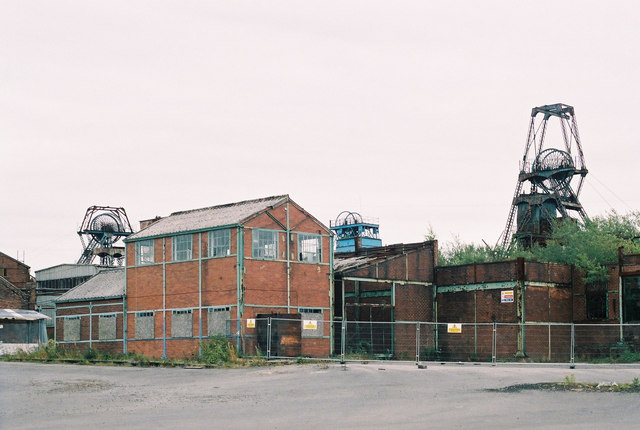
The whole site has stood vacant since the museum closed in 1993 and has been allowed to deteriorate; the Victorian Society has flagged it as needing substantial grant funding to rescue the surviving buildings. It was designated a Scheduled Monument in 1993, covering both the surface buildings and the sub-surface workings, and several of the colliery's structures also carry Grade II* listed status.
Described as the most complete surviving group of traditional colliery buildings from the period of peak production in England. Surviving structures include the 1891 brick chimney, the 1938 Lancashire boiler house, the pithead baths, the Platt Shaft headgear (c. 1900), the Institute Shaft headgear (c. 1910), the Winstanley Heapstead (c. 1913), and associated railway sidings and pumping equipment.
Redevelopment
The 'Black to Green Eco Park' redevelopment plan -- combining data centres (up to 150MW of grid capacity), a 10MW solar farm, a 49MW battery storage facility, a 20MW combined heat and power plant, and a district heat network drawing on the mine's own latent geothermal warmth -- was unveiled by Stoke-on-Trent City Council at the UK Real Estate Investment and Infrastructure Forum on 20-22 May 2025, alongside repair of the site's listed buildings with National Lottery Heritage Fund and government support. As of the plan's unveiling the project remained in the promotion and investor-marketing stage, with no confirmed funding or start date for construction.
Related mines
- Ubberley Colliery — Both Chatterley Whitfield Collieries Ltd pits; Ubberley was the company's Bucknall colliery in the 1890s.
- Wolstanton Colliery — Connected underground in 1975 as part of the same combined workings; Chatterley Whitfield's museum closure in 1993 followed rising groundwater after Wolstanton's own pump shutdown.
Nearby mines
- Victoria Colliery, Biddulph — 1.4 miles (2.3 km) N
- Sneyd Colliery — 2.0 miles (3.3 km) S
- Harriseahead Colliery — 2.2 miles (3.5 km) NW
- Birchenwood Colliery — 2.3 miles (3.8 km) W
- Boothen Colliery — 3.1 miles (5.0 km) S
Straight-line distance, within 9 miles (15 km). Show on the map.
Disasters & major incidents
-
Chatterley Whitfield (Whitfield) Colliery explosion
7 February 1881 · Explosion · 24 fatalities
A smithy fire spread through the ventilation flue and ignited gas underground, and further explosions followed when ventilation was cut to fight the fire — sources give the final death toll as anywhere from 21 to 28.
What's uncertain
Points where sources disagree or the record could not be settled; both accounts are kept. All open questions in the archive.
- It has been suggested coal was worked here as early as the 14th century by the Cistercian monks of Hulton Abbey, but the first firmly documented activity dates from 1750. (uncertain) 1
- A September 2022 report on a permission visit describes the Hesketh Heapstead as being at risk of collapse in the near future, and notes that most buildings remain fenced off and inaccessible despite £20,000 of roof repairs to the pithead baths building. (uncertain) 3
Recorded claims
Individual factual claims, each attached to the source(s) that support it below. Where sources disagree, both are kept.
- Coal production ceased on 16 January 1976; some secondary sources instead give 25 March 1977, which may reflect the date the last administrative wind-down was completed rather than the last day of extraction. 1
- It has been suggested coal was worked here as early as the 14th century by the Cistercian monks of Hulton Abbey, but the first firmly documented activity dates from 1750. (uncertain) 1
- In 1937, and again in 1938, Chatterley Whitfield became the first colliery in Britain to mine over one million tons of saleable coal in a single year. 1
- The site was designated a Scheduled Monument in 1993, covering both the surface buildings and the sub-surface workings; several structures also carry Grade II* listed status. 1,2
- A September 2022 report on a permission visit describes the Hesketh Heapstead as being at risk of collapse in the near future, and notes that most buildings remain fenced off and inaccessible despite £20,000 of roof repairs to the pithead baths building. (uncertain) 3
- Stoke-on-Trent City Council unveiled the 'Black to Green Eco Park' redevelopment plan for the site at the UK Real Estate Investment and Infrastructure Forum on 20-22 May 2025, combining data centres, solar and battery storage, and a geothermal district heat network drawing on the mine's own warmth, alongside continued repair of the listed colliery buildings. 4
Photographs & further reading
The site's own preservation trust, with a detailed history and information on ongoing conservation efforts.
View sourceOver 100 further freely-licensed photographs of the shafts, headgear and surviving buildings.
View sourceA permission visit made during a Heritage Open Day, covering the pit baths, lamp room, Area Shaft Building, powerhouse, Winstanley Headgear, Institute Shaft and engine house, Walker Fan House, Platt Shaft and the Hesketh Heapstead.
View sourceSources
- (secondary) Chatterley Whitfield — Wikipedia
- (secondary) Chatterley Whitfield Colliery, Staffordshire — The Victorian Society
- (observational) Chatterley Whitfield Colliery, Chell, Staffs — September 2022 (permission visit) — 28DaysLater
- (primary) Cutting-edge digital and green energy plan unveiled for Chatterley Whitfield — Stoke-on-Trent City Council
- (secondary) A History of Chatterley Whitfield Colliery — North Staffordshire Mining Gazetteer
Record created: 19 August 2026 · Last researched: 30 August 2026