 MineArchive
Brown Lees Colliery
| Location | Brown Lees, Biddulph valley, Staffordshire — 53.0943, -2.1874 (exact) |
|---|---|
| Commodity | Coal |
| Type | Coal |
| Worked | By 1887–1982 |
| Maximum depth | Unknown. |
| Operators | Robert Heath and Sons (1887–?) |
Overview
A Biddulph valley colliery bought by Robert Heath in 1887 and joined underground to his Victoria Colliery in 1893-95, which employed nearly 800 in 1915 and whose shafts pumped for Victoria until 1982.
History
Brown Lees Colliery lay in the Biddulph valley, about six miles north-north-west of Stoke-on-Trent. Robert Heath, the ironmaster who had built up the Biddulph Valley colliery and ironworks, acquired it in 1887. In 1896 it was a small pit under the manager James Lockett and under-manager Henry Ratcliffe, with 48 men below ground and 8 on the surface, working the Stoney Eight Feet and Rough Seven Feet for manufacturing and steam coal.
Between 1893 and 1895 one of its shafts was deepened and an underground connection made with the Biddulph Valley, or Victoria, Colliery, while the Salisbury pumping shaft was being sunk there. Employment rose quickly: 498 in 1900, 629 in 1910 and 776 in 1915, working the Bowling Alley, Holly Lane, Magpie, Seven Feet and Stoney Eight Feet. Its workings became the Brown Lees district of Victoria Colliery, where a fireman of 73 was still at work underground in 1952.
The Brown Lees shafts were kept as pumping shafts until Victoria closed in 1982 and were then filled. In the late 1980s and early 1990s the ground was opencast, the last plan of the Brown Lees opencast site being dated 1994, and the land has since been reclaimed.
Geology
North Staffordshire Coal Measures: the Stoney Eight Feet, Rough Seven Feet, Bowling Alley, Hard Mine, Holly Lane and Magpie seams; the opencast site later worked many shallower seams.
Workings
Shafts deepened 1893-95 and connected underground with Victoria Colliery; retained as pumping shafts until 1982.
Closure
Worked as part of Victoria Colliery; the shafts were kept for pumping until Victoria closed in 1982 and then filled. The site was opencast in the late 1980s and early 1990s.
What remains
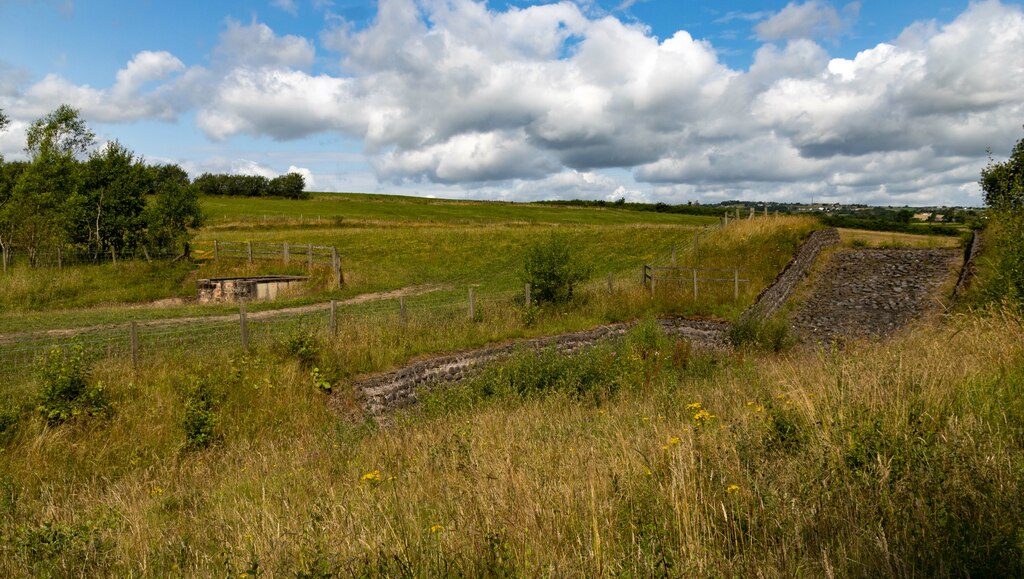
The site has been opencast and reclaimed as farmland.
Stone-lined drainage channels and a small concrete structure on the reclaimed land.
Related mines
- Victoria Colliery, Biddulph — Brown Lees was connected underground to Robert Heath's Victoria Colliery in 1893-95 and became its Brown Lees district, its shafts pumping for Victoria until 1982.
Nearby mines
- Victoria Colliery, Biddulph — 0.3 miles (0.4 km) NE
- Harriseahead Colliery — 1.1 miles (1.7 km) W
- Chell Colliery — 1.3 miles (2.0 km) S
- Chatterley Whitfield Colliery — 1.4 miles (2.2 km) S
- Birchenwood Colliery — 1.9 miles (3.0 km) W
Straight-line distance, within 9 miles (15 km). Show on the map.
Recorded claims
Individual factual claims, each attached to the source(s) that support it below. Where sources disagree, both are kept.
- Robert Heath acquired Brown Lees Colliery in 1887. 1
- In 1896 it employed 48 men below ground and 8 on the surface under the manager James Lockett. 2,3
- Between 1893 and 1895 a shaft was deepened and an underground connection made with Victoria Colliery. 1
- The colliery employed 776 people in 1915. 2
- The Brown Lees shafts were kept as pumping shafts until Victoria Colliery closed in 1982. 1
- The Brown Lees site was opencast, the last plan being dated 1994. 1,4
Photographs & further reading
Jim Worgan's history of Victoria Colliery, Biddulph, including the purchase of Brown Lees and its later role as Victoria's pumping shafts.
View sourceSources
- (secondary) A History of Victoria Colliery, by Jim Worgan — North Staffordshire Coalfield (NSMG) — North Staffordshire Miners' Group
- (primary) Brown Lees Colliery (Durham Mining Museum) — Durham Mining Museum
- (secondary) Brown Lees Mine (thepotteries.org, Stoke-on-Trent mines) — thepotteries.org
- (primary) BGS mine plan: BROWN LEES OC, Upper Burnwood, abandoned 10 October 1994 — British Geological Survey / Mining Remediation Authority
Record created: 25 October 2026 · Last researched: 25 October 2026