 MineArchive
Wheal Grenville
| Location | Troon, Camborne, Cornwall — 50.2009, -5.2712 (exact) |
|---|---|
| Commodities | Tin, Copper |
| Type | Metal |
| Worked | 1820s–1920 |
| Operators | Baroness Grenville (1845–1855), Wheal Grenville Company (1845–1855), John Taylor & Sons (1855–1906), Condurrow Mines Ltd (1910–1920) |
Overview
Wheal Grenville, on the western edge of Camborne's Great Flat Lode, spent its first ten years failing to live up to its own name before eventually becoming one of the district's most reliably profitable tin mines — outliving its early struggles by seven decades under a changing cast of owners.
History
Wheal Grenville was first worked from the 1820s but was not consistently productive until the 1850s. In 1845 the mineral lord, Baroness Grenville, granted a lease to work ground south-west of the existing Condurrow sett, absorbing the earlier Polgine and Newton Moor workings into the new Wheal Grenville Company. The mine did not live up to its early promise, and after around six years of disappointing returns the company was sold in 1855 to John Taylor and Sons, a firm run by the same local entrepreneur family behind the district's tramway network. An eastern extension, worked separately as East Wheal Grenville from 1859, proved unsuccessful and was abandoned and absorbed back into Wheal Grenville by 1877. By the late 1860s the shallower copper ore that had first been worked was largely exhausted, and the mine switched to the tin found at greater depth on the Great Flat Lode. Wheal Grenville paid its first dividend in 1881 and was highly profitable by 1890. In 1906 it merged with South Condurrow and part of West Wheal Frances to form Grenville United Mines; Condurrow Mines Ltd took over the combined operation in 1910, and the mine finally closed in 1920. Between 1860 and 1920 Wheal Grenville produced 30,824 tons of black tin and 2,329 tons of copper.
Geology
The mine worked tin- and copper-bearing lodes on the western extremity of the Great Flat Lode, the same gently dipping, tin-rich structure worked at Basset Mines and across the wider Camborne-Redruth orefield.
Geological setting: Hydrothermal Deposits (well documented example), Veins and Lodes (well documented example)
Workings
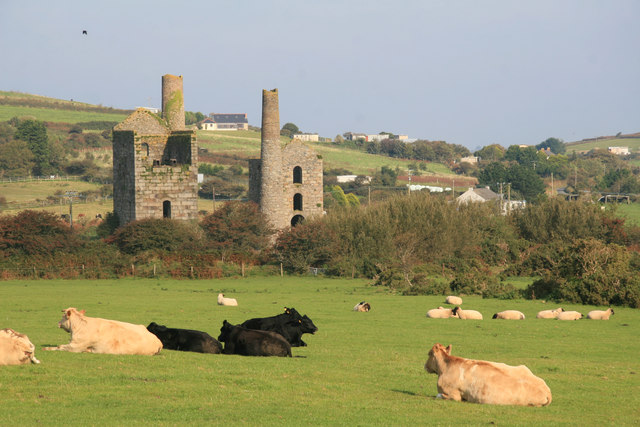
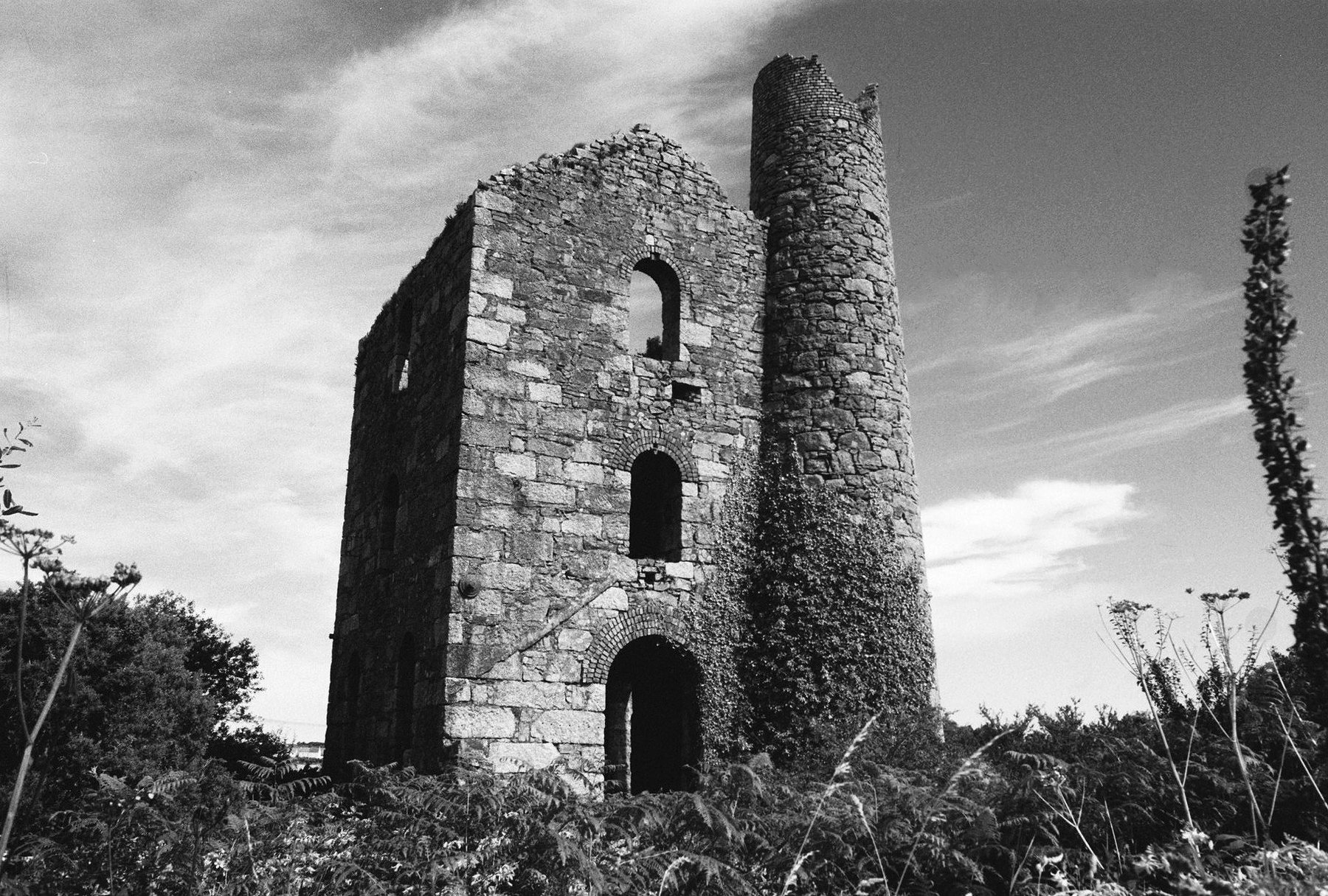
Fortescue's Shaft was equipped with a pumping engine and a matching whim engine house, both of which survive; the mine's shallower copper workings gave way from the late 1860s to deeper tin working on the Great Flat Lode.
Closure
The mine closed in December 1920, ten years after passing to Condurrow Mines Ltd, which had been formed in 1910 to take over Grenville United Mines, itself the 1906 merger of Wheal Grenville, South Condurrow and part of West Wheal Frances; the company was wound up the following year.
What remains
Fortescue's pumping and whim engine houses survive on the Grenville United Mines site at Troon, alongside further listed engine house remains associated with the neighbouring Trevoole and Grenville United South workings.
Related mines
- King Edward Mine (South Condurrow) — Grenville's closure in 1921 flooded King Edward's interconnected workings.
- Minera Lead Mines — Both were worked under the Cornish mine-management firm John Taylor & Sons.
- Nangiles Mine — An engine from Nangiles was sold on to West Condurrow in 1891 and eventually ended up at Wheal Grenville.
Nearby mines
- Carn Camborne Mine — 0.9 miles (1.4 km) NW
- Wheal Basset (Basset Mines) — 0.9 miles (1.4 km) NW
- South Wheal Frances — 1.0 miles (1.6 km) NE
- Cook's Kitchen Mine — 1.2 miles (1.9 km) N
- Dolcoath Mine — 1.2 miles (1.9 km) N
Straight-line distance, within 9 miles (15 km). Show on the map.
Recorded claims
Individual factual claims, each attached to the source(s) that support it below. Where sources disagree, both are kept.
- Between 1860 and 1920 the mine produced 30,824 tons of black tin and 2,329 tons of copper; it paid its first dividend in 1881 and was highly profitable by 1890. 1
- The mine was sold to John Taylor and Sons in 1855 after six disappointing years, merged into Grenville United Mines in 1906, and passed to Condurrow Mines Ltd in 1910 before closing in 1920. 1,2
- Under the new management of 1876, R. W. Goold as chairman and Captain T. Hodge as mine captain, the former North Shaft was reworked as Goold's Shaft with an 80-inch pumping engine built by Harvey & Co in 1875-80 at a cost of £1,800; the engine house foundations were cut in January 1877, and the following year Goold's located the ore of the Great Flat Lode. The beam broke in 1906 and was replaced by a 38-ton Holman beam; the engine was scrapped in 1928. 1
- A new shaft was sunk at Fortescue's in 1889, 2,370 feet (395 fathoms) deep, with houses for a 90-inch pumping engine and a 28-inch rotative whim completed in 1892; Grenville New Stamps was built in 1889-92 with a 30-inch engine bought from West Condurrow for £300, increased to 136 heads in 1892. Condurrow Mines Ltd was formed in 1910 to take over from Grenville United, and Fortescue's closed in December 1920. 1
- The British Geological Survey's catalogue holds abandonment plans for Grenville United with Condurrow South, Grenville East and Polgine (tin ore, OM7185), for Grenville East (OM565, OMR78A) and for Grenville West, formerly Trevoole (OM2846). 3
Photographs & further reading
Photographs taken in April 2016 at Fortescue's Shaft, with a careful eye on the engine houses: the 90-inch pumping engine house whose engine, built by Harvey & Co, was taken out in 1922 for reuse at New Cook's Kitchen shaft at South Crofty — the sole plate and stools still visible on the bob wall — and the whim engine house with its cylinder bed stone.
View sourceSources
- (secondary) Grenville United Mine Cornwall — Cornwall Calling
- (primary) Part of the mining complex at Wheal Grenville and East Wheal Grenville Mines — Historic England (Scheduled Monument record)
- (primary) Grenville United; Condurrow South; Grenville East; Polgine mine plans (BGS Mine Plans Catalogue) — British Geological Survey / The Coal Authority
Record created: 23 August 2026 · Last researched: 24 September 2026