 MineArchive
King Edward Mine (South Condurrow)
| Location | Troon, near Camborne, Cornwall — 50.2020, -5.3080 (approximate) |
|---|---|
| Commodities | Tin, Copper |
| Type | Metal |
| Worked | 1844–1896 |
| Operators | Camborne School of Mines (1897–2005) |
Overview
South Condurrow, reopened in 1844 and renamed King Edward Mine in 1901, became something rarer than a working mine: a fully equipped training mine for the Camborne School of Mines, teaching students Cornish mining practice for over a century and surviving today as the oldest complete mine site in Cornwall.
History
The site had been worked, under the name Old Tye, before being reopened in 1844 alongside the neighbouring Great Condurrow mine around 300 metres to the north; it was renamed South Condurrow in 1850. The mine did not produce profitable tin until 1864, but went on to pay annual dividends until 1893, before closing in 1896. In 1897 the eastern part of South Condurrow, around the engine shaft, was reopened by the Camborne School of Mines as a fully operational training mine, and was renamed King Edward Mine in 1901; it was completely re-equipped, on the surface and underground, with machinery reflecting the best contemporary Cornish practice. The mine continued producing tin until the First World War, when operations were suspended, resuming by 1920 — but only briefly, since the deeper, interconnected Grenville Mine ceased working in 1921, and the resulting flooding also flooded King Edward's own workings. Despite this, King Edward Mine continued in use as a working training site for Camborne School of Mines students until 2005.
Geology
The mine worked tin and copper lodes of the Camborne-Redruth mining district, part of the granite-related hydrothermal mineralisation of central Cornwall, interconnected underground with the neighbouring Grenville Mine.
Geological setting: Hydrothermal Deposits (well documented example), Veins and Lodes (well documented example)
Workings
The mine was re-equipped in 1897 with surface and underground machinery representing the best contemporary Cornish mining practice, giving students of the Camborne School of Mines direct experience of a fully working mine; its workings were interconnected underground with the deeper Grenville Mine, whose 1921 flooding also flooded King Edward's own workings.
Closure
South Condurrow closed in 1896 after paying dividends until 1893; reopened the following year as King Edward Mine, it continued as a working training site for Camborne School of Mines students until 2005.
What remains
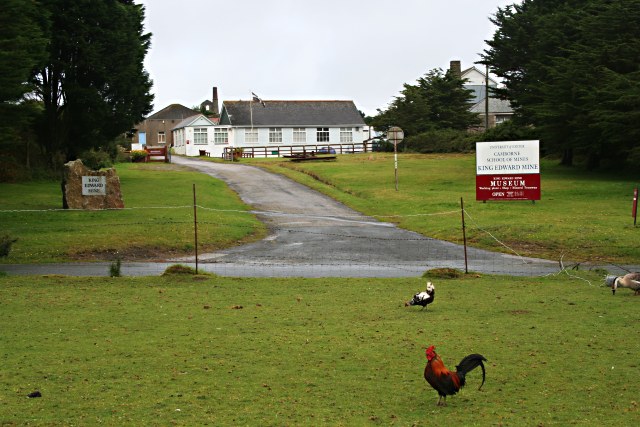
The site is now the King Edward Mine Museum, recognisable by its square forge chimney and cluster of surviving buildings, restored and reopened by volunteers after years of dereliction and forming part of the Cornish Mining UNESCO World Heritage Site.
A cluster of mine buildings survives, including engine houses and the square forge chimney, making King Edward Mine the oldest complete mine site in Cornwall.
Related mines
- Wheal Grenville — Grenville's closure in 1921 flooded King Edward's interconnected workings.
Nearby mines
- Pendarves Mine — 0.1 miles (0.1 km) SE
- Carn Camborne Mine — 1.0 miles (1.6 km) NE
- Wheal Basset (Basset Mines) — 1.2 miles (1.9 km) NE
- Cook's Kitchen Mine — 1.6 miles (2.6 km) NE
- Dolcoath Mine — 1.6 miles (2.6 km) NE
Straight-line distance, within 9 miles (15 km). Show on the map.
Recorded claims
Individual factual claims, each attached to the source(s) that support it below. Where sources disagree, both are kept.
- The mine was completely re-equipped in 1897 with surface and underground machinery reflecting the best contemporary Cornish practice, and was used to train Camborne School of Mines students until 2005. 1,2
- The deeper, interconnected Grenville Mine ceased working in 1921, and the resulting flooding also flooded King Edward's own workings. 1,2
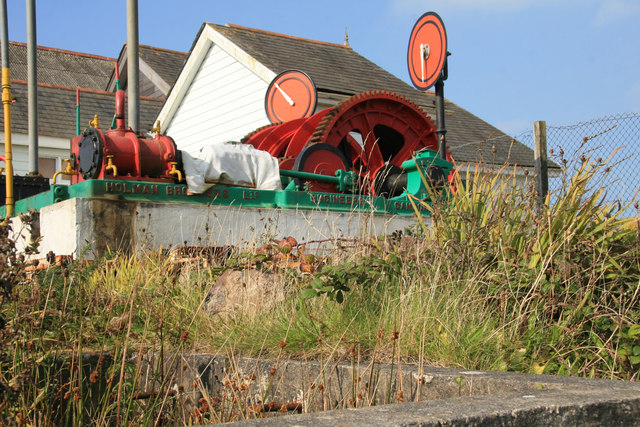
- Californian stamps bought from Fraser and Chalmers were installed in 1900 and a Holman winding engine in 1908; the stamps building is listed Grade II*. 1
- A surface plan of King Edward Mine dated June 1944, at 1:500 and donated by Pendeen Community Heritage (Geevor Tin Mine), is held by the British Geological Survey and can be viewed online. 3
- Teaching and the pilot plant moved to the Trevenson campus in 1974; a volunteer group formed in 1987 to restore the site, the school left for Penryn in 2004, and Prince Edward opened the restored boiler house exhibition space in 2017. 1
Photographs & further reading
The scanned surface plan, viewable online.
View sourceSources
- (secondary) History of Cornish Tin Mining at King Edward Mine — King Edward Mine Museum
- (secondary) King Edward Mine — Wikipedia
- (primary) Surface plan of King Edward Mine, June 1944, MP26249 (BGS mine plans catalogue) — British Geological Survey
- (secondary) King Edward Mine, South Condurrow Mine, Grenville United Mines, Troon, Camborne — Mindat
Record created: 24 August 2026 · Last researched: 24 September 2026