 MineArchive
Wheal Uny
| Also known as | East Wheal Uny |
|---|---|
| Location | Redruth, Cornwall — 50.2270, -5.2450 (approximate) |
| Commodities | Copper, Tin |
| Type | Metal |
| Worked | worked from c. 1800–1893 |
Overview
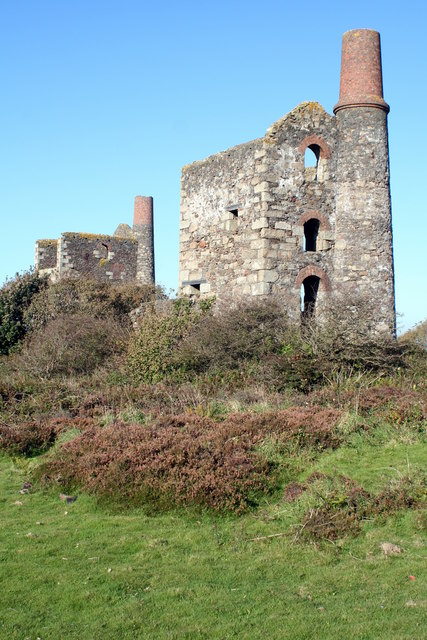
Wheal Uny, on the hill overlooking Redruth, shifted from copper to tin partway through its working life and left behind one of the finest surviving pairs of engine houses anywhere in the Cornish mining landscape.
History
Wheal Uny was worked from around 1800, producing copper through the early 19th century with significant stamping capacity already in place by the 1840s, powered by waterwheels fed from the mine's pumping engines. The mine reopened in 1851 with a shift to tin. Between 1826 and 1856 it produced 755 tons of 4.5% copper ore and 7,660 tons of black tin. In 1866 Wheal Uny amalgamated with the neighbouring North Wheal Buller. Hind's pumping engine house, built in 1869-70, housed a 70-inch Cornish engine, standing at right angles to a matching whim engine house built the same year to house a 26-inch winding engine. The mine closed for the final time in 1893. The mine's early 19th-century career was uneven: the company that ran the group of mines east of Church Town was liquidated in 1837 and Wheal Uny itself was closed and put up for sale in 1839, before the 1851 reopening for tin. East Wheal Uny, worked separately from 1846 to 1850 for 2,700 tons of copper, was still at work in 1883 under a lease from J. Buller of Crediton, with a 70-inch pumping engine, a 22-inch whim and a 36-inch stamps engine and a cost-book company of 6,000 shares whose purser was R. H. Pike of Camborne. Today the ground is overgrown, the main shaft under an extensive metal cap and the smaller shafts fenced.
Geology
The mine worked copper and tin lodes within the Camborne-Redruth orefield, the same hydrothermal, granite-related Cornubian mineralisation worked at the neighbouring Wheal Peevor and Basset Mines.
Geological setting: Hydrothermal Deposits (well documented example), Veins and Lodes (well documented example)
Workings
Hind's pumping engine house, built 1869-70, housed a 70-inch Cornish engine, standing at right angles to a matching whim engine house built the same year for a 26-inch winding engine; significant stamping capacity, powered by waterwheels fed from the pumping engines, was already in place by the 1840s.
Closure
The mine closed for the final time in 1893, following its 1866 amalgamation with North Wheal Buller.
What remains
The mine left one of the finest surviving pairs of engine houses in Cornwall, on the hill overlooking Redruth. The ground is overgrown with gorse, thistle, buddleia and heather, little mine waste exposed; the main shaft carries an extensive metal cap and the smaller shafts are fenced.
The twin engine houses at Hind's Shaft — the pumping engine house and its matching whim engine house, built at right angles to each other in 1869-70 — survive overlooking Redruth, along with associated chimneys and mine shafts.
Related mines
- Tywarnhayle Mine — Tywarnhayle's own pumping engine was moved to Wheal Uny in 1864.
- Wheal Buller — Amalgamated with North Wheal Buller in 1866.
Nearby mines
- Wheal Union — 0.4 miles (0.7 km) NE
- West Tolgus Mine — 0.7 miles (1.1 km) W
- Wheal Agar — 0.7 miles (1.2 km) W
- East Pool Mine — 0.8 miles (1.3 km) W
- Wheal Buller — 0.8 miles (1.3 km) W
Straight-line distance, within 9 miles (15 km). Show on the map.
Recorded claims
Individual factual claims, each attached to the source(s) that support it below. Where sources disagree, both are kept.
- Between 1826 and 1856 the mine produced 755 tons of 4.5% copper ore and 7,660 tons of black tin. 1
- Hind's pumping engine house of 1869-70 housed a 70-inch Cornish engine, standing at right angles to a matching whim engine house built the same year for a 26-inch winding engine. 1,2
- The company running the group of mines east of Church Town (East Wheal Uny, Clijah, Wentworth, Wheal Buckets and Wheal Perseverance) was liquidated in 1837, and Wheal Uny itself was closed and put up for sale in 1839; East Wheal Uny (Wheal Buckets) worked from 1846 to 1850, producing 2,700 tons of copper, James Sims erecting an engine there in 1845. The lode lies within killas close to the granite contact on the northern outcrop of the Great Flat Lode; Dines gives 755 tons of 4.5% copper ore and 7,660 tons of black tin for 1826-56. 1
- In 1883 East Wheal Uny, a mile from Redruth, was held on a 21-year lease from J. Buller of Crediton at a royalty of one-twenty-fourth for two years and one-twenty-second thereafter, with seven known lodes, the old Clijah tin lode lately reopened at the 20-fathom level; it was worked by a 70-inch pumping engine, a 22-inch winding engine with steam capstan and a 36-inch stamps engine, the cost-book company of 6,000 shares with £1 5s paid having R. H. Pike of Camborne as purser. 1
- The British Geological Survey's catalogue holds abandonment plans for Wheal Uny under its own name, for tin ore (OM3077 and OMR113B). 3
Sources
- (secondary) Wheal Uny Mine, Cornwall — Cornwall Calling
- (primary) Winding Engine House on Site of Wheal Uny Mine at SW 695 407, Redruth — Historic England (Listed Building record)
- (primary) Wheal Uny mine plans (BGS Mine Plans Catalogue) — British Geological Survey / The Coal Authority
Record created: 23 August 2026 · Last researched: 24 September 2026