 MineArchive
West Tolgus Mine
| Also known as | Wheal Raven, Wheal Royal, West Tolgus and Treloweth |
|---|---|
| Location | West Tolgus, near Redruth, Cornwall — 50.2300, -5.2600 (exact) |
| Commodity | Copper |
| Type | Metal |
| Worked | By the 1720s–February 1884 |
| Maximum depth | 312 feet (52 fathoms) by April 1862; later reported at 135 fathoms |
| Operators | John Taylor & Sons (1860–1884) |
Overview
West Tolgus was a copper mine north of Redruth, on ground worked from the early 1720s. It began as Wheal Raven, which raised over 700 tons of copper ore in the 1760s along with a little zinc and hardly any tin, then closed under competition from richer neighbours. It was reopened repeatedly — as Wheal Royal between 1810 and 1819, as Wheal Raven again in the boom of 1824, and after 1844 as West Tolgus and Treloweth, shortened to West Tolgus from 1850. Bought by John Taylor and Sons in 1860 and managed by Captain Joseph Jewell, it reached 52 fathoms by 1862 and employed over 230 people by 1879. A run of flooding accidents in the 1870s made the workings wet and expensive, and it stopped for the last time in February 1884.
History
Mining at West Tolgus goes back to the early 1720s. As Wheal Raven the mine produced over 700 tons of copper ore in the 1760s together with a little zinc ore but hardly any tin, and then, facing stiff competition from more successful mines nearby, fell into difficulty and closed. Attempts to reopen it were made in 1793 and 1805; between 1810 and 1819 it worked as Wheal Royal before being abandoned again, and in the mining boom of 1824 it reverted to Wheal Raven, producing over 1,500 tons of copper ore of moderate grade before closing once more. A further spell between 1831 and 1836 yielded over 500 tons. In 1844 a new company bought the mine and renamed it West Tolgus and Treloweth, shortened to West Tolgus from 1850; it closed in 1851. Its last and longest phase began in 1860 when John Taylor and Sons bought it. Under Captain Joseph Jewell they built an engine house with a 60-inch pumping engine, later replaced by a 65 and then a 70, with a ten-foot stroke, and by April 1862 the mine had reached 312 feet, or 52 fathoms. It employed over 120 people at that date and over 230 by 1879. Then the water beat it: a series of accidents in the 1870s flooded the workings, one in 1873 closing the mine for five months, and in January 1879 the balance bob broke in two places in Richards' Shaft. The damage drove up costs and left the mine wet, and it ceased operations for the last time in February 1884.
Geology
The mine worked copper in the Redruth district of the Cornubian orefield, on the Tolgus ground north of the town. Copper was overwhelmingly its product: as Wheal Raven it raised hundreds and then thousands of tons of copper ore but only a little zinc and hardly any tin, which is unusual for this district and marks the mine out from its tin-rich neighbours. The wider Tolgus valley was tin ground — records from the sixteenth century show tin mines and alluvial works between the top of Redruth and Tolgus, and through the nineteenth century both sides of the valley carried stream works recovering tin from the tailings of the works above.
Geological setting: Veins and Lodes (historical documentary reference)
Workings
The 1860s reworking was a pumping operation above all. John Taylor and Sons built an engine house carrying a 60-inch pumping engine, later a 65-inch and then a 70-inch, with a ten-foot stroke, which let the mine reach 312 feet — 52 fathoms — by April 1862. A later report gives West Tolgus as 135 fathoms deep, against 157 for South Tolgus and 80 for Great South Tolgus, so the workings were driven considerably deeper afterwards. Richards' Shaft carried a balance bob, which broke in two places in January 1879. Richard Thomas's survey of the Manor of Tolgus of 1818-19 shows stamping mills at each end of the valley site and a burning house at the centre with a stack to the west.
Closure
A series of accidents in the 1870s caused the mine to flood, including one in 1873 that closed it for five months, and the breaking of the balance bob in Richards' Shaft in January 1879. The resulting costs and wet working conditions led to abandonment, and the mine ceased operations for the final time in February 1884.
What remains
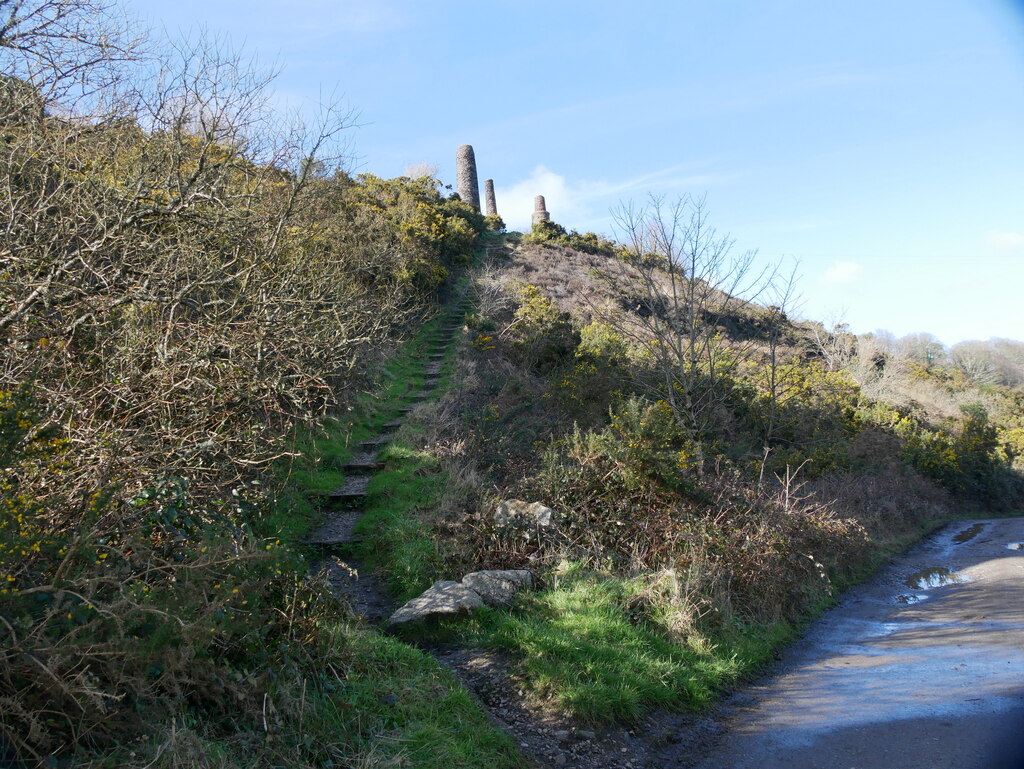
Disused. The chimneys built for the mine still stand.
The mine's chimneys survive, photographed in 2025 and visible as the most conspicuous remains of the workings.
Related mines
- Minera Lead Mines — Both were worked under the Cornish mine-management firm John Taylor & Sons.
Nearby mines
- East Pool Mine — 0.1 miles (0.2 km) NW
- Wheal Agar — 0.2 miles (0.2 km) SW
- Wheal Buller — 0.5 miles (0.8 km) S
- Wheal Uny — 0.7 miles (1.1 km) E
- South Crofty — 0.8 miles (1.3 km) SW
Straight-line distance, within 9 miles (15 km). Show on the map.
Recorded claims
Individual factual claims, each attached to the source(s) that support it below. Where sources disagree, both are kept.
- The area was mined from the early 1720s. Wheal Raven produced over 700 tons of copper ore in the 1760s and a little zinc ore, but hardly any tin. 1
- The mine reopened as Wheal Royal between 1810 and 1819, reverted to Wheal Raven in the boom of 1824, was renamed West Tolgus and Treloweth by a new company in 1844, and became simply West Tolgus from 1850. 1
- John Taylor and Sons bought the mine in 1860. Managed by Captain Joseph Jewell, they built an engine house with a 60-inch pumping engine — later 65 and then 70 inch — with a ten-foot stroke, enabling mining to reach 312 feet or 52 fathoms by April 1862. It employed over 120 people at the time and over 230 by 1879. 1
- A series of accidents in the 1870s caused the mine to flood, including in 1873 when flooding closed it for five months, and in January 1879 when the balance bob broke in two places in Richards' Shaft. The damage led to increased costs and wet mining conditions and to eventual abandonment in February 1884. 1
- Records from the sixteenth century show tin mines and alluvial works between the top end of Redruth and Tolgus, and through the nineteenth century both sides of the valley were occupied by stream works recovering tin from the tailings of the works above. 2
Photographs & further reading
The village article's mining section is the fullest account of the mine — the sequence of names and reopenings from the 1720s, the pumping engines John Taylor and Sons installed, and the flooding that finished it — referenced to the Mining and Smelting Magazine of 1862 and the Royal Cornwall Gazette of 1884.
View sourceSources
- (secondary) West Tolgus — Wikipedia
- (secondary) Tolgus Calciner, Cornwall — Cornwall Calling
Record created: 4 September 2026 · Last researched: 4 September 2026