 MineArchive
Tywarnhayle Mine
| Also known as | Wheal Rock, United Hills Mine |
|---|---|
| Location | above Porthtowan, St Agnes mining district, Cornwall — 50.2823, -5.2368 (exact) |
| Commodities | Copper, Tin |
| Type | Metal |
| Worked | 1750–1864 |
| Maximum depth | Unknown. |
Overview
A copper and tin mine above Porthtowan in the St Agnes mining district, worked under three successive names from 1750 to 1864 and briefly revived in 1906 for an early, technologically significant trial of froth flotation.
History
The site was first worked as Wheal Rock from 1750, renamed United Hills Mine in 1809, and finally became Tywarnhayle Mine in 1848 -- Cornish for roughly 'house on the estuary'. It was an important copper producer through the first half of the 19th century, raising some 86,800 tons of copper ore between 1826 and 1906, and worked tin alongside copper at different periods before closing in 1864. On 3 February 1830, while still known as United Hills Mine, an engine boiler burst, killing nine of the thirteen people present -- one of the worst individual accidents recorded at any St Agnes mine (see Disasters, below). The mine reopened in 1906 with fresh investment to rework its old spoil heaps, installing Cornwall's first electrically driven centrifugal pumps (built by Worthington Simpson, pumping at 1,000 gallons a minute) and an Elmore froth-flotation plant to separate complex sulphide ores from the reworked material -- a genuinely early application of the process in Britain, though the Cornwall and Scilly Historic Environment Record's own description of the surviving plant goes further, calling it the remains of 'the world's first commercial froth flotation plant'; no other account makes that claim, and it should be treated with real caution rather than repeated as settled fact. The 1906 venture was not commercially successful. From 1907 the underground workings were used as a training site by London's Royal School of Mines (now part of Imperial College), specialising in surveying and timber preservation instruction.
Geology
Copper, worked with tin at different periods, in the lodes of the St Agnes district.
Workings
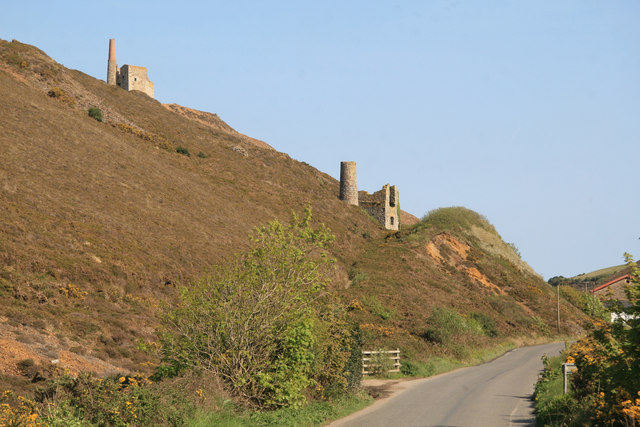
Two engine houses survive on site: Taylor's, built for an 80-fathom shaft and housing a 58-inch pumping engine with a wooden beam -- reputedly the last wooden-beam pumping engine built in Cornwall -- which drove James' Shaft via some 350 metres of flat rods; and John's, built in 1861 for a second-hand 70-inch pumping engine that worked here only briefly before being moved on to Wheal Uny in 1864. The 1906 rework centred on St John's Shaft, adding the electric centrifugal pumps and the flotation plant to process the old spoil heaps.
Closure
The main 19th-century working closed in 1864 as the John's Shaft engine was moved on to Wheal Uny; a 1906 revival aimed at reworking the spoil heaps for their remaining copper failed commercially and the underground workings were given over to use as a Royal School of Mines training site from 1907.
What remains
Both engine houses survive as ruins, along with shafts, adit portals, rodways and tramways centred on St John's Shaft, and extensive spoil dumps; remnants of the 1906 flotation plant -- concrete walls, foundations, a tank and a chimney -- also survive nearby.
Taylor's and John's engine houses, shaft and adit remains, rodways and tramways, spoil dumps, and the 1906 flotation plant's concrete structures.
Related mines
- Wheal Uny — Tywarnhayle's own pumping engine was moved to Wheal Uny in 1864.
Nearby mines
- Wheal Sterran — 0.4 miles (0.7 km) S
- Wheal Ellen — 0.6 miles (0.9 km) SE
- Wheal Towan — 0.5 miles (0.9 km) NE
- Great Wheal Charlotte — 1.0 miles (1.6 km) N
- Wheal Coates — 1.5 miles (2.4 km) N
Straight-line distance, within 9 miles (15 km). Show on the map.
Disasters & major incidents
-
United Hills Mine boiler explosion, 1830
3 February 1830 · Machinery · 9 fatalities
An engine boiler burst at United Hills Mine (later Tywarnhayle Mine), near Porthtowan, killing nine of the thirteen people present.
What's uncertain
Points where sources disagree or the record could not be settled; both accounts are kept. All open questions in the archive.
- The Cornwall and Scilly Historic Environment Record describes surviving remains of a 1906 flotation plant -- concrete walls, loadings, a tank and a chimney -- which it calls the remains of 'the world's first commercial froth flotation plant'; no other source corroborates this specific superlative, though multiple sources agree an early Elmore flotation trial took place here in 1906. (disputed) 2
Recorded claims
Individual factual claims, each attached to the source(s) that support it below. Where sources disagree, both are kept.
- The mine was worked successively as Wheal Rock (from 1750), United Hills Mine (from 1809) and Tywarnhayle Mine (from 1848), producing about 86,800 tons of copper ore between 1826 and 1906. 1,2
- Taylor's engine house held a 58-inch pumping engine with a wooden beam, said to be the last of its kind built in Cornwall, driving James' Shaft via about 350 metres of flat rods; John's engine house, built 1861, held a second-hand 70-inch engine that moved on to Wheal Uny in 1864. 3,2
- The Cornwall and Scilly Historic Environment Record describes surviving remains of a 1906 flotation plant -- concrete walls, loadings, a tank and a chimney -- which it calls the remains of 'the world's first commercial froth flotation plant'; no other source corroborates this specific superlative, though multiple sources agree an early Elmore flotation trial took place here in 1906. (disputed) 2
- Located at about 50.282 N, 5.237 W. 1
Photographs & further reading
The Historic Environment Record entry this page draws its engine-house and flotation-plant detail from.
View sourceSources
- (secondary) Tywarnhayle Mine — Wikipedia
- (primary) Tywarnhayle Mine (Cornwall and Scilly Historic Environment Record) — Cornwall and Isles of Scilly Historic Environment Record
- (secondary) Tywarnhayle Mine, Cornwall — Cornwall Calling
Record created: 31 August 2026 · Last researched: 31 August 2026