 MineArchive
Great Wheal Charlotte
| Location | Between Porthtowan and Chapel Porth, St Agnes parish, Cornwall — 50.2967, -5.2350 (exact) |
|---|---|
| Commodities | Copper, Tin |
| Type | Metal |
| Worked | By 1820–c. 1840 (reduced working to c. 1863) |
| Maximum depth | At least six shafts were sunk; the deepest, Engine Shaft, reached about 150 metres (492 feet). Midwinter's Shaft reached about 132 metres, West Shaft about 77 metres, and William's and Moyle's shafts about 59 metres each. |
Overview
Great Wheal Charlotte was a copper and tin mine on the Cornish coast between Porthtowan and Chapel Porth, worked from before 1820 into the 1860s. At its peak in the 1830s it was a significant producer, contributing nearly 2% of all Cornish copper ore output, before falling returns and a partial closure around 1840 reduced it to a shadow of its former scale.
History
Great Wheal Charlotte was certainly working by 1820, and probably before then, extracting copper ore from a lode formed where Devonian slate (killas) meets a granite intrusion at depth -- part of the mineralisation event around 320 million years ago that produced Cornwall's tin and copper deposits generally. The mine's ore in its 1830s heyday assayed around 7.25% copper from chalcopyrite, malachite and cuprite, with cassiterite (tin) and arsenopyrite as secondary minerals. Annual production peaked at around 2,800 tons of ore in the 1830s, and total recorded output for 1820-56 reached 23,100 tons, at one point contributing close to 2% of all Cornish ore raised in 1834-6 and again in 1840. At least six shafts were sunk to work the lode, the deepest -- Engine Shaft -- reaching some 150 metres, pumped by a 60-inch engine installed in 1828, with a smaller 36-inch engine above Cock's Shaft. The mine partially closed around 1840 as returns fell, and its winding and crushing equipment was sold off in 1842, but some working continued at a reduced scale, with production records extending to at least 1856 and possibly as late as 1863.
Geology
The lode lies within Devonian metamorphosed mudstones (killas/slate) close to a granite intrusion, part of the broader granite-slate boundary mineralisation that produced Cornwall's copper and tin lodes around 320 million years ago. Ore minerals recorded include chalcopyrite, malachite and cuprite (copper), with cassiterite (tin) and arsenopyrite (arsenic) as secondary minerals.
Workings
The mine worked its main copper lode from at least six shafts of varying depth, the two largest -- Engine Shaft and Midwinter's Shaft -- reaching 150 and 132 metres respectively, with three shallower shafts (West, William's and Moyle's) supplementing them along the lode's length.
Closure
The mine partially closed around 1840 as the richest ore was worked out, with pumping and winding equipment auctioned off in 1842. Some working continued afterward at a much reduced scale into the 1850s and possibly the early 1860s.
What remains
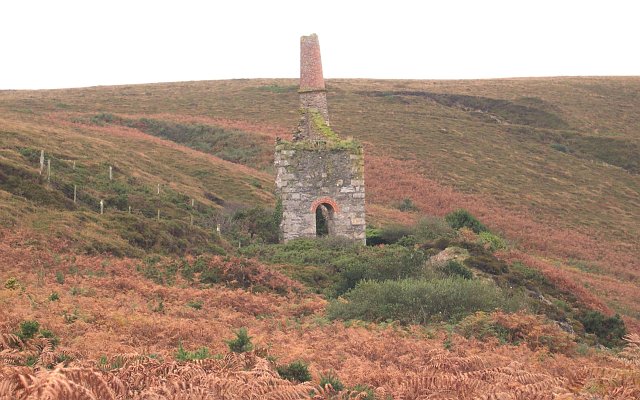
Only the wall and door arch of an engine house survive above ground, at Chapel Combe, alongside an adjacent fenced-off mine shaft. The surrounding spoil tips remain conspicuously barren of vegetation owing to their heavy metal content.
Ruined engine house wall and door arch; fenced mine shaft; heavy-metal-contaminated spoil tips.
Nearby mines
- Wheal Coates — 0.5 miles (0.8 km) N
- Wheal Towan — 0.6 miles (0.9 km) S
- Tywarnhayle Mine — 1.0 miles (1.6 km) S
- Wheal Ellen — 1.4 miles (2.2 km) S
- Wheal Sterran — 1.4 miles (2.3 km) S
Straight-line distance, within 9 miles (15 km). Show on the map.
Recorded claims
Individual factual claims, each attached to the source(s) that support it below. Where sources disagree, both are kept.
- Peak annual production reached around 2,800 tons of ore in the 1830s, and total output for 1820-56 was 23,100 tons. 1,2
- The mine's ore assayed around 7.25% copper in its 1830s-1840 heyday, from chalcopyrite, malachite and cuprite, with cassiterite and arsenopyrite as secondary minerals. 2
- The Mining Remediation Authority's mine plans catalogue holds eleven separate plan records for Wheal Charlotte and Wheal Charlotte Great, covering tin and copper ore workings. 3
Photographs & further reading
Mindat's locality record for the mine, with mineral species recorded from the site and links to related nearby workings.
View sourceSources
- (secondary) Great Wheal Charlotte — National Trust / Explore Cornwall
- (secondary) Wheal Charlotte (Great Wheal Charlotte), Porthtowan, St Agnes, Cornwall — Mindat.org
- (primary) BGS/Mining Remediation Authority mine plans catalogue: Wheal Charlotte Great — Mining Remediation Authority
Record created: 1 September 2026 · Last researched: 1 September 2026