 MineArchive
Wheal Towan
| Also known as | Great Wheal Towan, Towan Consols |
|---|---|
| Location | Porthtowan, St Agnes, Cornwall — 50.2891, -5.2307 (approximate) |
| Commodities | Copper, Tin |
| Type | Metal |
| Worked | By 1756 (as Wheal Sound)–1837 (abandonment plan) |
| Maximum depth | Unknown. |
Overview
A copper mine on the cliffs above Porthtowan, among Cornwall's most productive in the 18th century, where a steam engine was erected underground in 1785 and where, as Great Wheal Towan, two 80-inch pumping engines were later the most powerful in the county.
History
Wheal Towan, on the cliffs above Porthtowan in St Agnes parish, was a profitable 18th-century copper mine, at one time connected with Ralph Allen Daniell of Trelissick, nicknamed 'guinea a minute' for the income it was reputed to bring him night and day. It was first mentioned under the name of Wheal Sound, a mine at the western end of the sett, which produced 9 tons of copper ore in 1756–57, and by 1765 the group appears to have been known as Wheal Towan. In 1784 James Watt wrote that a cylinder for Wheal Towan had been ordered to come with Poldice's and that he would order another for a crane, and in 1785 the mine had the first of the rare steam engines erected underground. Like a number of Cornish copper mines it then suffered from the opening of the great Parys Mountain mines in Anglesey and lay idle from 1788 to 1799, but from 1800 to June 1814 it produced 37,859 tons of copper ore, sold for £470,619. Later, as Great Wheal Towan, it was reworked by Captain Nicholas Vivian with Captain Samuel Grose as chief engineer, who put up a pair of 80-inch cylinder pumping engines, the most powerful then in Cornwall; around 1830 the mine had a Wilson's 80-inch engine. The young engineer William West, who worked there for two or three years before 1831, had the boilers of one pumping engine covered with sawdust to stop the heat escaping; the saving in coal was so great that Grose had the cylinder and pipes lagged in the same way, and the engine's reported duty rose so far that mine agents and engineers doubted it until a public trial vindicated the figures. Vivian then recommended West to J. T. Treffry, who made him engineer at Fowey Consols in 1831. The Mining Remediation Authority's abandonment plan of Wheal Towan and its neighbouring setts is dated 1837.
Geology
Minerals recorded from the mine and its East Wheal Towan section include chalcopyrite, the copper ore, with cassiterite, galena, sphalerite, pyrite, arsenopyrite, siderite, clinochlore and quartz; copper and tin are its recorded commodities.
Workings
A steam engine was erected underground in 1785, one of the first anywhere. In the 1820s the mine was pumped by two 80-inch cylinder engines, and around 1830 by a Wilson's 80-inch engine, whose boilers, cylinder and pipes were lagged with sawdust to save coal. The 1837 abandonment plan is titled 'Wheal Towan Cliff Down Towan North Wheal Sound Wheal Tallack Wheal Towan East'.
Closure
The Mining Remediation Authority's abandonment plan of Wheal Towan and its neighbouring setts, in copper ore, is dated 1837.
What remains
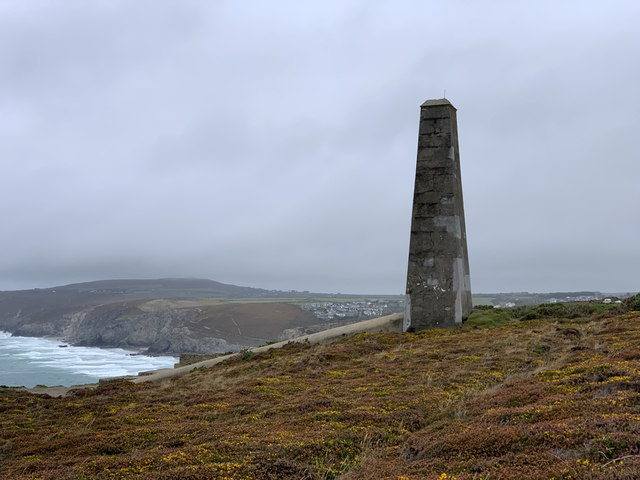
A 2019 photograph shows a tall stone chimney standing on the heath of the cliff top above Porthtowan, remote from the engine it served: the smoke came up the hillside in a flue from further down the slope.
A detached stone chimney on the cliff top, fed by a flue from lower down the slope.
Nearby mines
- Great Wheal Charlotte — 0.9 km N
- Wheal Sterran — 1.5 km S
- Wheal Coates — 1.7 km N
- Tywarnhayle Mine — 1.9 km S
- Wheal Peevor — 2.7 km S
Straight-line distance, within 15 km. Show on the map.
People
- Ralph Allen Daniell · shareholder — Of Trelissick; connected with the mine, whose copper earned him the nickname 'guinea a minute'.
- Samuel Grose · engineer — Chief engineer at Great Wheal Towan, who erected two 80-inch pumping engines and lagged their cylinders and pipes.
- Nicholas Vivian · manager — Reworked Great Wheal Towan and in 1831 recommended William West to J. T. Treffry.
- James Watt · contractor, 1784 — Ordered a cylinder for Wheal Towan in 1784.
- William West (1801–1879) · engineer, to 1831 — Worked here two or three years before 1831 and had an engine's boilers lagged with sawdust, raising its duty.
Recorded claims
Individual factual claims, each attached to the source(s) that support it below. Where sources disagree, both are kept.
- Wheal Towan was a profitable 18th-century copper mine, at one time connected to Ralph Allen Daniell of Trelissick, 'guinea a minute' Daniell. 1
- In 1784 James Watt wrote that the Wheal Towan cylinder was ordered to come with Poldice's. 1
- Steam engines were only rarely erected underground, and the first was at Wheal Towan in 1785. 1
- Great Wheal Towan was reworked by Captain Nicholas Vivian with Captain S. Grose as chief engineer, who erected two 80-inch cylinder pumping engines, the most powerful then in Cornwall; around 1830 the mine had a Wilson's 80-inch engine. 1,2
- William West had the boilers of one pumping engine covered with sawdust; Grose then had the cylinder and pipes enclosed too, and the rise in duty was doubted until a public trial vindicated it. 2
- The abandonment plan titled 'Wheal Towan Cliff Down Towan North Wheal Sound Wheal Tallack Wheal Towan East' (OMR41E), in copper ore, is dated 1837. 3
- A 2019 photograph shows a chimney at Wheal Towan remote from the source of the smoke, which came up the hillside in a pipe. 4
- The mine was first mentioned as Wheal Sound, at the western end of the sett, which produced 9 tons of copper ore in 1756–57; by 1765 the group appears to have been known as Wheal Towan. 5
- Wheal Towan lay idle in 1788–99 after the opening of the Parys Mountain mines, and produced 37,859 tons of copper ore selling for £470,619 from 1800 to June 1814. 5
- Minerals recorded include chalcopyrite, cassiterite, galena, sphalerite, pyrite, arsenopyrite and siderite, with copper and tin as the commodities. 5
Photographs & further reading
The engineer's 1880 obituary, describing the two 80-inch engines at Great Wheal Towan and how lagging their boilers with sawdust raised their duty.
View sourceSources
- (secondary) Wheal Towan Mine, Cornwall — Cornwall Calling
- (secondary) William West (1801-1879), obituary (Institution of Civil Engineers, 1880) — Grace's Guide
- (primary) Wheal Towan Cliff Down Towan North Wheal Sound Wheal Tallack Wheal Towan East (abandonment plan OMR41E) — British Geological Survey / Mining Remediation Authority
- (observational) Mining relics at Wheal Towan (photograph, 2019) — Geograph (John Allan)
- (secondary) Wheal Towan (Towan Consols), Porthtowan, St Agnes — Mindat
Record created: 18 September 2026 · Last researched: 18 September 2026