 MineArchive
Wheal Lushington
| Also known as | West Wheal Towan, New Wheal Towan |
|---|---|
| Location | Cliffs between Portreath and Porthtowan, Illogan and St Agnes, Cornwall — 50.2862, -5.2420 (approximate) |
| Commodities | Copper, Lead, Tin |
| Type | Metal |
| Worked | 18th century–1927 |
| Maximum depth | 87 fathoms (159 m) at Lushington Engine (Reynolds') Shaft |
Overview
A group of ancient copper, tin and lead workings strung along the cliffs from Portreath to Porthtowan, whose 1872 engine house at Porthtowan never received its engine and is now a house.
History
Wheal Lushington, also known as West Wheal Towan, came to stretch almost all the way from Portreath to Porthtowan and took in a large number of smaller mines worked at different times, often from the same lodes and shafts: Wheal Fiddle, Wheal West, Wheal Sterran, Old Metal, Wheal Tobban, Wheal Vincent, Wheal Fox, Wheal Tye, Wheal Sally, Wheal Clarence, Cliff Down, Wheal Mary, Sparrow and Nancekuke. Their records are sparse; plans of the setts begin around 1805. In 1761 John Vivian of Camborne was granted the land between Wheal Fox and Nancekuke village, and in 1807 a small part of the group was known as North Wheal Unity. Old Metal, already an old mine, was reopened in 1750 and produced 42 tons of copper in 1761, and Wheal Tobban raised 6 tons of galena in 1759.
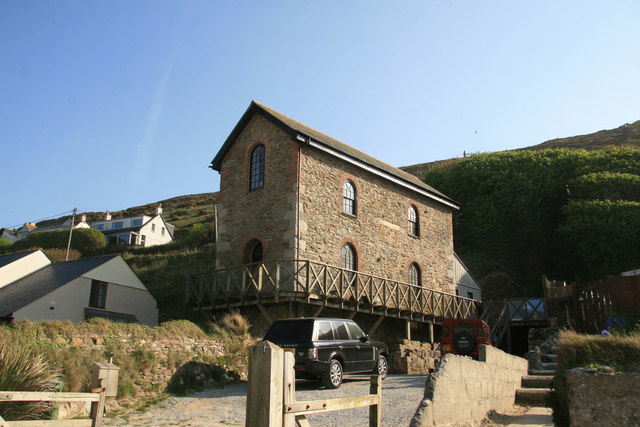
In the 19th century Wheal Sterran and Wheal Tye produced 519.5 tons of black tin between 1852 and 1881, from shafts up to 73 fathoms deep; Cliff Down raised 316 tons of copper ore in 1823-41 and Sparrow 2,227 tons in 1829-41, while Nancekuke produced copper, tin and 13,706 ounces of silver. The deepest shaft, Lushington Engine or Reynolds', reached 87 fathoms. In 1872 the sett was reworked as New Wheal Towan, and an engine house was built in the Porthtowan valley for an engine bought second-hand, but the engine was never installed before the mine closed again; the house, built for an indoor beam engine, has since been a café and is now a private house. Wheal Sally was reopened in 1920-25 through an inclined shaft that found only patchy zinc, lead, copper and silver ores, and Vivian's Shaft at Wheal Sterran was reopened in 1927. Some buildings around Wheal Sally lie behind a Ministry of Defence fence.
Geology
Copper, tin, lead and zinc lodes, among them the Wheal Towan, Tye, Taylor's, Lushington (Langdon's) and Wheal Sally lodes.
Workings
Many shafts and cliff adits, including Kite's, Vivian's, Caroline's, Sally's Bottom and Lushington Engine shafts, and the Wheal Lushington and Bluff adits.
Closure
The 1872 New Wheal Towan reworking closed before its engine was installed; the 1920s reopenings came to little.
What remains
Shafts and dumps along the cliffs; the 1872 engine house is a private house.
The 1872 engine house at Porthtowan, a stamps engine site and reservoirs, capped shafts and cliff dumps.
Redevelopment
The engine house is a dwelling; some buildings around Wheal Sally are within Ministry of Defence land.
Related mines
- Wheal Sterran — Wheal Sterran and Wheal Tye were part of the Wheal Lushington (West Wheal Towan) amalgamation.
- Wheal Towan — Neighbouring mine at Porthtowan; Wheal Lushington was also called West Wheal Towan.
Nearby mines
- Tywarnhayle Mine — 0.3 miles (0.6 km) SE
- Wheal Towan — 0.5 miles (0.9 km) E
- Wheal Sterran — 0.8 miles (1.2 km) S
- Great Wheal Charlotte — 0.8 miles (1.3 km) NE
- Wheal Ellen — 0.9 miles (1.5 km) SE
Straight-line distance, within 9 miles (15 km). Show on the map.
What's uncertain
Points where sources disagree or the record could not be settled; both accounts are kept. All open questions in the archive.
- The 1872 engine house was built for a rotative pumping engine bought second hand from Ireland. (disputed) 1
- The 1872 engine house appears to have been for winding, built for an indoor beam engine. (disputed) 2
Recorded claims
Individual factual claims, each attached to the source(s) that support it below. Where sources disagree, both are kept.
- Wheal Lushington stretched almost from Portreath to Porthtowan and included many smaller mines, among them Wheal Sterran, Wheal Tye, Wheal Sally, Wheal Fox, Cliff Down, Wheal Mary, Sparrow and Nancekuke. 1
- In 1761 John Vivian of Camborne was given the land between Wheal Fox and Nancekuke village. 1
- Wheal Sterran and Wheal Tye produced 519.5 tons of black tin, 200 tons of pyrite and 1.5 tons of zinc between 1852 and 1881. 1
- As Nancekuke mine the sett produced 40 tons of black tin, 747 tons of copper ore and 13,706 oz of silver. 1
- The engine house of Wheal Lushington, also known as New Wheal Towan, was built in 1872 but never contained an engine; it is now a private house. 1,2
- The 1872 engine house was built for a rotative pumping engine bought second hand from Ireland. (disputed) 1
- The 1872 engine house appears to have been for winding, built for an indoor beam engine. (disputed) 2
- A plan of Wheal Lushington East and West in lead, tin and copper ores is recorded as abandoned in 1804. 3
Sources
- (secondary) Wheal Lushington Mine — Explore Cornwall
- (secondary) Wheal Lushington — Northern Mine Research Society
- (primary) BGS mine plan: Wheal Lushington East and West, lead, tin and copper ores, 1804 — British Geological Survey / Mining Remediation Authority
Record created: 18 October 2026 · Last researched: 18 October 2026