 MineArchive
Wheal Ellen
| Also known as | South Wheal Ellen, Old Wheal Basset |
|---|---|
| Location | Tywarnhayle valley at Mawla Lane End, south-east of Porthtowan, St Agnes, Cornwall — 50.2776, -5.2264 (approximate) |
| Commodities | Copper, Lead, Zinc |
| Type | Metal |
| Worked | c. 1826–1862 (reworking tried 1866 and 1907) |
| Maximum depth | Unknown. |
Overview
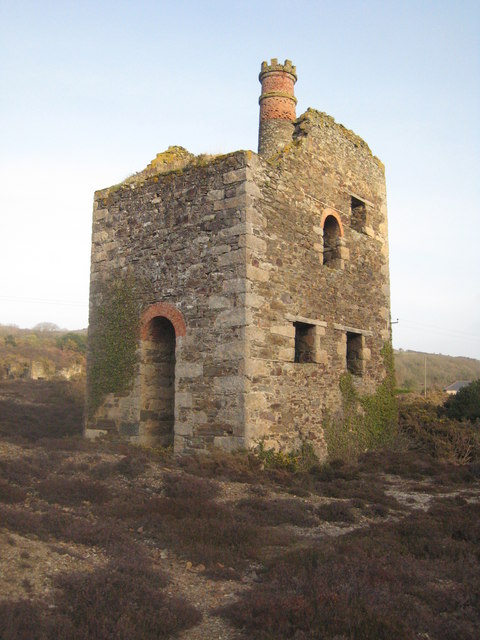
A copper mine in the Tywarnhayle valley near Porthtowan, once called Old Wheal Basset, which raised about 24,000 tons of copper ore between 1826 and 1862. Its pumping engine house, built in 1866 for a reopening whose engine was never installed, is the only one in Cornwall with a castellated chimney.
History
Wheal Ellen, formerly known as Old Wheal Basset, worked copper lodes in the Tywarnhayle valley south-east of Porthtowan from about 1826, and between 1826 and 1862 raised 24,153 tons of copper ore at about 6 per cent; 220 people were employed there in 1836-37. Mindat records eight lodes and Explore Cornwall names ten, among them the Wheal Bank, Lead, Black, Red, Flat, Champions, Green, Paulls and the Great and Little Caunter lodes, from shafts that included Nice's, William's, Engine, Martin's and three New shafts. In April 1837 John Harris, a tributer working at the bottom of the five fathom level west of Wheal Bank Shaft, was crushed by a fall of about two tons of ground as he tried to prop it, and died before he could be brought to surface. The neighbouring South Wheal Ellen, whose abandonment plans for copper ore are dated 1860, is recorded as producing copper with some lead and zinc, though the accounts differ: 9,000 tons of copper between 1845 and 1861 by one, 2,600 tons between 1856 and 1861 by another. In 1866 a pumping engine house was built for a reopening, intended for a 70-inch engine from Boscawen mine; the engine was never installed there and went instead to Blencowe Consols and then to Van Mine in Wales. A reworking in 1907, which tried the new flotation processes on the mine's complex chalcopyrite and sphalerite ores and put up an office and foundations for a gas engine, was unsuccessful. The engine house survives on the valley floor, and its castellated chimney is the only one on a Cornish engine house; in 2024 it was given protective fencing.
Geology
Copper lodes in the St Agnes mining district, eight by Mindat's count and ten named by Explore Cornwall, carrying complex chalcopyrite and sphalerite ores; specimens recorded include native copper, cuprite, chrysocolla, scorodite, pharmacosiderite, pyrite and sphalerite. Some lead and zinc was recorded at South Wheal Ellen.
Geological setting: Veins and Lodes (well documented example)
Workings
About ten copper lodes, among them the Wheal Bank, Lead, Black, Red, Flat, Champions, Green, Paulls and Great and Little Caunter, worked from shafts including Nice's, William's, Engine, Martin's and three New shafts; in 1837 there was a five fathom level west of Wheal Bank Shaft. The 1866 engine house was built for a 70-inch pumping engine from Boscawen mine that never arrived.
Closure
Copper sales ended in 1862 (1861 at South Wheal Ellen). A reopening in 1866 got as far as a new engine house but its engine was never installed, and a reworking for copper and zinc in 1907 was unsuccessful.
What remains
The 1866 engine house stands on the valley floor and is Grade II listed. Photographs published online show that the upper part of its front wall has collapsed, and in June 2024 it had new protective fencing, with scaffolding work on a nearby shaft.
The engine house with its castellated stack, widespread waste tips on the hillside west of the road opposite Menagissey Farm, and remains of the 1907 office and gas-engine foundations south-east of the engine house.
Nearby mines
- Tywarnhayle Mine — 0.6 km S
- Wheal Sterran — 0.7 km W
- Wheal Towan — 1.3 km N
- Wheal Peevor — 1.5 km SW
- Great Wheal Charlotte — 2.2 km N
Straight-line distance, within 15 km. Show on the map.
People
- John Harris (d. 1837) · victim, 1837 — Tributer killed by a fall of ground at the five fathom level, April 1837.
What's uncertain
Points where sources disagree or the record could not be settled; both accounts are kept. All open questions in the archive.
- South Wheal Ellen worked from 1845 to 1861, producing 9,000 tons of copper, some lead and some zinc. (disputed) 3
- South Wheal Ellen worked from 1856 to 1861, producing 2,600 tons of copper, some lead and some zinc. (disputed) 4
Recorded claims
Individual factual claims, each attached to the source(s) that support it below. Where sources disagree, both are kept.
- Wheal Ellen, formerly Old Wheal Basset, raised 24,153 tons of 6 per cent copper ore between 1826 and 1862, and employed 220 people in 1836-37. 1,2
- South Wheal Ellen worked from 1845 to 1861, producing 9,000 tons of copper, some lead and some zinc. (disputed) 3
- South Wheal Ellen worked from 1856 to 1861, producing 2,600 tons of copper, some lead and some zinc. (disputed) 4
- The pumping engine house was built in 1866 for a 70-inch engine from Boscawen mine that was never installed, going instead to Blencowe Consols and then to Van Mine in Wales. 1,2
- The engine house's chimney is castellated, the only such stack on a Cornish engine house. 3,5,6
- In April 1837 an inquest at the Chiverton Arms heard that John Harris, about 39, a tributer at the bottom of the five fathom level west of Wheal Bank Shaft, was killed by a fall of about two tons of ground while putting in timber. 4
- An attempt to rework the sett for copper and zinc in 1907 put up an office and foundations for a gas engine but was unsuccessful. 3,2
- Abandonment plans for Wheal Ellen South, for copper ore, are dated 1860. 7
- Wheal Ellen is recorded as having eight lodes and an output of 24,153 tons of copper ore between 1826 and 1862. 8
- An unsuccessful attempt was made in 1907 to use new flotation processes on the complex chalcopyrite and sphalerite ores found here. 8
- In June 2024 new fencing had been put up to protect the engine house, and scaffolding work was under way on a nearby shaft. 8
Photographs & further reading
Photographs of the Wheal Ellen engine house among the St Agnes district's mines.
View sourceLodes, shafts, output and the story of the engine that never arrived, with references.
View sourceSouth Wheal Ellen's output and the 1837 inquest on John Harris.
View sourceSources
- (secondary) St Agnes Mining District — Cornish Mine Images
- (secondary) Wheal Ellen — Explore Cornwall
- (secondary) Wheal Ellen — Northern Mine Research Society
- (secondary) Wheal Ellen Mine, Cornwall — Cornwall Calling
- (observational) Wheal Ellen - GooseyGoo — GooseyGoo
- (observational) Engine house at Wheal Ellen mine (Geograph photo 1200071, Rod Allday, 2009) — Geograph Britain and Ireland
- (primary) Wheal Ellen South (Mining Remediation Authority abandonment plan OMR288A, via BGS catalogue item 21867345) — British Geological Survey / Mining Remediation Authority
- (secondary) Wheal Ellen (Old Basset Mine), Mawla Lane End, St Agnes, Cornwall, England, UK — Mindat.org
Record created: 18 September 2026 · Last researched: 18 September 2026