 MineArchive
Coed Mawr Pool Mine
| Also known as | Pool Mine, Coedmor |
|---|---|
| Location | Around Llyn Pencraig, Gwydir Forest, Betws-y-Coed, Conwy — 53.1088, -3.8225 (exact) |
| Commodity | Lead |
| Type | Metal |
| Worked | Before 1697 (as Coedmor)–1930 |
| Operators | Coed Mawr Pool and Ffridd Lead Mining Company (1881–1887) — Registered 26 September 1881; official liquidator appointed by December 1887. Coed Mawr Pool Lead and Blende Company (1899–?) — Formed about eighteen months before November 1900. |
A Gwydir Forest lead mine around Llyn Pencraig above Betws-y-Coed, perhaps working before 1697. It was revived with compressed-air drills about 1899 and left in 1930.
Location
Recorded location. The large pin is this mine; the small round markers are the nearest mines on record. Click one for its page. View on full map
History
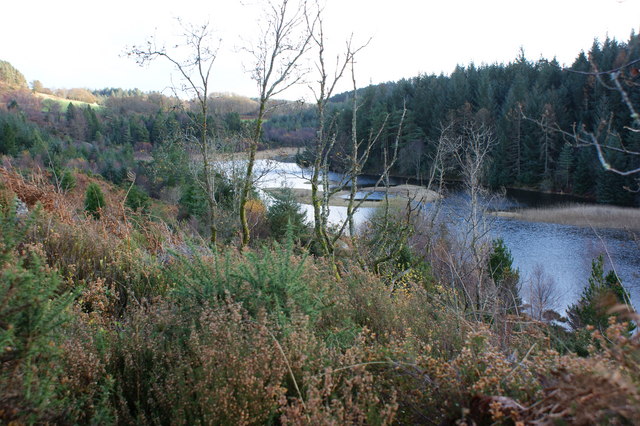
Coed Mawr Pool was a Gwydir Forest lead mine whose workings were spread around Llyn Pencraig, in the hills north of Betws-y-Coed. It may have begun as Coedmor, recorded as producing lead before 1697; it was probably working in the 1750s and prospering by the 1820s. In December 1856 it sold 24 tons of lead ore at the Holywell ticketing. Substantial money went into it after 1851, and its main east–west lode ran on into the neighbouring Penrallt grant, revived in 1878 as the South De Eresby mine.
Miners who knew the district thought it the most promising mine there, which may explain why people kept coming back to it. A company spent heavily on it in about the 1870s and had some success, but the outlay crippled the promoters. To drain the mine they began an adit from the Llugwy valley a few hundred yards below the Swallow Falls and drove it nearly five hundred yards into the mountain, but the bearings were wrong from the start, the level wandered off course, and the scheme was given up in about 1882. The Coed Mawr Pool and Ffridd Lead Mining Company was registered in September 1881 with a capital of £50,000 to work this mine and the Ffridd; by December 1887 it was in the hands of an official liquidator, and the inspector recorded Coed Mawr Pool and Ffridd as abandoned during 1890.
About 1899 the Coed Mawr Pool Lead and Blende Company took the mine on with compressed air and diamond rock drills. Water off the hill drove a Pelton wheel beside the Llugwy, which worked a Larmuth air compressor of the size used on the Hirnant tunnel for the Vyrnwy water scheme, and by 1900 the adit was again being driven, at about four feet a day. A boiler and steam engine were added at the adit mouth in 1905, when the village heard the mine was about to reopen, and a tramway and pipe bridge carried ore across the river to a crushing mill. The last lessee company was dissolved in 1930.
Geology
East-south-easterly and east-north-easterly lodes of the Llanrwst mining field, in Lower Palaeozoic rocks. The mine produced lead almost exclusively, though zinc blende is present.
Workings
Shafts and adits around Llyn Pencraig, with a wheelpit for winding and a bob pit at one shaft, and extensive hand dressing floors at the eastern end of the lake. A drainage and haulage adit runs over a kilometre south-west to the Afon Llugwy, where a mill of the 1880s held crushing machinery and a six-foot Pelton wheel, with a compressor house, jiggers, vanning tables and eight settling ponds.
Closure
Abandoned in 1890 after the Coed Mawr Pool and Ffridd company's liquidation. Reworked from about 1899 by the Coed Mawr Pool Lead and Blende Company; the last lessee company was dissolved in 1930.
What remains
The dressing floors survive as masses of broken rock with walls and ore bins, a wheelpit, a bob pit, a circular powder store and three stone pillars that carried a launder. By the Llugwy the mill stands to eaves height, with the adit mouth, two bridge piers and the low walls of the compressor house.
Dressing floors, wheelpit, bob pit, powder store, launder pillars; on the Llugwy the mill, adit mouth, bridge piers and settling ponds.
Nearby mines
- Llanrwst Mine — 0.6 miles (0.9 km) N
- Cyffty Mine — 0.6 miles (1.0 km) NW
- Aberllyn Mine — 0.9 miles (1.5 km) E
- Vale of Conwy Mine — 0.9 miles (1.5 km) N
- Hafna Mine — 1.1 miles (1.7 km) N
Straight-line distance, within 9 miles (15 km).
Further reading
The scheduled lead mill on the Afon Llugwy that served Coed Mawr Pool, with its Pelton wheel, Green's patent crushing mill, compressor house and bridge piers.
View sourceThe scheduled dressing floors at the east end of Llyn Pencraig, from Cadw's description.
View sourceSources
- (primary) Cadw scheduled monument CN332: Coed Mawr Pool Lead Mine — Cadw
- (primary) Cadw scheduled monument CN331: Afon Llugwy Lead Mill — Cadw
- (secondary) Ticketing for lead ores, Holywell, 11 December 1856 (North Wales Chronicle, 20 December 1856) — Welsh Newspapers Online, National Library of Wales
- (secondary) New companies: Gartheiniog Slate Company, Limited (North Wales Express, 7 October 1881) — Welsh Newspapers Online, National Library of Wales
- (secondary) Coed Mawr Pool and Fridd Lead Mining Company: notice to creditors (Carnarvon and Denbigh Herald, 23 December 1887) — Welsh Newspapers Online, National Library of Wales
- (secondary) Local and district news: mines inspector's report (North Wales Chronicle, 27 June 1891) — Welsh Newspapers Online, National Library of Wales
- (secondary) Mining enterprise in the Vale of Conway district (Welsh Coast Pioneer, 23 November 1900) — Welsh Newspapers Online, National Library of Wales
- (secondary) Bettws y Coed: good news (Weekly News, Colwyn Bay, 13 January 1905) — Welsh Newspapers Online, National Library of Wales
- (secondary) Mineralisation: Capel Curig and Betws-y-Coed, description of 1:25 000 sheet SH 75 — British Geological Survey, Earthwise
- (secondary) Mining in North Wales (Wrexham Guardian, 16 March 1878) — Welsh Newspapers Online, National Library of Wales
Record created: 23 November 2026 · Last researched: 23 November 2026