 MineArchive
Skelton Park Pit
| Location | Skelton, North Yorkshire — 54.5480, -0.9700 (approximate) |
|---|---|
| Commodity | Iron |
| Type | Ironstone |
| Worked | 1870–1938 |
| Maximum depth | Worked the Cleveland Main Seam, over 115 metres below the surface, 3.1 metres thick. |
| Operators | Bell Brothers (1862–1923), Dorman, Long and Company (1923–1938) |
Overview
The northernmost of the Cleveland ironstone mines developed by the Bell Brothers from 1862, sunk in 1870-72 to work the richest ironstone seam in the district, and now considered the most complete and best-preserved Cleveland ironstone mine site to survive.
History
Skelton Park Pit was the northernmost entry point into the Skelton ironstone mines, developed from 1862 by the three Bell brothers -- Isaac Lowthian, Thomas and John -- to supply ironstone to their own ironworks at Port Clarence on the Tees, having leased the mineral rights and land from Mr Wharton of Skelton Castle. Shaft sinking at Park Pit itself began in 1870 and was completed in 1872 at a cost of £50,602; the mine worked the Cleveland Main Seam, here some 3.1 metres thick and over 115 metres below the surface, with an iron content of around 32 per cent -- among the highest concentrations found anywhere in the Cleveland ironstone. Output reached 176,238 tons in 1873 alone. Bell Brothers operated the pit from 1872 to 1923, introducing mechanical rock drilling using compressed-air Walker drills (patented 1875) from 1876, alongside a compressed-air underground haulage system; both were exhibited to the North of England Institute of Mining Engineers in 1881 as advanced practice for the time. Dorman Long & Co. took over in 1923 and worked the pit until its closure in 1938.
Geology
The richest of the Cleveland ironstone seams, worked from the northernmost entry into the Skelton mines.
Workings
Two shafts sunk 1870-72; worked the Cleveland Main Seam (3.1m thick, ~32% iron content) over 115m deep; compressed-air Walker rock drills and underground haulage introduced from 1876.
Closure
Closed in 1938 under Dorman Long & Co., which had taken over from Bell Brothers in 1923.
What remains
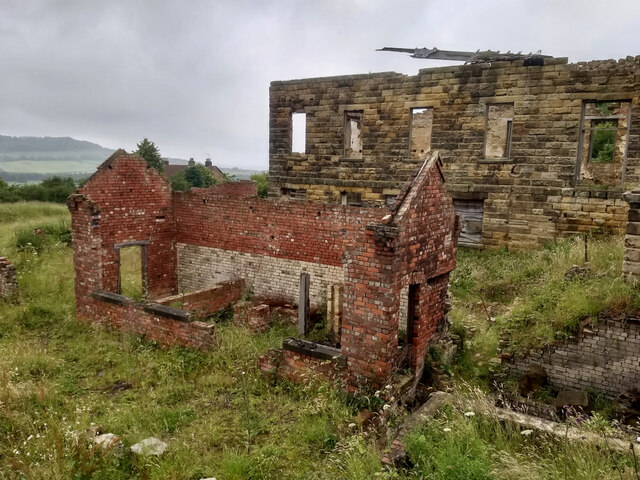
Considered the most complete and best-preserved of the Cleveland ironstone mines to survive; several structures, including the powerhouse, office, substation and winding houses, are Grade II listed.
Winding houses, a fanhouse, chimney bases, a powerhouse (built c.1876 to power the compressed-air drilling and haulage systems), an office and an electricity substation, several of them Grade II listed.
Nearby mines
- North Skelton Mine — 0.6 miles (1.0 km) NE
- Boosbeck Mine — 0.7 miles (1.1 km) SW
- South Skelton Mine — 1.0 miles (1.6 km) SW
- Longacres Mine — 1.3 miles (2.0 km) N
- Lumpsey Mine — 1.4 miles (2.2 km) NE
Straight-line distance, within 9 miles (15 km). Show on the map.
Recorded claims
Individual factual claims, each attached to the source(s) that support it below. Where sources disagree, both are kept.
- Skelton Park Pit's shafts were sunk 1870-72 at a cost of £50,602, working the Cleveland Main Seam at 3.1m thick, over 115m deep and around 32% iron content -- among the highest concentrations in Cleveland; output reached 176,238 tons in 1873. 1
- From 1876 Bell Brothers introduced compressed-air Walker rock drills (patented 1875) and a compressed-air underground haulage system, both exhibited to the North of England Institute of Mining Engineers in 1881. 1
- Skelton Park is considered the most complete and best-preserved of the Cleveland ironstone mines to survive, with several structures Grade II listed. 2
Photographs & further reading
The official listing for the powerhouse, office and substation, the best-preserved building at the site.
View sourceSources
- (secondary) Skelton Park Ironstone Mine (1870-1938) — Co-Curate (Newcastle University)
- (primary) Powerhouse, office and substation at Skelton Park disused iron mine (List Entry 1115787) — Historic England
Record created: 1 September 2026 · Last researched: 1 September 2026