 MineArchive
Lumpsey Mine
| Also known as | Lumpsey Mines |
|---|---|
| Location | Brotton, in the northern part of Kilton near the railway, North Yorkshire — 54.5593, -0.9399 (exact) |
| Commodity | Ironstone |
| Type | Ironstone |
| Worked | from 1880 or 1882 (sources differ) |
| Operators | Bell Brothers (1882–1923, owner) Dorman, Long and Company (1923–?, owner) |
Overview
The deepest and longest-lived of Bell Brothers' Cleveland mines, sunk at Brotton in the early 1880s with shafts a hundred fathoms down and hydraulic drills at the face. It outlasted the other three by thirty years and was still returning ironstone in 1954.
History
Lumpsey was commenced in the early 1880s — Bulmer's directory of 1890 says 1882, the Victoria County History says the mine was opened in 1880 — in the northern part of Kilton near the railway, and it was a different kind of mine from its neighbours. Where Cliff, Huntcliffe and Carlin How were adits and drifts worked by hand, Lumpsey was sunk: two shafts about a hundred fathoms deep, with drilling machines worked by hydraulic power used in winning part of the stone. Bulmer's gives its output as about three thousand tons a week and its workforce as a hundred and forty men and boys.
It grew. The official returns show 139 employed in 1883, 276 by 1894, 397 by 1905 and 476 by 1910. Ownership passed with the rest of Bell Brothers' mines to Dorman, Long and Company in April 1923 — the year the return drops to 62, and the following year Lumpsey's people are counted in with Carlin How's. It recovered afterwards and went on working the Cleveland Main seam long after the others had gone: 470 employed in 1929, 363 in 1945, 275 in 1950 and 204 in 1954.
Geology
The Cleveland Main seam of the Cleveland Ironstone Formation, reached here by shaft rather than by adit — the returns for 1950 and 1954 name it explicitly.
Workings
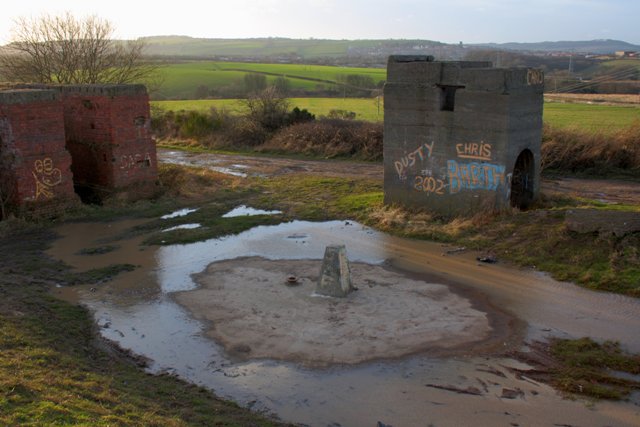
Two shafts about a hundred fathoms deep, with hydraulic drilling machines used in winning part of the stone and about three thousand tons a week raised in the 1880s. The shafts are capped now, one of them marked by a concrete post on its circular cap.
Closure
The closure date is not known. The official returns run to 1954, when 204 people were employed and the mine was working the Cleveland Main.
What remains
The site holds the capped remains of the two shafts, one marked by a concrete post on its circular cap, photographed in 2008.
The two capped shafts and their surrounding ground.
Related mines
- Carlin How Mine — One of Bell Brothers' four east Cleveland ironstone mines, described together in Bulmer's directory of 1890 as a single undertaking spread along the coast: Cliff from 1860, Huntcliffe from 1871, Carlin How from 1873 and Lumpsey from the early 1880s, all passing to Dorman, Long and Company in April 1923.
Nearby mines
- Kilton Mine — 0.6 miles (1.0 km) NE
- North Skelton Mine — 0.8 miles (1.3 km) SW
- Longacres Mine — 1.2 miles (1.9 km) NW
- Skelton Park Pit — 1.4 miles (2.3 km) SW
- Carlin How Mine — 1.5 miles (2.4 km) E
Straight-line distance, within 9 miles (15 km). Show on the map.
What's uncertain
Points where sources disagree or the record could not be settled; both accounts are kept. All open questions in the archive.
- The Victoria County History states that Lumpsey mine, in the northern part of Kilton near the railway, was opened in 1880. (disputed) 2
- Bulmer's directory of 1890 states that Lumpsey Mines were commenced in 1882, and the Durham Mining Museum's first return for the mine is for that year. (disputed) 1,3
Recorded claims
Individual factual claims, each attached to the source(s) that support it below. Where sources disagree, both are kept.
- Lumpsey Mines were commenced in 1882. The shafts are about a hundred fathoms deep. Drilling machines, worked by hydraulic power, are used in winning part of the stone. About three thousand tons a week are obtained, employing a hundred and forty men and boys. 1
- The Victoria County History states that Lumpsey mine, in the northern part of Kilton near the railway, was opened in 1880. (disputed) 2
- Bulmer's directory of 1890 states that Lumpsey Mines were commenced in 1882, and the Durham Mining Museum's first return for the mine is for that year. (disputed) 1,3
- The official returns run from 1882 to 1954 and show the mine growing to 476 employed in 1910 and 483 in 1921, dropping to 62 in 1923 — the year ownership passed to Dorman, Long and Company — being counted in with Carlin How in 1924, and then recovering: 470 in 1929, 441 in 1935, 363 in 1945 and 204 in 1954, working the Cleveland Main seam. 3
Photographs & further reading
The official returns from 1882 to 1954 year by year, the change of owner in 1923 and the Cleveland Main seam it was working at the end.
View sourceThe description of the mine's shafts, its hydraulic drilling machines, its weekly output and its workforce.
View sourceSources
- (primary) Bulmer's History and Directory of North Yorkshire (1890), Brotton parish — Bulmer's Directory, transcribed by GENUKI
- (secondary) The wapentake of Langbaurgh (east): Brotton — Victoria County History, via British History Online
- (primary) Lumpsey (Ironstone) — Durham Mining Museum
Record created: 11 September 2026 · Last researched: 11 September 2026