 MineArchive
Swinhope Mine
| Location | Swinhope valley, near Coalcleugh, East Allendale, Northumberland — 54.8122, -2.2738 (approximate) |
|---|---|
| Commodities | Lead, Zinc |
| Type | Metal |
| Worked | 1809–1960s |
| Maximum depth | Unknown. |
| Operators | Blackett-Beaumont family (1809–1872), Vieille Montagne Zinc Company (1896–1896), Durham Chemicals Ltd (1951–1955), New Consolidated Gold Fields Ltd (1955–1960) |
Overview
A Beaumont lead mine at the head of the Swinhope valley in East Allendale, worked on the Williams Vein from about 1809 to 1872, then for zinc, and reopened in the 1950s by Durham Chemicals and New Consolidated Gold Fields, whose deep exploration found little; the site later took waste from Allenheads.
History
The Beaumont company opened the Swinhope mines on the Williams Vein, the continuation of the Barneycraig Vein, working it first between 1809 and 1814 from the Swinhopehead whimsey shaft and level. The Swinhope Low Level, a horse level, was begun around 1814 to reach the bottom of the whimsey; it ran barren for its first 860 metres and then proved productive to the West Allen boundary, most of the ore coming from the Great Limestone, and in time it joined the Barneycraig workings. Trial levels were driven for other veins, Deepcleugh in 1818-22 and Struther Sike in 1825-29 and again in 1874-78, without success. The Beaumonts worked the mine until 1872, when the price of lead fell. The North Vein, poor in lead but rich in sphalerite, was reworked for zinc in 1896 by the Vieille Montagne company. Durham Chemicals reopened the mine in 1951-52 and sent about 4,500 tons of ore to Birtley, but the haul made it uneconomic. New Consolidated Gold Fields took over in 1955, drove a 32-degree incline from Swinhopehead and a level 2.29 km towards Killhope Law, cutting four veins of which two carried ore; water poured from the broken veins for two months, and the project was abandoned in 1960. A last small venture with Settlingstones Mines and the Weardale Lead Company treated 2,400 tons of ore before the mine closed, and its site was afterwards used to tip waste from the reopened Allenheads mine and from British Steel's Groverake workings.
Geology
The Williams Vein (continuation of the Barneycraig Vein) and the North and Whitewood veins, ore mostly from the Great Limestone with some from the Coal Sills and Little Limestone; galena, with sphalerite on the North Vein.
Workings
The Swinhopehead whimsey shaft and level, the Swinhope Low (horse) Level, the Deepcleugh and Struther Sike trial levels, and a 1950s 32-degree incline with a 2.29 km exploratory level.
Closure
Beaumont working ended in 1872; the 1950s exploration was abandoned in 1960 and a small follow-on venture found the mine unprofitable.
What remains
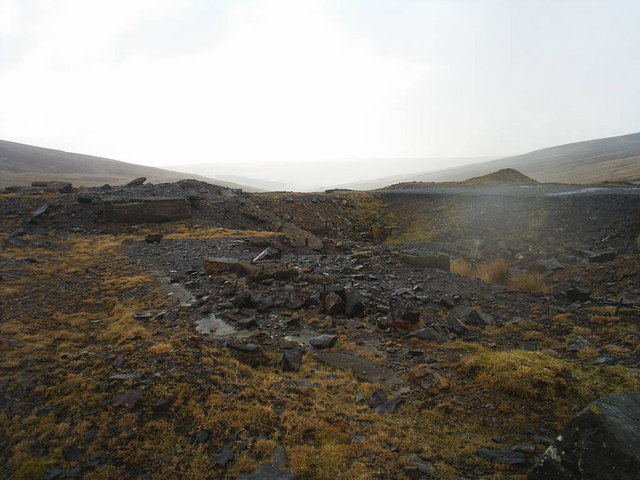
Little is left beyond spoil, rubble and the track to the site, which was later filled with waste from Allenheads mine and Groverake.
Spoil heaps and building foundations.
Redevelopment
Used as a tip for mine waste after closure.
Related mines
- Allenheads Mines — Swinhope's site was used to tip waste from the reopened Allenheads mine, and Gold Fields explored towards the Allenheads veins.
- Coalcleugh — Neighbouring Beaumont lead mines at the head of the Allen valleys, later both reworked for zinc by Vieille Montagne.
Nearby mines
- St Peter's Mine — 2.4 km N
- Holmslinn Mine — 2.9 km NE
- Killhope Lead Mine — 3.2 km S, County Durham
- Allenheads Mines — 3.7 km E
- Sipton Mine — 4.1 km NE
Straight-line distance, within 15 km. Show on the map.
What's uncertain
Points where sources disagree or the record could not be settled; both accounts are kept. All open questions in the archive.
- The Mine Explorer Society dates the first Beaumont development to 1809-1814; Allen Valleys Local History gives Beaumont ownership in 1815. (disputed) 1,2
Recorded claims
Individual factual claims, each attached to the source(s) that support it below. Where sources disagree, both are kept.
- The Beaumont Company worked the Williams Vein via Swinhopehead Whimsey and Level (developed 1809-1814) and the Swinhope Low Level, started around 1814; the low level was barren for its first 860m. 1
- Owned by the Beaumont family in 1815, the mine was worked until 1872 and then for zinc (1896); reopened in 1951 by Durham Chemicals, then Consolidated Goldfields; briefly reopened in the 1960s. 2,3
- The North Vein was strongly mineralised with sphalerite, reworked in 1896 by the Vieille Montagne Zinc Company. 1
- Durham Chemicals Ltd reopened the mine in 1951-52 and shipped some 4,500 tons (4% lead, 8% zinc) to Birtley; New Consolidated Goldfields took over in 1955, drove a 32-degree incline and an exploratory level, and abandoned the project in 1960 after 2.29km. 1
- The Mine Explorer Society dates the first Beaumont development to 1809-1814; Allen Valleys Local History gives Beaumont ownership in 1815. (disputed) 1,2
Photographs & further reading
Catalogue record for an abandonment plan of the mine, one of several Swinhope plans and assay plans held by the BGS.
View sourceSources
- (observational) Swinhope Mines, East Allendale — The Mine Explorer Society
- (secondary) Location: Swinhope — Allen Valleys Local History
- (observational) Swinhope Mine & Blue Streak Silo — A Vested Interest (author's site)
Record created: 21 September 2026 · Last researched: 21 September 2026