 MineArchive
Fron-Boeth and Pant Mawr Quarry
| Location | western slopes of Moelwyn Mawr, near Croesor, Gwynedd — 52.9967, -4.0800 (approximate) |
|---|---|
| Commodity | Slate |
| Type | Slate |
| Worked | Around 1850–1918 |
| Maximum depth | Unknown. |
Overview
Two closely interconnected slate quarries on the western slopes of Moelwyn Mawr, worked the same slate vein as the neighbouring Moelwyn Quarry and linked to the Croesor Tramway by an unusually long pure-access tunnel, before both closed during the First World War.
History
Pant Mawr began working around 1850 on the western slopes of Moelwyn Mawr, at first carrying slate to the Ffestiniog Railway at Penrhyndeudraeth by pack animal before a small mill and incline were built in the same decade. Its fortunes were transformed in 1863 by a second incline and access tramway connecting to the Croesor Tramway -- a 1,000-foot descent via two pitches that made it, at the time, the highest two-pitch incline anywhere in the British slate industry. By 1878 the mill had been upgraded with a steam engine and employed around 100 workers, but the quarry closed the following year, in 1879. It was partly reopened in 1886, when it was amalgamated with the newly opened Fron-Boeth quarry, an extension of the Pant Mawr workings served by its own lower mill; Fron-Boeth initially employed around 50 workers, though output declined through the early 1900s. The combined operation's tramway included a remarkable roughly 500-yard tunnel cut through the ridge between Cwm Croesor and Cwm Maesgwyn -- described as one of the only tunnels in North Wales built purely to carry an access tramway rather than as part of a mine's own workings, and among the longest anywhere cut for horse-drawn traffic. Both Pant Mawr and Fron-Boeth worked the pillar-and-chamber system, following the same slate vein as the neighbouring Moelwyn Quarry higher up the mountain, with underground pillars aligned between the two workings to preserve structural integrity. Both quarries closed during the First World War, in 1914.
Geology
The same slate vein worked by the neighbouring Moelwyn Quarry, on the western slopes of Moelwyn Mawr.
Workings
Worked by the pillar-and-chamber system along the same vein as the neighbouring Moelwyn Quarry; slate reached the Croesor Tramway via two inclines (one, at Pant Mawr, a 1,000-foot two-pitch descent) and a roughly 500-yard access tunnel through the ridge between Cwm Croesor and Cwm Maesgwyn, from where it travelled on to the slate quays of Porthmadog.
Closure
Both quarries closed in 1914 with the outbreak of the First World War.
What remains
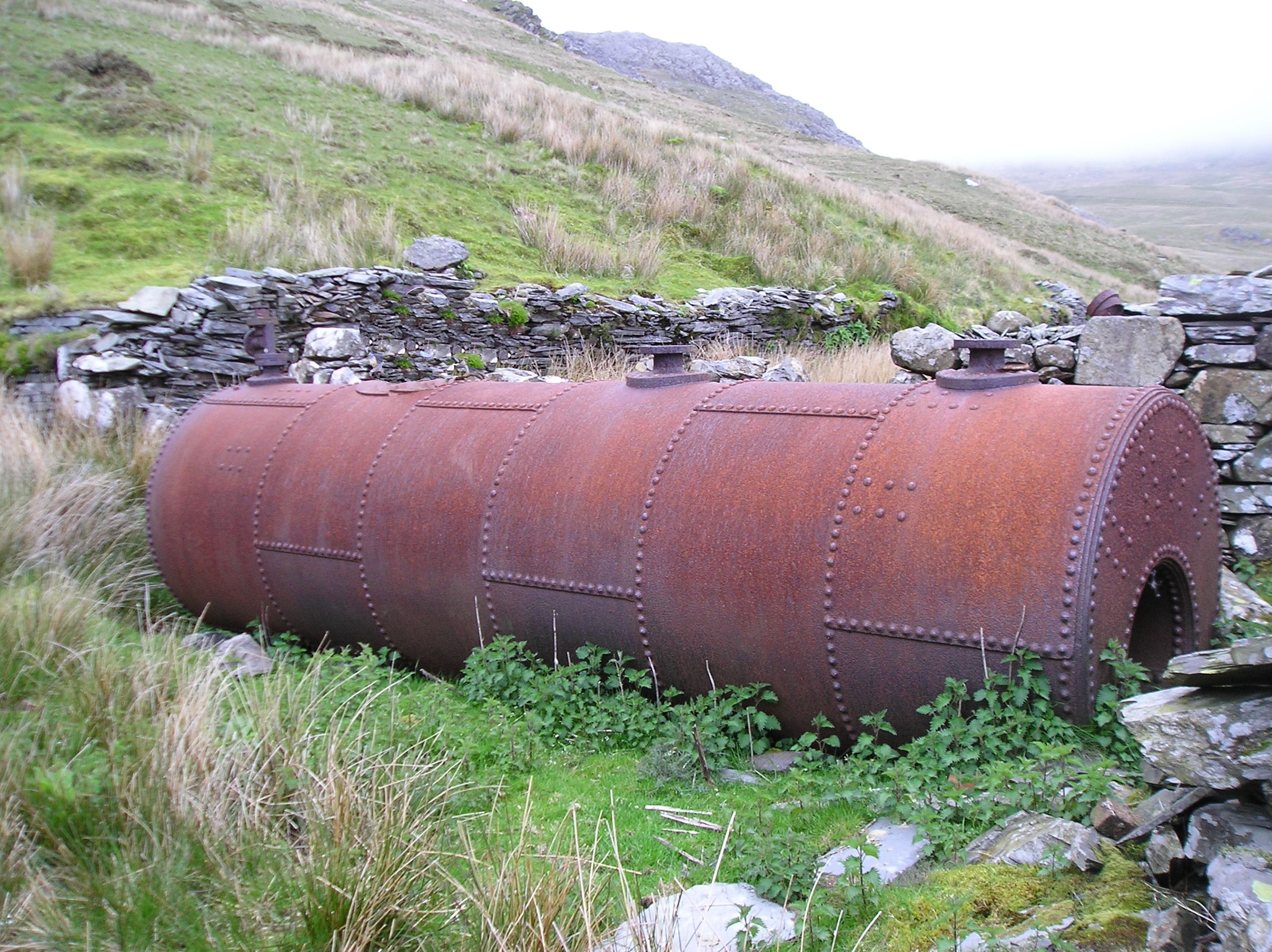
Open adits, incline infrastructure, mill remains including a Lancashire boiler, sections of track, drumhouses and the long access tunnel all survive on site.
Mill ruins (including a surviving Lancashire boiler), open adits, incline infrastructure, drumhouses, track sections, and the roughly 500-yard access tunnel.
Related mines
- Moelwyn Quarry — The two quarries worked the same slate vein, with underground pillars deliberately aligned between them to preserve structural integrity.
Nearby mines
- Sygun Copper Mine — 1.3 miles (2.2 km) N
- Gorseddau Quarry — 2.1 miles (3.4 km) W
- Croesor Quarry — 3.3 miles (5.3 km) E
- Prince of Wales Quarry — 3.5 miles (5.6 km) W
- Rhosydd Quarry — 3.7 miles (6.0 km) E
Straight-line distance, within 9 miles (15 km). Show on the map.
Recorded claims
Individual factual claims, each attached to the source(s) that support it below. Where sources disagree, both are kept.
- A second incline and access tramway built in 1863, connecting to the Croesor Tramway, descended 1,000 feet via two pitches -- at the time, the highest two-pitch incline anywhere in the British slate quarrying industry. 1
- The tramway serving the combined quarries included a roughly 500-yard tunnel through the ridge between Cwm Croesor and Cwm Maesgwyn, considered one of the only North Wales tunnels built purely to carry an access tramway rather than as part of a mine, and among the longest anywhere cut for horse-drawn traffic. 1
- Both Pant Mawr and Fron-Boeth worked the same slate vein as the neighbouring Moelwyn Quarry, with underground pillars deliberately aligned between the two workings to preserve structural integrity. 1
- Pant Mawr was partly reopened in 1886 when amalgamated with the newly opened Fron-Boeth quarry; both quarries closed in 1914 at the outbreak of the First World War. 1
Sources
- (secondary) Fron-Boeth and Pant Mawr quarries — Wikipedia
- (observational) Fron-Boeth boiler — Geograph Britain and Ireland (Chris Andrews)

Record created: 30 August 2026 · Last researched: 30 August 2026