 MineArchive
Croesor Quarry
| Location | Cwm Croesor, near Blaenau Ffestiniog, Gwynedd — 52.9910, -4.0016 (exact) |
|---|---|
| Commodity | Slate |
| Type | Slate |
| Worked | 1846–1930 |
| Operators | Parc and Croesor Slate Quarries Company (1895–1930) |
Overview
Croesor, a totally underground slate quarry in a remote valley near Blaenau Ffestiniog, was small and marginal for most of its early life — until new management in 1895 turned it into one of the most technically innovative slate workings in Wales, introducing Britain's first electric underground quarry locomotives.
History
Small-scale slate quarrying began at Croesor in 1846, and by 1861 two separate companies were working the site; they merged in 1865, the same year the quarry was connected to the newly opened Croesor Tramway, which ran the finished slate down to the wharves at Porthmadog. Output remained modest — just 226 tons in 1868 — and the Croesor United Slate Company eventually closed the quarry in 1878. It reopened in 1895 under new management, worked in conjunction with the neighbouring Parc quarry by the Parc and Croesor Slate Quarries Company, and output rose to around 5,000 tonnes of slate a year. The quarry's manager, Kellow, introduced genuine technical innovation to the Welsh slate industry: Croesor and Parc were the first slate workings in Britain to use electric underground locomotives, alongside a rock drill of Kellow's own patent design. Despite these advances, the quarries declined through the early 20th century; Parc closed in 1920, and Croesor followed in 1930.
Geology
The quarry worked slate beds within the Cambrian slate belt of Snowdonia, the same formation worked at the neighbouring Rhosydd and Parc quarries.
Geological setting: Slate and Regional Metamorphism (well documented example)
Workings
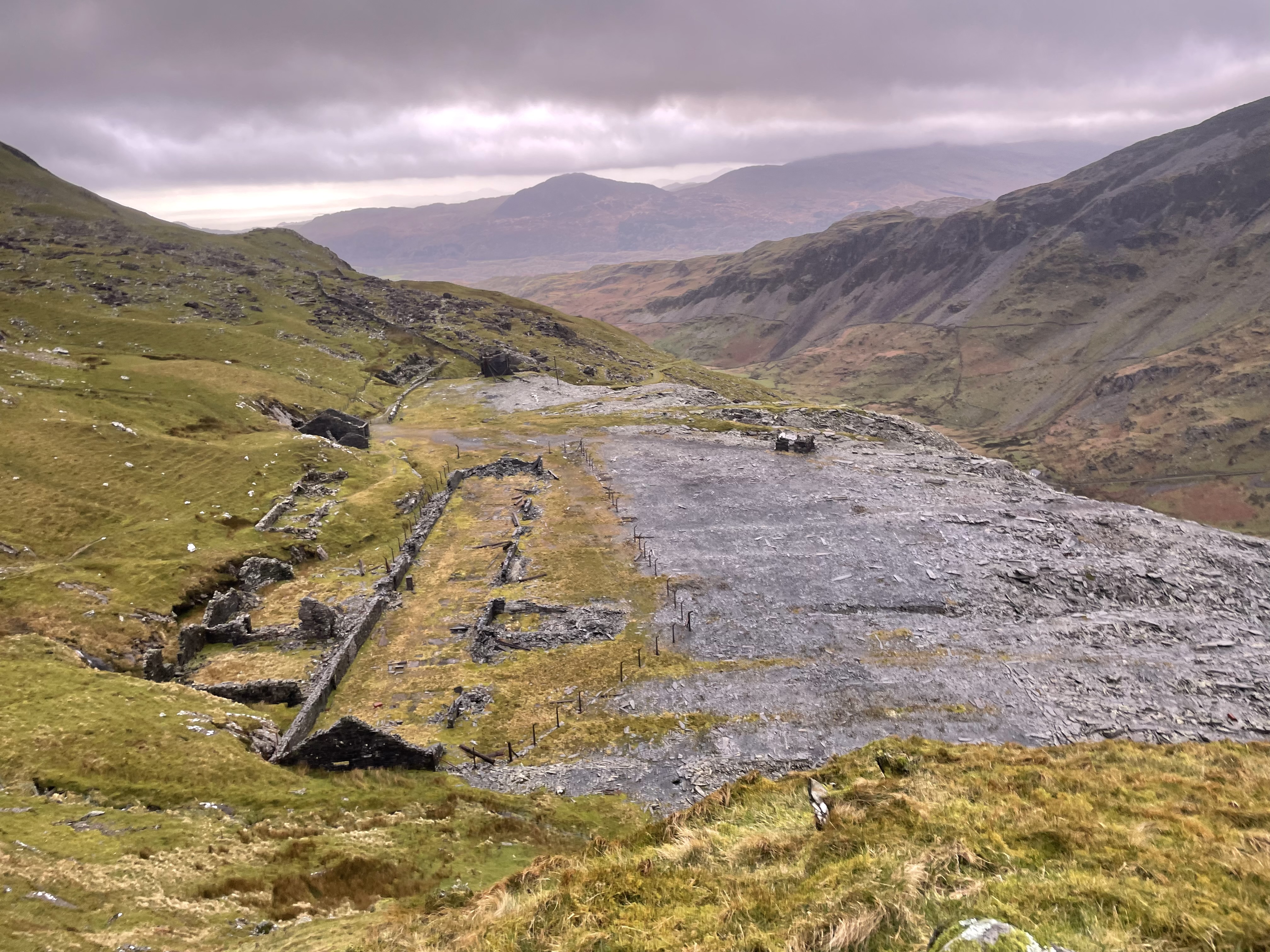
Croesor was worked entirely underground, connected to the neighbouring Parc quarry and, via the Croesor Tramway and its incline, down to the wharves at Porthmadog; extensive dressing floors processed the quarried slate on site.
Closure
The quarry closed in 1930, a decade after the neighbouring Parc quarry, ending large-scale working at the site.
What remains
Underground chambers, dressing floors and the route of the Croesor Tramway and its incline survive, now explored via a connecting route through to the neighbouring Rhosydd quarry.
Related mines
- Coedmadoc Quarry — Coedmadoc bought one of Croesor's own De Winton steam locomotives secondhand in the 1870s.
- Rhosydd Quarry — The two quarries' underground workings run through the mountain and connect to each other.
Nearby mines
- Rhosydd Quarry — 0.6 miles (1.0 km) NE
- Conglog Quarry — 1.0 miles (1.6 km) NE
- Wrysgan Quarry — 1.2 miles (2.0 km) E
- Cwmorthin Slate Mine — 1.4 miles (2.3 km) E
- Moelwyn Quarry — 1.6 miles (2.6 km) SE
Straight-line distance, within 9 miles (15 km). Show on the map.
Recorded claims
Individual factual claims, each attached to the source(s) that support it below. Where sources disagree, both are kept.
- Under the Parc and Croesor Slate Quarries Company from 1895, the combined quarries produced around 5,000 tonnes of slate a year. 1,2
- Manager Kellow introduced the first electric underground locomotives used in any British slate quarry, alongside a rock drill of his own patent design. 1,2
- A plan of Croesor's underground workings and of the workings on the Old Vein, at one inch to forty feet and annotated by D. Blundell, is held by the British Geological Survey from the Cumbria Amenity Trust's collection (CT241) and can be viewed online. 3
- Located at about 52.991 N, 4.002 W. 1
Photographs & further reading
A November 2019 walking visit, deliberately made without ropes or boat, so it shows what can be reached on foot: the hour's climb up the incline road a mine owner built to drive his car to the adit in the 1920s, and the chamber where blocks the size of double-decker buses have come down from the roof. Includes a short film of the trip.
View sourceThe scanned plan of the underground workings and the Old Vein workings, viewable online.
View sourceSources
- (secondary) Croesor quarry — Wikipedia
- (secondary) The Croesor Tramway - A History of the Tramways and Quarries of Cwm Croesor — Welsh Highland Railway Heritage Group
- (primary) CROESOR SLATE QUARRY (Cumbrian Amenity Trust Historical Mining Society mine plans CT241, BGS mine plans catalogue) — British Geological Survey / Mining Remediation Authority
- (primary) Croesor Slate Quarry (BGS Mine Plans Catalogue) — British Geological Survey / Cumbrian Amenity Trust Historical Mining Society
Record created: 23 August 2026 · Last researched: 24 September 2026