 MineArchive
Conglog Quarry
| Location | north-west of Tanygrisiau, near Blaenau Ffestiniog, Gwynedd — 52.9999, -3.9836 (exact) |
|---|---|
| Commodity | Slate |
| Type | Slate |
| Worked | 1854–1910 |
| Maximum depth | Unknown. |
| Operators | Conglog Slate and Slab Company Ltd (1873–1880) |
Overview
A small slate quarry above Tanygrisiau, near Blaenau Ffestiniog, worked from 1854 to 1910 under a long succession of proprietors -- from an ambitious limited company with £40,000 of capital to, in its final years, an informal partnership of just six local quarrymen.
History
Robert Roberts, a surgeon from Ffestiniog, leased 177 acres at Conglog in 1854 at a royalty of two shillings per ton extracted, with a minimum charge of £25, and began working the quarry's back and north slate veins across around ten chambers reached by four access adits. Devon-based developers W.H.B. Kempe and T.M. Matthews took over operations in the 1860s, and in 1873 the site passed to the newly formed Conglog Slate and Slab Company Ltd, capitalised at £40,000, followed in the 1880s by a reconstituted New Conglog Slate and Slab Company Ltd. A 30-foot waterwheel powered the quarry's mill, sited around 305 feet below the upper workings. Roberts, the quarry's original lessee, died in 1892 without seeing its later years; ownership passed in 1895 to Ronald Robert Hamilton Lochart Ross's Glyn Ffestiniog Quarry company, which worked it until 1901. From 1901 an informal partnership of six Tanygrisiau quarrymen took the quarry on directly, working it through its final decade; output peaked in 1902-1903, and the last documented load of slate left the site in 1909. The quarry closed in 1910, its machinery abandoned in place.
Geology
Slate above Tanygrisiau near Blaenau Ffestiniog; the vein is not named on the record.
Workings
Two slate veins -- a back vein and a north vein -- worked across around ten chambers reached by four access adits (labelled A to D), with a 30-foot waterwheel driving a mill sited some 305 feet below the upper workings.
Closure
Closed in 1910 with its machinery left in place, the last documented load of slate having left the quarry in 1909.
What remains
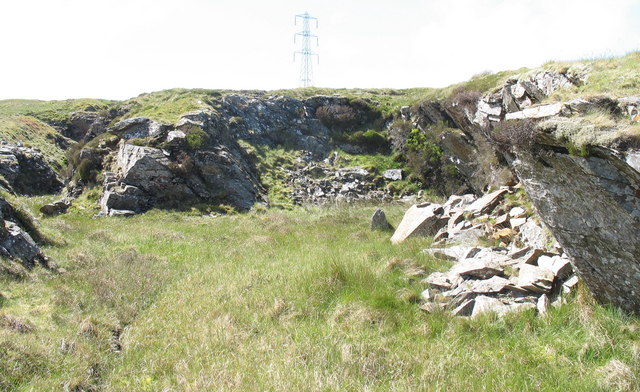
Abandoned quarry workings and machinery survive on site, overlooking Llyn Conglog-mawr.
Disused adits, spoil tips, a trench-like open pit and abandoned quarry machinery.
Nearby mines
- Rhosydd Quarry — 0.4 miles (0.6 km) SW
- Cwmorthin Slate Mine — 0.8 miles (1.3 km) SE
- Wrysgan Quarry — 0.8 miles (1.3 km) SE
- Croesor Quarry — 1.0 miles (1.6 km) SW
- Nyth-y-Gigfran Quarry — 1.3 miles (2.0 km) E
Straight-line distance, within 9 miles (15 km). Show on the map.
Recorded claims
Individual factual claims, each attached to the source(s) that support it below. Where sources disagree, both are kept.
- Robert Roberts leased 177 acres at Conglog in 1854 at a royalty of two shillings per ton extracted, subject to a minimum charge of £25. 1
- The Conglog Slate and Slab Company Ltd, formed in 1873, was capitalised at £40,000. 1
- From 1901 an informal partnership of six Tanygrisiau quarrymen worked the quarry directly; output peaked in 1902-1903, the last documented load of slate left in 1909, and the quarry closed in 1910 with its machinery abandoned in place. 1
Sources
- (secondary) Conglog quarry — Wikipedia
- (observational) The 'mouth' of the Conglog Quarry — Geograph Britain and Ireland (Eric Jones)
- (secondary) Conglog Slate Quarry: an industrial site hidden among the Welsh mountains — Abandoned Spaces

Record created: 30 August 2026 · Last researched: 30 August 2026