 MineArchive
Drws-y-Coed Copper Mine
| Location | Nantlle Valley, Gwynedd — 53.0585, -4.1703 (exact) |
|---|---|
| Commodity | Copper |
| Type | Metal |
| Worked | Medieval (recorded 1284)–1903 |
| Operators | Richard Yarrington (1756–?) |
Overview
Drws-y-Coed, in the Nantlle Valley beneath Snowdon, was reputedly visited by King Edward I in 1284 to see its rich copper workings — and went on to draw miners and 'copper ladies' from as far as Cornwall, Scotland and Anglesey's Parys Mountain before finally closing in 1903.
History
Drws-y-Coed is believed to have been worked for copper since medieval times, with rich workings reputedly seen by King Edward I himself in 1284. Cornish miners are recorded working the site by 1761, and the mining complex was actively exploited from 1768 into the early 20th century. During the 1830s, as the lodes at Parys Mountain on Anglesey grew less productive, many miners and 'copper ladies' — women who worked ore on the dressing floors — relocated to Drws-y-Coed. The mine probably reached its peak between around 1820 and 1840, remaining in production until towards the end of the 19th century; more than 70 men from the village and further afield, including Cornwall and Scotland, worked there during the 18th century alone. Ore was crushed at a mill on site before being carted to Beddgelert and Porthmadog for shipment to Swansea for refining. The mine finally closed in 1903, its copper largely exhausted. The Nantlle Valley's own history adds the beginnings: in 1756 Richard Yarrington, parson of Llangybi, leased the copper of Talmignedd, Y Ffridd and Drws-y-Coed from William Smith of the Faenol estate, and in 1761 Cornish and Scottish men came to work at Simdde'r Dylluan. The Napoleonic demand for copper made the turn of the century the mine's flourishing time; between 1821 and 1840 over six thousand tons of ore went by sea from Caernarfon to Swansea, and the Cloddfa Ganol accounts for 1829-30 show £1,428 of copper won by 114 men and 4 boys.
Geology
The mine worked copper lodes within the Nantlle Valley beneath Snowdon, a hydrothermal mineralised system hosted in Cambrian rocks, distinct from both the granite-related lodes of Cornwall and the non-magmatic Parys Mountain-style mineralisation of Anglesey.
Geological setting: Hydrothermal Deposits (well documented example), Veins and Lodes (well documented example)
Workings
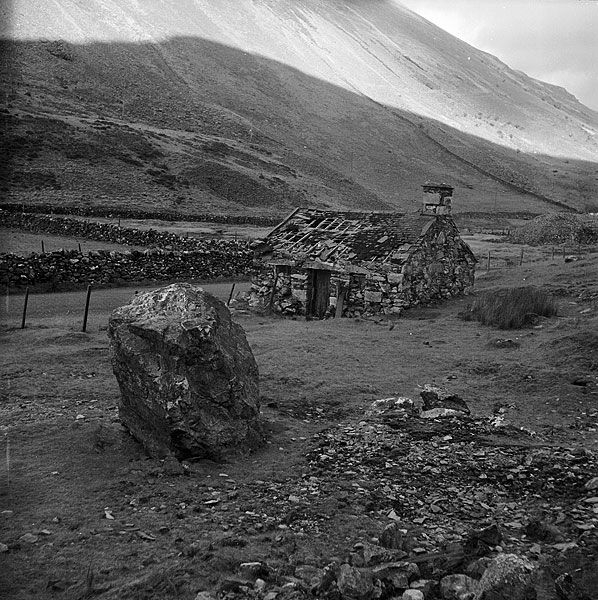
Ore was crushed at a mill on site, powered by a water wheel fed via a water tower, before being carted to Beddgelert and Porthmadog for shipment to Swansea for refining; the complex included a level driven into the hillside and the ruins of a deserted miners' village dating from around 1830.
Closure
The mine closed in 1903 once most of the accessible copper had been extracted.
What remains
Foundations of the crushing machinery, the ruins of processing buildings, a level, and the water tower survive, along with the remains of the largely deserted miners' village.
Nearby mines
- Pen-yr-Orsedd Quarry — 2.2 miles (3.6 km) W
- Moel Tryfan Quarry — 2.5 miles (4.0 km) NW
- Pen-y-Bryn Quarry — 2.5 miles (4.0 km) W
- Alexandra Quarry — 2.5 miles (4.1 km) NW
- Cilgwyn Quarry — 2.8 miles (4.6 km) W
Straight-line distance, within 9 miles (15 km). Show on the map.
Recorded claims
Individual factual claims, each attached to the source(s) that support it below. Where sources disagree, both are kept.
- More than 70 men from the village and further afield, including Cornwall and Scotland, worked at the mine during the 18th century; the mine probably reached its peak between around 1820 and 1840. 1,2
- During the 1830s many miners and 'copper ladies' relocated to Drws-y-Coed from Anglesey's Parys Mountain as that site's lodes became less productive. 1,2
- A section of the Drws-y-Coed copper mine, a copy of Health and Safety Executive abandonment plan 13918, is held by the British Geological Survey (AP2249) and can be viewed online. 3
- Cornish miners were at work at Drws-y-Coed by 1761, and the complex was worked from 1768 into the early twentieth century, closing in 1903 once most of the accessible copper had been taken. 2
- In 1756 Richard Yarrington, parson of Llangybi, took a lease from William Smith of the Faenol estate to mine copper at Talmignedd, Y Ffridd and Drws-y-Coed; in 1761 men from Cornwall and Scotland came to work at Simdde'r Dylluan near Drws-y-Coed. 2
- The accounts of Cloddfa Ganol show copper worth £1,428 won at Drws-y-Coed in 1829-30 by 114 men and 4 boys, and between 1821 and 1840 more than six thousand tons of copper ore went by sea from Caernarfon to Swansea. 2
Photographs & further reading
The valley's own history page on the mine, its Cornish miners and the copper ladies from Parys Mountain.
View sourceThe scanned section of the mine from the HSE abandonment plan, viewable online.
View sourceSources
- (secondary) Drws-y-Coed Mine (Drwy-y-Coed Mine), Nantlle Vale, Llanllyfni, Gwynedd, Wales, UK — Mindat
- (secondary) Mining for Copper at Drws y Coed — The Official Nantlle Valley Website
- (primary) A SECTION OF DRWS Y COED COPPER MINE CARNARVONSHIRE (AP – Official Scottish non-coal abandonment mine and quarry AP2249, BGS mine plans catalogue) — British Geological Survey / Mining Remediation Authority
- (primary) Drws y Coed Copper Mine abandonment plan (BGS Mine Plans Catalogue) — British Geological Survey
Record created: 23 August 2026 · Last researched: 24 September 2026