 MineArchive
Glanrafon Quarry
| Also known as | Glan yr Afon Quarry, Glanrafon Slate Quarry |
|---|---|
| Location | South end of Llyn Cwellyn, north of Rhyd Ddu, Betws Garmon, Gwynedd — 53.0649, -4.1207 (exact) |
| Commodity | Slate |
| Type | Slate |
| Worked | By 1875–c. 1916 |
| Maximum depth | Unknown. |
Overview
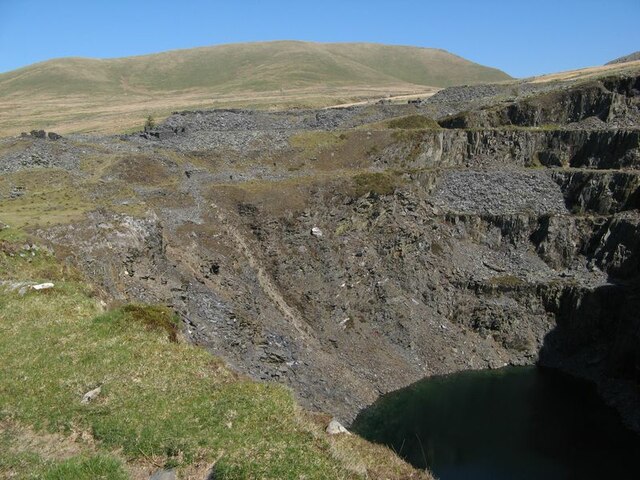
The largest slate quarry in Cwm Gwyrfai, an open pit north of Rhyd Ddu that grew with the North Wales Narrow Gauge Railway from 1881, employed nearly 200 men in 1887 and closed during the First World War.
History
Glanrafon (Glan yr Afon) quarry lies north of Rhyd Ddu at the south end of Llyn Cwellyn, beside the line of the North Wales Narrow Gauge Railway. It was working by 1875, but stayed small until the late 1870s, when the coming of the railway let it grow into the largest quarry in the Cwm Gwyrfai district. E. M. Owen and partners worked it in 1878, W. H. Owen and Sons of the Vulcan Foundry, Caernarfon, from 1879, and E. H. and J. Owen from 1892; by 1904 it belonged to Glanrafon Slate Quarry Ltd, which was wound up in 1916.
Sidings to the railway were put in in 1881, reached by a short and then a longer incline ending in a triangular junction, and the slate company is believed to have paid for the railway's bridge over the Afon Treweunydd. Output is given as 992 or 1,725 tons in 1882, with 92 to 97 men, and 3,499 tons in 1886; there were 193 employees in 1887, and one account puts the peak at some 450. As the main pit deepened, rock was raised by a powered incline or water balance and the pit was pumped by flat rods from a distant water wheel until a drainage tunnel was cut; a quarter-mile tramway tunnel and several small locomotives later served the double mill. The quarry closed about 1915-16, and working had ceased by 1919, though slate waste was scavenged afterwards.
Geology
Unknown.
Workings
One large open pit and several smaller workings, the main pit served first by an incline and later by a tramway tunnel about a quarter of a mile long, with a drainage tunnel.
Closure
Closed about 1915-16, after Glanrafon Slate Quarry Ltd went into liquidation in 1916; working had stopped by 1919, though the tips were scavenged later.
What remains
The main pit is flooded to the level of leakage through its tunnels; spoil tips and derelict buildings remain, and the weighhouse by the railway lost its roof in the late 1960s or early 1970s.
The flooded pit, spoil tips, the quarrymen's barracks and other derelict buildings, the mills area, the incline to the railway, and the ruined weighhouse beside the Welsh Highland Railway.
Redevelopment
The quarry is farmland in private ownership; the restored Welsh Highland Railway runs past its foot.
Related mines
- Garreg Fawr Slate Quarry — Gwyrfai valley slate quarries on the North Wales Narrow Gauge Railway.
Nearby mines
- Clogwyn Coch Copper Mine — 1.8 miles (2.9 km) NE
- Drws-y-Coed Copper Mine — 2.1 miles (3.4 km) W
- Hafod y Llan Slate Quarry — 2.3 miles (3.7 km) SE
- Braich yr Oen Mine — 2.7 miles (4.4 km) SE
- Hafod y Porth Copper Mine — 2.8 miles (4.5 km) SE
Straight-line distance, within 9 miles (15 km). Show on the map.
What's uncertain
Points where sources disagree or the record could not be settled; both accounts are kept. All open questions in the archive.
- In 1882 Glanrafon produced 1,725 tons with 92 men. (disputed) 1
- In 1882 Glanrafon produced 992 tons with 97 employees; output was 3,499 tons in 1886 and there were 193 employees in 1887. (disputed) 3
- At its peak Glan yr Afon quarry employed some 450 men. (uncertain) 2
Recorded claims
Individual factual claims, each attached to the source(s) that support it below. Where sources disagree, both are kept.
- Glanrafon was a small-scale working until the late 1870s and grew with the coming of the railway into the largest quarry in the Cwm Gwyrfai district. 1,2
- The quarry was worked by E. M. Owen and partners in 1878, W. H. Owen and Sons from 1879, E. H. and J. Owen from 1892, and Glanrafon Slate Quarry Ltd by 1904, which was liquidated in 1916. 3
- In 1882 Glanrafon produced 1,725 tons with 92 men. (disputed) 1
- In 1882 Glanrafon produced 992 tons with 97 employees; output was 3,499 tons in 1886 and there were 193 employees in 1887. (disputed) 3
- Sidings on the North Wales Narrow Gauge Railway served the quarry from 1881, reached by inclines ending in a triangular junction. 1,3
- At its peak Glan yr Afon quarry employed some 450 men. (uncertain) 2
- The quarry closed about 1915-16, and working had ceased by 1919. 1,3,2
Sources
- (secondary) Glanrafon Slate Quarry, Betws Garmon (NPRN 305780) — Coflein (RCAHMW)
- (secondary) Glan yr Afon (The Glan yr Afon Project) — Welsh Highland Railway Heritage Group
- (secondary) Glanrafon Quarry — Festipedia (FR Heritage Group)
Record created: 19 October 2026 · Last researched: 19 October 2026