 MineArchive
Greenside Mine fire, 1952
A fire that broke out over a weekend in the North Shaft workings released carbon monoxide through the mine when the day shift restarted the air compressor, killing four miners — the worst single loss of life in Greenside's history.
| Date | 7 July 1952 |
|---|---|
| Mine | Greenside Mine |
| Region | Cumbria |
| Primary type | Fire |
| Associated types | Gas / Asphyxiation, Rescue |
| Fatalities | 4 (Four miners who had descended the 940 North winze were killed by carbon monoxide poisoning; other men who reached the 175 Fathom Level were overcome by gas but got out alive.) |
| Injuries | Several miners were overcome by gas short of the winze and survived; no other fatalities were reported. |
| Context | During active mining |
Cause
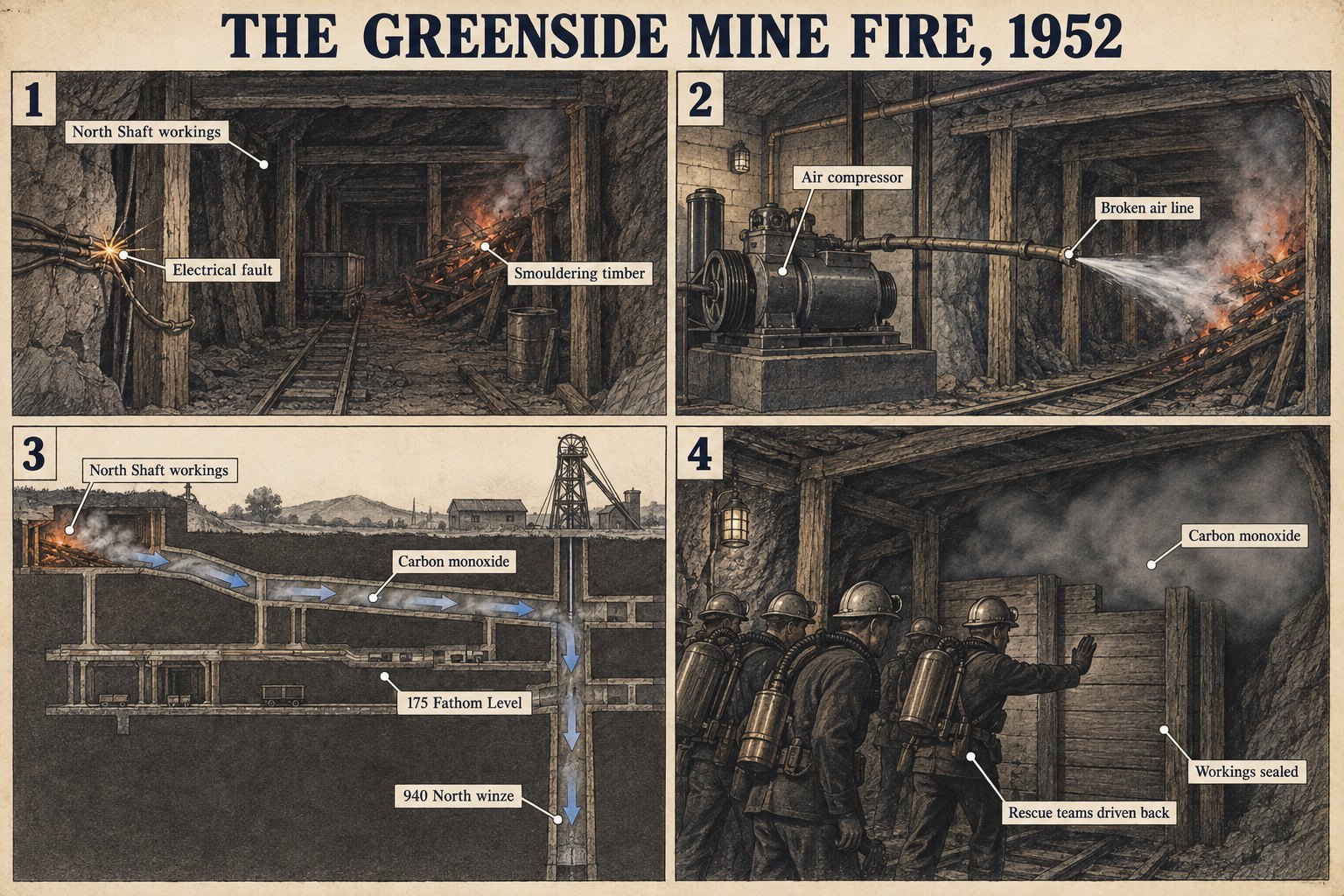
An electrical fault is believed to have started a fire in timbering at the far northern end of the mine, above the 200 fathom level, sometime over the preceding weekend.
Contributing factors
When the day shift started the air compressor on the Monday morning, air escaping from a broken line fanned the smouldering fire and drove carbon monoxide through the workings ahead of any warning.
What happened
On the morning of Monday 7 July 1952, miners returning to work at Greenside started the compressor supplying compressed air underground. A fire had been smouldering in timber supports deep in the North Shaft workings since some point over the weekend, probably started by an electrical fault; the compressed air, escaping from a broken line near the fire, fanned it and forced carbon monoxide gas through the mine's ventilation. Four men who had gone down the 940 North winze were overcome and killed; others reaching the 175 Fathom Level were affected by gas but managed to get out.
Rescue & recovery
Rescue teams attempting to reach the trapped men were themselves driven back as gas concentrations kept rising through the Monday evening; by around 10pm it was judged the four men could not have survived, and the decision was taken to seal the affected workings until the gas cleared rather than risk further rescuers. The bodies were not recovered until Wednesday 16 July, nine days after the fire started.
Memorials & commemoration
George William Gibson, Richard Mallinson and John (“Johnny”) Miller were posthumously awarded the Edward Medal for their part in the rescue attempt. Cyril Conner received the MBE and Walter Burnett the BEM; Walter Kirk and Richard Glaister received the Queen's Commendation for Brave Conduct.
Recorded claims
Individual factual claims, each attached to the source(s) that support it below. Where sources disagree, both are kept.
- An electrical fault is believed to have ignited timbering in the North Shaft workings over the weekend before 7 July 1952; the fire was fanned into a lethal carbon-monoxide source when the air compressor was restarted on the Monday morning. 1,2
- Four miners who had gone down the 940 North winze were killed by carbon monoxide poisoning on 7 July 1952. 1,3
- Rescue workers were driven back by gas on the Monday night; the bodies were not recovered until 16 July, nine days after the fire. 3,2
- George William Gibson, Richard Mallinson and John Miller were posthumously awarded the Edward Medal (Bronze); Cyril Conner received the MBE, Walter Burnett the BEM, and Walter Kirk and Richard Glaister the Queen's Commendation for Brave Conduct. 3,4
- The mine remained closed until 1 September 1952 while the fire-damaged workings were made safe. 1
Related terminology
Mining terms this disaster is structurally linked to, with the nature of the relationship.
- Afterdamp (direct cause)
Four miners were killed by carbon monoxide gas released when a fire in timbering fanned into life; textbook afterdamp poisoning following a mine fire rather than an explosion. - Fathom (contextual relationship)
The fire started in timbering above the 200 fathom level — depth at Greenside, as in most British metal mines, being reckoned in fathoms rather than feet. - Level (contextual relationship)
An electrical fault is thought to have set fire to timbering at the far north end of the mine, above the 200 fathom level, at some point over the weekend before anyone was there to find it. - Shaft (contextual relationship)
The fire was in the North Shaft workings, and it was restarting the air compressor on Monday morning that pushed its carbon monoxide through the rest of the mine. - Winze (contextual relationship)
Four men went down the 940 North winze and were overcome and killed there; others who got as far as the 175 Fathom Level were gassed but escaped.
Photographs & further reading
This page doesn't try to reproduce everything — these are the best original sources found for this disaster.
Local-history blog account of the fire, rescue attempt and the bravery awards made afterwards.
View sourceSources
- (secondary) Greenside Mine — Wikipedia
- (secondary) Greenside Mine – 70th Anniversary of 1952 Accident — Friends of the Ullswater Way (blog)
- (secondary) Greenside Disaster — Patterdale TODAY
- (secondary) Edward Medal Recipients — Mines Rescue History
Record created: 20 August 2026 · Last researched: 20 August 2026