 MineArchive
Keppel Cove dam burst, 1927
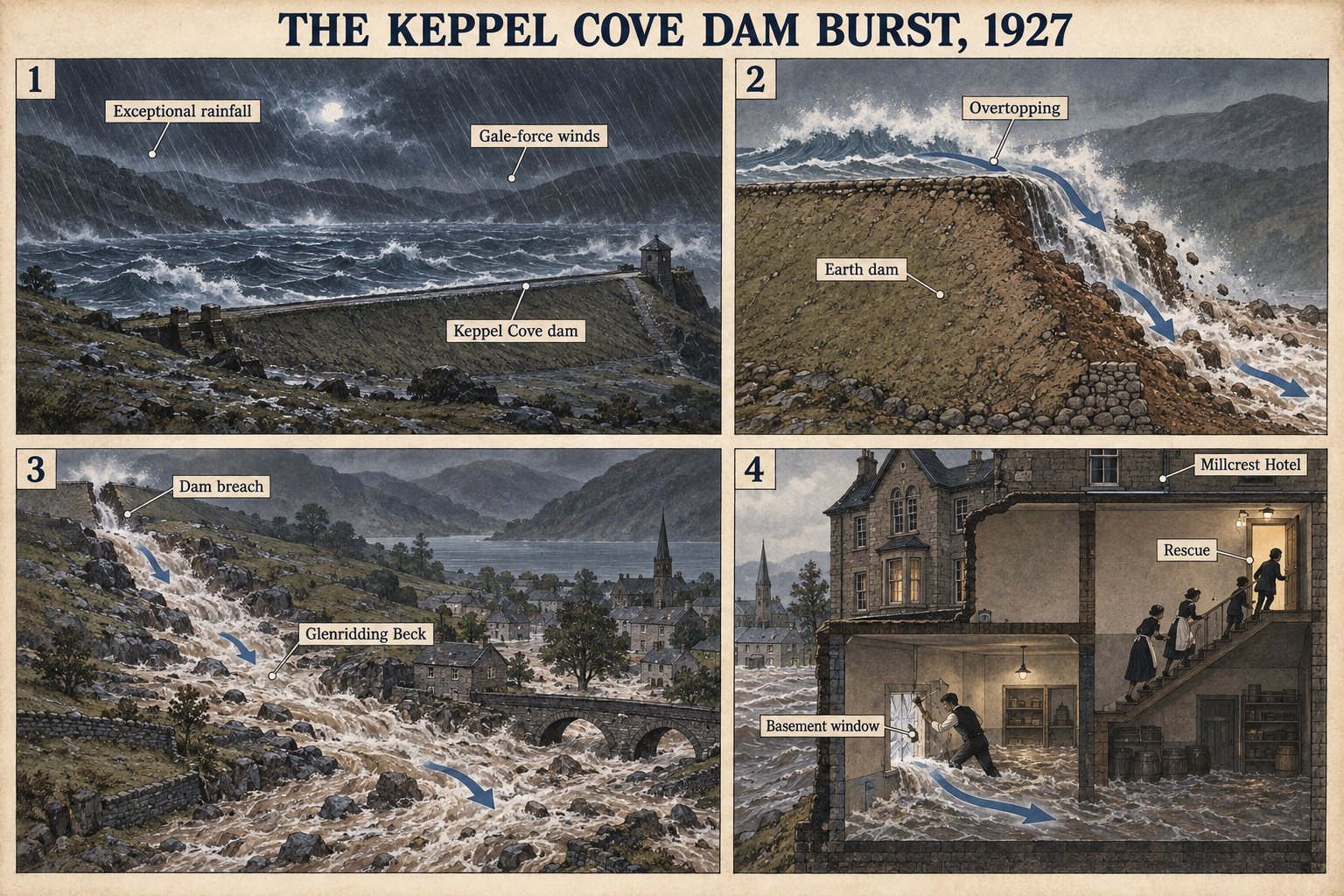
After a night of exceptional rainfall and gale-force winds, the earth dam supplying Greenside Mine's hydro-electric power at Keppel Cove was overtopped and burst, sending a flood down into Glenridding village that wrecked shops, bridges and a hotel — four hotel staff were rescued from a flooding basement.
| Date | night of 28–29 October 1927 |
|---|---|
| Mine | Greenside Mine |
| Region | Cumbria |
| Primary type | Flooding / Inundation |
| Associated types | Rescue, Surface / Tip Failure |
| Fatalities | 0 (None reported.) |
| Injuries | None reported; four hotel staff at the Millcrest Hotel were trapped by rising water in a basement room and rescued. |
| Context | During active mining (The dam supplied water to Greenside Mine's hydro-electric winding plant rather than being part of the underground workings, but its failure was a direct consequence of the mine's own infrastructure and caused major damage and a real risk to life in Glenridding village below.) |
Cause
Exceptional rainfall (3.38 inches in 12 hours, per the Parish Council's account) combined with gale-force winds caused the tarn at Keppel Cove to rise until it overtopped the earth dam; wave action eroded the crest and the dam then failed rapidly, releasing the reservoir down Glenridding Beck.
Contributing factors
The dam was an earth structure retaining an artificial tarn built to feed Greenside's hydro-electric winding and lighting plant — the same basic arrangement that had made the mine one of the first in the UK to use electric underground haulage.
What happened
On the night of 28–29 October 1927 (one local account instead gives 4 November 1927 — see below), a severe storm brought exceptional rainfall and gale-force winds to the fells above Glenridding. The earth dam impounding the tarn at Keppel Cove, built to feed water to Greenside Mine's hydro-electric plant, was overtopped and gave way in the early hours. The resulting flood tore down Glenridding Beck, destroying Rattlebeck Bridge at Gillside Farm and damaging Rattlebeck Cottage, before sweeping through the village itself — wrecking shops on Eagle Road including the Co-operative store, flooding the Post Office and village hall, and overtopping Glenridding Bridge before pouring into the Millcrest Hotel (today the Ullswater/Glenridding Inn).
Rescue & recovery
Four female staff of the Millcrest Hotel were trapped by rising water in a basement room, reportedly clinging to a floating mattress as the water rose. Ernest Thompson, the hotel's 16-year-old “boots”, broke a window and got them to safety after hearing their screams.
Legal & regulatory aftermath
Compensation claims against the mining company followed — put at over £4,500 by one account and over £25,000 by another; either figure represented several years' worth of the mine's profits.
Changes to practice & legislation
A replacement reinforced-concrete dam was built at Keppel Cove by 1928, but it too failed in 1931 after the bedrock beneath its north side was undermined.
What's uncertain
Points where sources disagree or the record could not be settled; both accounts are kept. All open questions in the archive.
- The Patterdale Parish Council account dates the dam burst to the night of 28–29 October 1927; the Patterdale PAST account instead gives 4 November 1927. (disputed) 1,2
- Compensation claims against the mining company were later put at over £4,500 by one account and over £25,000 by another. (disputed) 1,2
Recorded claims
Individual factual claims, each attached to the source(s) that support it below. Where sources disagree, both are kept.
- Exceptional rainfall and gale-force winds caused the Keppel Cove reservoir dam, which fed Greenside Mine's hydro-electric plant, to be overtopped and to fail in the early hours. 1,2
- The Patterdale Parish Council account dates the dam burst to the night of 28–29 October 1927; the Patterdale PAST account instead gives 4 November 1927. (disputed) 1,2
- The flood destroyed Rattlebeck Bridge, damaged Rattlebeck Cottage, wrecked shops on Eagle Road including the Co-operative store, and flooded the Millcrest Hotel, Post Office and village hall. 1,2
- Four hotel staff trapped in a flooding basement of the Millcrest Hotel were rescued by 16-year-old hotel “boots” Ernest Thompson. 2
- Compensation claims against the mining company were later put at over £4,500 by one account and over £25,000 by another. (disputed) 1,2
- A replacement reinforced-concrete dam completed in 1928 itself failed in 1931 after its foundations were undermined. 2
Related terminology
Mining terms this disaster is structurally linked to, with the nature of the relationship.
- Haulage (contextual relationship)
Named in this record’s contributing factors: “…that had made the mine one of the first in the UK to use electric underground haulage.” - Winze (contextual relationship)
Named in this record’s cause: “…combined with gale-force winds caused the tarn at Keppel Cove to rise until it overtopped the earth dam; wave action eroded the crest and…”
Photographs & further reading
This page doesn't try to reproduce everything — these are the best original sources found for this disaster.
Patterdale Parish Council's local account of the Keppel Cove dam burst and its effect on the village.
View sourceSources
- (secondary) 1927 Floods — Patterdale Parish Council
- (secondary) Keppel Cove Disaster - 1927 — Patterdale PAST
- (secondary) Greenside Lead Mine, Glenridding — Friends of the Ullswater Way
Record created: 20 August 2026 · Last researched: 20 August 2026