 MineArchive
Albion Colliery explosion, 1894
A firedamp and coal-dust explosion tore through Albion Colliery on 23 June 1894, killing 290 men and boys — the second-worst death toll of any British colliery disaster after Senghenydd in 1913.
| Date | 23 June 1894 |
|---|---|
| Mine | Albion Colliery |
| Region | Rhondda Cynon Taf |
| Type | Explosion |
| Fatalities | 290 (290 men and boys died out of 295 underground at the time; 123 of the 125 pit ponies underground also died. Eleven bodies were so badly mutilated they could never be identified.) |
| Context | During active mining |
Cause
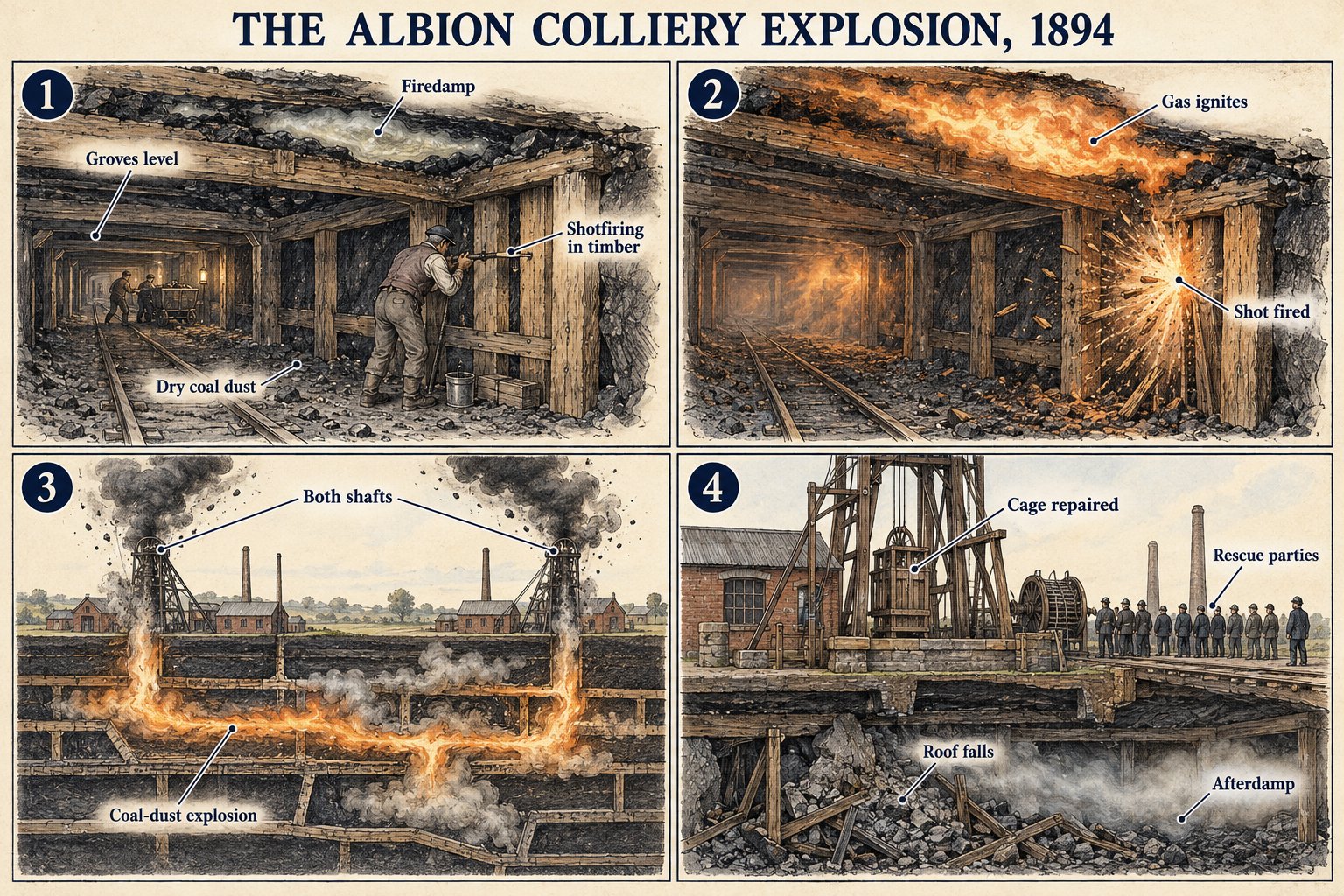
The government investigator concluded that shotfiring of pit timbers on the Groves level ignited a firedamp accumulation, which in turn ignited coal dust; risk was amplified by shotfiring during a working shift, inadequately watered roadways, and a recently altered Saturday shift pattern that removed the normal dust-clearing interval.
What happened
Two explosions were heard at the surface around 3:45-4:00pm on Saturday 23 June 1894, blowing dust, debris and smoke from both shafts. Recovery of bodies was hampered by roof falls and afterdamp over several days: 86 bodies had been recovered by the following morning, and 260 by the Thursday after. One household on Howell Street lost eleven members.
Rescue & recovery
The manager and rescuers descended once the cage was repaired and conditions allowed; rescuers reported hearing calls for help from areas too dangerous to reach.
Investigation & inquiry
A nine-day coroner's inquest before a 17-member jury found that shotfiring had been carried out without sufficient precautions; a separate Home Office investigation led by barrister J. Roskill with four Mines Inspectors, reporting in September 1894, agreed that shotfiring in timber should be banned as contrary to good mining practice.
Legal & regulatory aftermath
Despite the inquest's negligence finding, the colliery manager was fined only £10 and a chargeman £2; the case against the company itself was dismissed. The pit reopened within about two weeks and was back to near-full output by September 1894.
Memorials & commemoration
A memorial to the eleven unidentified victims, erected in 1907 and designed by Alfred H. Sweet of Cardiff, stands in St Mabon's churchyard, Llanfabon, near Nelson — a tall white marble monument with a Welsh-language poem and a figure of an angel scattering flowers, unveiled by William Abraham MP ('Mabon'). It is Grade II listed.
Recorded claims
Individual factual claims, each attached to the source(s) that support it below. Where sources disagree, both are kept.
- 290 men and boys died, corroborated independently by Wikipedia, the NMRS accident record, Welsh Coal Mines, and the Cadw statutory listing for the disaster memorial. This differs from the 281 figure sometimes quoted elsewhere. 1,2
Related terminology
Mining terms this disaster is structurally linked to, with the nature of the relationship.
- Afterdamp (contextual relationship)
Named in this record’s narrative: “…from both shafts. Recovery of bodies was hampered by roof falls and afterdamp over several days: 86 bodies had been recovered by the following…” - Cage (contextual relationship)
Named in this record’s rescue and recovery: “The manager and rescuers descended once the cage was repaired and conditions allowed; rescuers reported hearing calls…” - Firedamp (contextual relationship)
Named twice in this record, first in the summary: “A firedamp and coal-dust explosion tore through Albion Colliery on 23 June…” - Level (contextual relationship)
Named in this record’s cause: “…investigator concluded that shotfiring of pit timbers on the Groves level ignited a firedamp accumulation, which in turn ignited coal dust;…” - Roof Fall (contextual relationship)
Named in this record’s narrative: “…and smoke from both shafts. Recovery of bodies was hampered by roof falls and afterdamp over several days: 86 bodies had been recovered by the…”
Sources
- (secondary) Albion Colliery Explosion - Pontypridd - 1894 — Northern Mine Research Society
- (primary) Albion Colliery Disaster Memorial (Cadw ref. 82672) — Cadw (Welsh Government statutory listing)
- (secondary) Albion Colliery — Wikipedia
- (secondary) The Albion Colliery, 50 Years On — Pontypridd Museum
Record created: 26 August 2026 · Last researched: 26 August 2026