 MineArchive
Albion Colliery
| Location | Cilfynydd, near Pontypridd, Rhondda Cynon Taf — 51.6253, -3.3217 (exact) |
|---|---|
| Commodity | Coal |
| Type | Coal |
| Worked | 1884 (sinking)–September 1966 |
| Maximum depth | 646 yards |
Overview
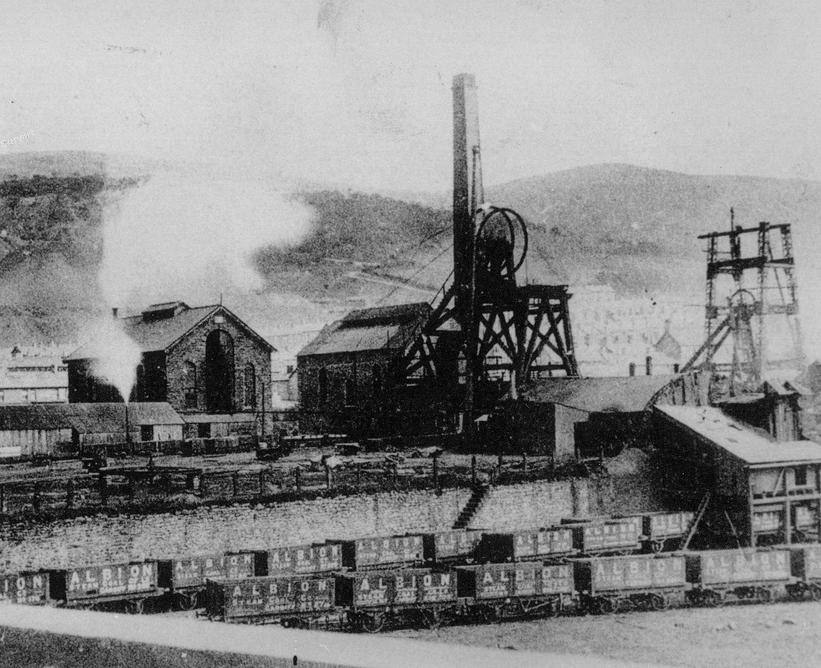
A large coal mine at Cilfynydd, near Pontypridd, sunk 1884-87 by the Albion Steam Coal Company and worked until 1966. It is overwhelmingly notable for the firedamp and coal-dust explosion of 23 June 1894, which killed 290 men and boys — the second-worst death toll of any British colliery disaster after Senghenydd. The site is now occupied by Pontypridd High School and an industrial estate; a memorial to the eleven unidentified victims stands at St Mabon's churchyard, Llanfabon.
History
Sinking began in 1884 on land formerly part of Ynyscaedudwg Farm; six men were killed during the sinking itself, in March and November 1886 (see Disasters, below). Two shafts, each 19ft in diameter and sunk 33 yards apart, reached a depth of 646 yards, and the colliery officially opened in August 1887 under the Albion Steam Coal Company Ltd. Average weekly output reached 12,000 tons, said at the time to be the largest for any single-shaft colliery in South Wales, and the workforce grew rapidly — from around 1,500 in 1893 to a peak of 2,589 in 1908 — with the surrounding village of Cilfynydd growing to over 3,000 people. On 23 June 1894 the colliery was the scene of one of Britain's worst mining disasters — see Disasters, below. A second, smaller explosion followed on 10 November 1906 (see Disasters, below).
Ownership passed from the Albion Steam Coal Company (liquidated 1928) to the Powell Duffryn Company and then, on nationalisation in 1947, to the National Coal Board. The colliery closed in September 1966, 72 years after the disaster. The site is now occupied by Pontypridd High School and the Albion Industrial Estate; several streets in Cilfynydd still carry the 'Albion' name.
Geology
Coal of the South Wales coalfield; the seams worked are not recorded.
Workings
Sunk from 1884 on land that had been part of Ynyscaedudwg Farm, to 646 yards; six men were killed during the sinking itself, in March and November 1886.
Closure
Closed in September 1966, 72 years after the disaster, having passed from the Albion Steam Coal Company through Powell Duffryn to the National Coal Board.
What remains
The site is now occupied by Pontypridd High School and the Albion Industrial Estate.
Nearby mines
- Abercynon Colliery — 1.1 miles (1.8 km) N
- Lady Windsor Colliery — 1.8 miles (2.8 km) NW
- Pwllgwaun Colliery — 2.0 miles (3.2 km) SW
- Universal Colliery — 2.0 miles (3.2 km) SE, Caerphilly
- Great Western Colliery — 2.2 miles (3.6 km) SW
Straight-line distance, within 9 miles (15 km). Show on the map.
Disasters & major incidents
-
Albion Colliery shaft accident, March 1886
24 March 1886 · Winding / Shaft Accident · 2 fatalities
Two sinkers were killed by falling fireclay while working in the side of the shaft being sunk at Albion Colliery, Cilfynydd, on 24 March 1886. -
Albion Colliery shaft collapse, November 1886
4 November 1886 · Collapse / Roof Fall · 4 fatalities
The side of the shaft being sunk at Albion Colliery, Cilfynydd, gave way on 4 November 1886, bringing down fresh walling on the sinkers and killing four. -
Albion Colliery explosion, 1894
23 June 1894 · Explosion · 290 fatalities
A firedamp and coal-dust explosion tore through Albion Colliery on 23 June 1894, killing 290 men and boys — the second-worst death toll of any British colliery disaster after Senghenydd in 1913. -
Albion Colliery explosion, 1906
1906 · Explosion · 6 fatalities
At about 3.10 p.m. on Saturday 10 November 1906, after the day shift had ended, an explosion of firedamp in C district of the No. 1 seam at the Albion Colliery, Cilfynydd, killed repairers and officials at work there. It was put down to a spark from an electric lamp relighter.
Recorded claims
Individual factual claims, each attached to the source(s) that support it below. Where sources disagree, both are kept.
- Sinking began in 1884, with six men killed during the sinking itself in March and November 1886; the colliery officially opened in August 1887, its two shafts 19ft in diameter and 646 yards deep. 1,2
- The colliery closed in September 1966, 72 years after the 1894 disaster. 1,2
- The BGS/Coal Authority mine plans catalogue holds a plan for the Yard and Seven Feet, No. 4 Seam at Albion Colliery. 3
Sources
- (secondary) Albion Colliery — Wikipedia
- (secondary) Albion Colliery, Cilfynydd — Welsh Coal Mines
- (primary) Albion Colliery mine plan record — British Geological Survey / Coal Authority mine plans catalogue
Record created: 26 August 2026 · Last researched: 26 August 2026