 MineArchive
Universal Colliery
| Also known as | Senghenydd Colliery |
|---|---|
| Location | Senghenydd, Caerphilly — 51.6117, -3.2806 (exact) |
| Commodity | Coal |
| Type | Coal |
| Worked | 1891 (sinking)–1928 |
| Maximum depth | 1,950 feet |
| Operators | William Lewis, 1st Baron Merthyr |
Overview
A South Wales steam-coal colliery that was the site of the worst mining disaster in British history — 439 men and boys killed in an explosion in 1913, twelve years after an earlier explosion at the same colliery had already killed 81.
History
William Lewis, later 1st Baron Merthyr, began developing Universal Colliery at Senghenydd — then a farming hamlet of around a hundred people — from 1890, with shaft-sinking starting in 1891 and the first coal raised in 1896. By 1913 the colliery was producing 1,800 long tons of prized steam coal a day from two shafts, Lancaster (downcast) and York (upcast), both 1,950 feet deep. The colliery suffered two catastrophic explosions twelve years apart: 81 men were killed on 24 May 1901, and 439 men and boys plus one rescuer — 440 in total — were killed on 14 October 1913, the worst death toll of any mining disaster in British history (see Disasters, below, for both). Manager Edward Shaw, convicted of safety breaches after the 1913 disaster, remained in post until the colliery finally closed in November 1928.
Geology
The colliery worked South Wales steam coal, a high-quality fuel much sought after for naval and merchant shipping, from a gassy seam whose firedamp content contributed directly to both of the pit's major explosions.
Workings
Two shafts served the colliery: Lancaster, the downcast (intake) shaft, and York, the upcast (return) shaft, both sunk to 1,950 feet.
Closure
The colliery closed in 1928 and its buildings were later demolished.
What remains
The colliery closed in 1928 and its buildings were later demolished; the site is now occupied by Nant-y-Parc Primary School and the Welsh National and Universal Mining Disaster Memorial Garden, added to the Cadw/ICOMOS Register of Parks and Gardens in March 2024.
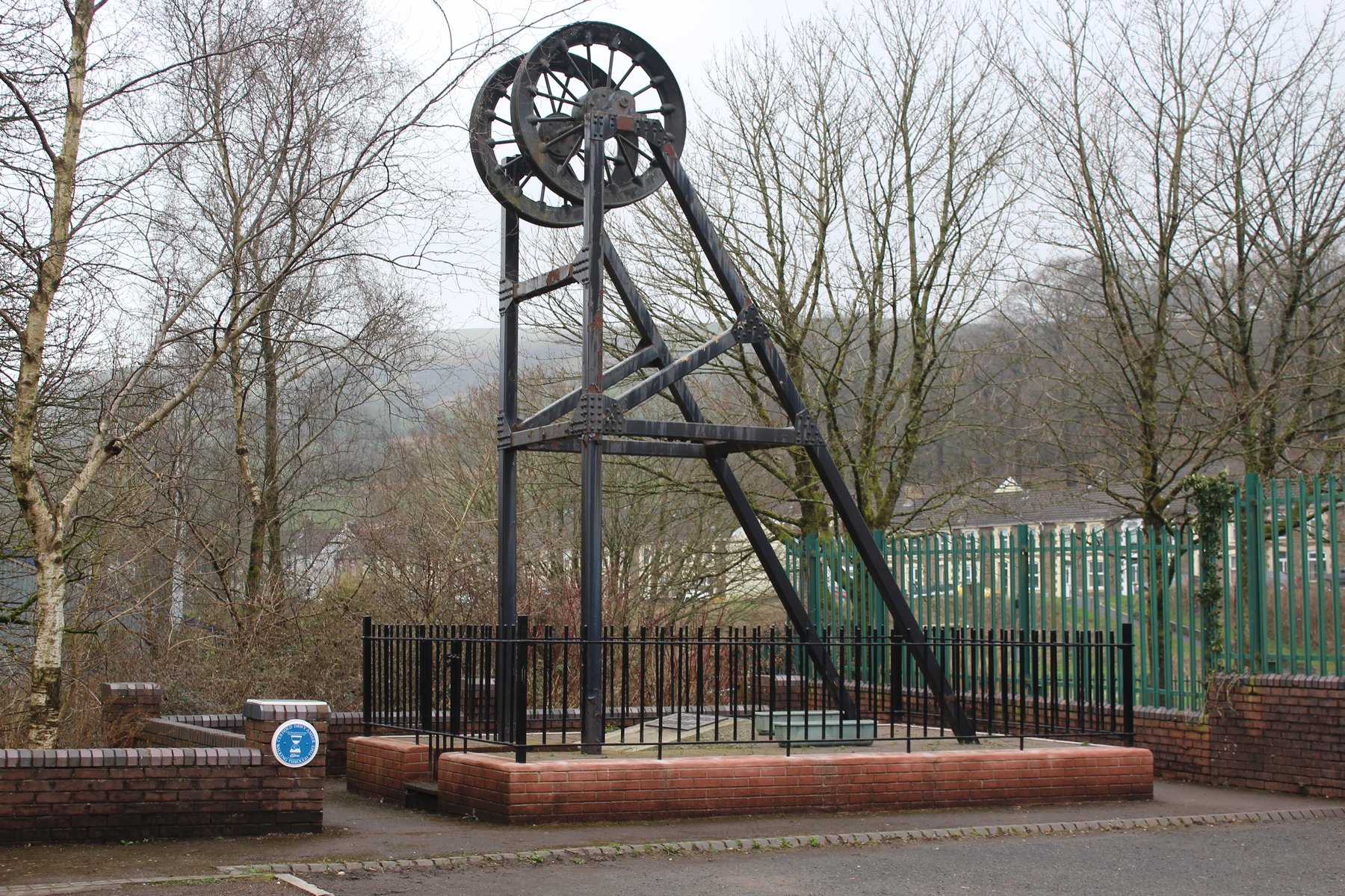
Nothing of the working colliery survives above ground; a 20-foot replica of the pit's winding gear (erected by the National Coal Board in 1981) and later memorial sculptures, including a 2013 centenary monument depicting a rescuer aiding a survivor, now mark the site.
Related mines
- Lewis Merthyr Colliery — Lewis Merthyr Consolidated Collieries Ltd acquired the Universal Colliery at Senghenydd in 1905, eight years before the explosion there that killed 439 men and boys.
- Windsor Colliery — Windsor's underground workings were connected to Universal Colliery specifically for ventilation from 1902, a genuine structural link between the two collieries rather than mere proximity — though Windsor itself had no direct involvement in Universal's own 1913 disaster.
Nearby mines
- Windsor Colliery — 0.9 miles (1.5 km) SE
- Albion Colliery — 2.0 miles (3.2 km) NW, Rhondda Cynon Taf
- Llanbradach Colliery — 2.1 miles (3.4 km) E
- Llanbradach Quarry — 2.2 miles (3.5 km) SE
- Abercynon Colliery — 2.9 miles (4.6 km) NW, Rhondda Cynon Taf
Straight-line distance, within 9 miles (15 km). Show on the map.
Disasters & major incidents
-
Senghenydd colliery disaster, 1901
24 May 1901 · Explosion · 81 fatalities
Three underground explosions killed 81 miners at Universal Colliery as the night shift was leaving — an earlier disaster at the same colliery that struck again, far more severely, in 1913. -
Senghenydd colliery disaster, 1913
14 October 1913 · Explosion · 440 fatalities
An explosion in the western workings of Universal Colliery killed 439 miners and one rescuer — the worst mining disaster in British history.
Culture
- Senghenydd RFC and the 1913 explosion (Sports)
Five members of the Senghenydd rugby team died in the 1913 explosion at this colliery. - Welsh National Mining Memorial, Senghenydd (Art)
The memorial garden stands at Senghenydd for the 1901 and 1913 Universal Colliery disasters and for every mining disaster in Wales.
Recorded claims
Individual factual claims, each attached to the source(s) that support it below. Where sources disagree, both are kept.
- The colliery was owned by the Universal Steam Coal Company, a subsidiary of Lewis Merthyr Consolidated Collieries Limited. Manager and agent Edward Shaw had held the post for twelve years by 1913 (agent for the last four), overseeing separate East and West Side management structures with pit districts locally named Kimberley, Ladysmith, Mafeking and Pretoria. 1
- Nearly 950 men were working underground on the morning of the 1913 explosion. Unprecedented pre-war demand for Welsh steam coal, driven above all by the Royal Navy's coal-fired battleships, had kept the privately owned and run colliery prospering in the years leading up to the disaster. 2
- On the day shift in 1913 the West Side alone ran three overmen and fourteen firemen across its districts; the Pretoria district had 27 working places and a total of 79 men (colliers, hauliers, wallers and repairers) on shift. 1
Sources
- (secondary) Universal Colliery Explosion - Senghenydd - 1913 — Northern Mine Research Society
- (secondary) 1913 Universal Colliery Disaster — Aber Valley Heritage Group / BBC Wales History
- (primary) Universal Colliery / Senghenydd Mine Plans (BGS/Coal Authority, SWR1397/SWR1398) — British Geological Survey / The Coal Authority
- (secondary) Senghenydd colliery disaster — Wikipedia
Record created: 22 August 2026 · Last researched: 28 August 2026