 MineArchive
Senghenydd colliery disaster, 1913
An explosion in the western workings of Universal Colliery killed 439 miners and one rescuer — the worst mining disaster in British history.
| Date | 14 October 1913 |
|---|---|
| Mine | Universal Colliery |
| Region | Caerphilly |
| Primary type | Explosion |
| Associated types | Rescue |
| Fatalities | 440 |
| Context | During active mining |
Cause
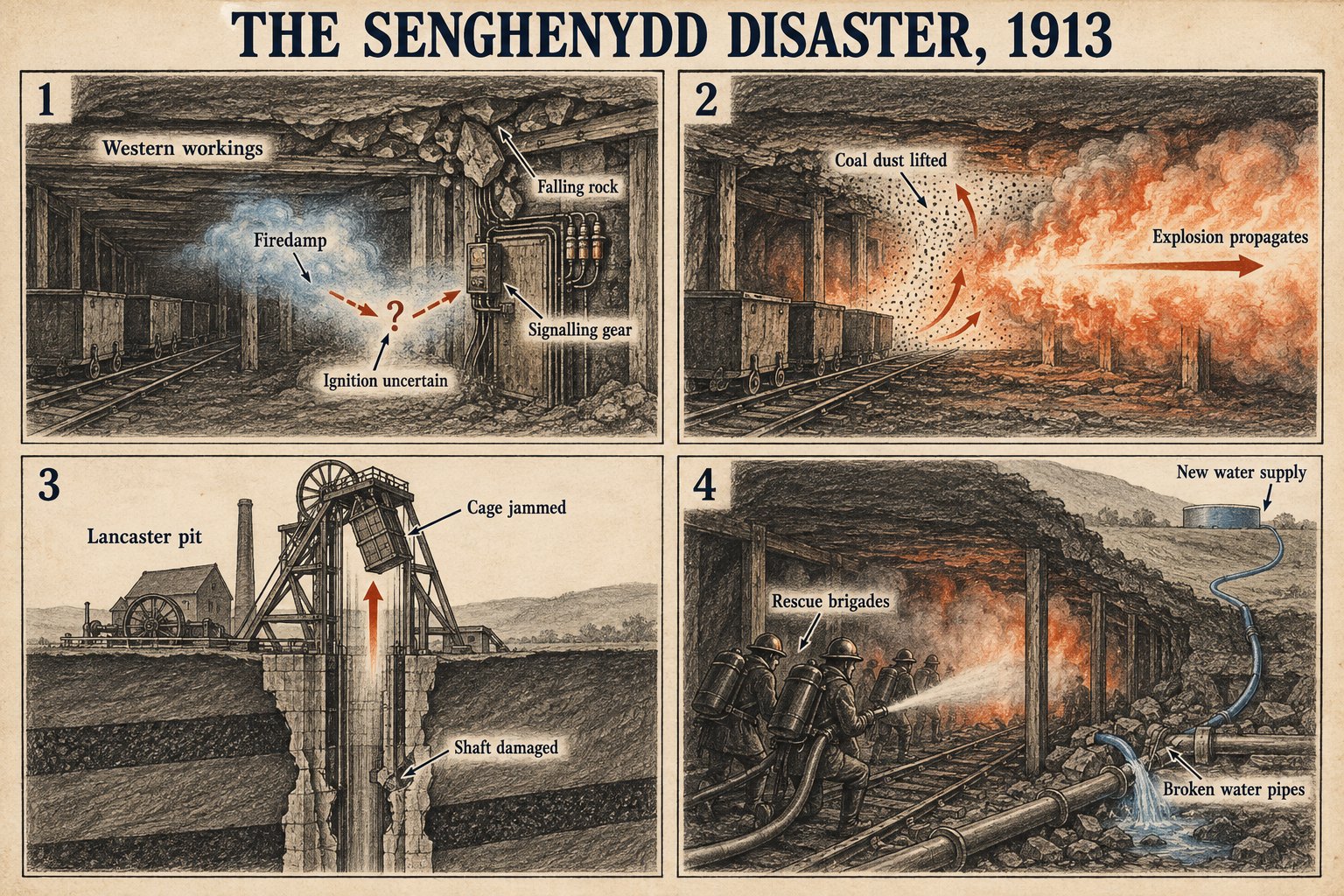
An official inquiry considered the most likely cause to have been a spark from underground signalling gear igniting a pocket of firedamp (methane), the resulting explosion then propagating through accumulated coal dust in the western workings. The Durham Mining Museum records the official attribution as firedamp ignited either by sparking from the electric signalling apparatus or by falling rock — the inquiry could not choose between them.
What happened
At around 8am on 14 October 1913 an explosion tore through Universal Colliery's western workings. The blast and the fires it started killed 439 men and boys outright or in the days that followed, plus one member of the rescue effort — 440 deaths in total, of whom 60 were under 20 years old. The disaster left 542 children fatherless and made 205 women widows.
945 men and boys had gone down for the day shift at six that morning. The explosion came at ten past eight, and its violence at the surface was the first sign of what had happened below: the cage in the Lancaster pit was blown back up the shaft and jammed in the winding gear at the pithead, and a banksman standing nearby was killed outright by a piece of flying timber. Underground the firedamp ignition raised the coal dust lying on the floor, which ignited in turn and raised more, so that the explosion fed itself along the workings; the fires that followed filled them with afterdamp, and men who had survived the blast were suffocated by it.
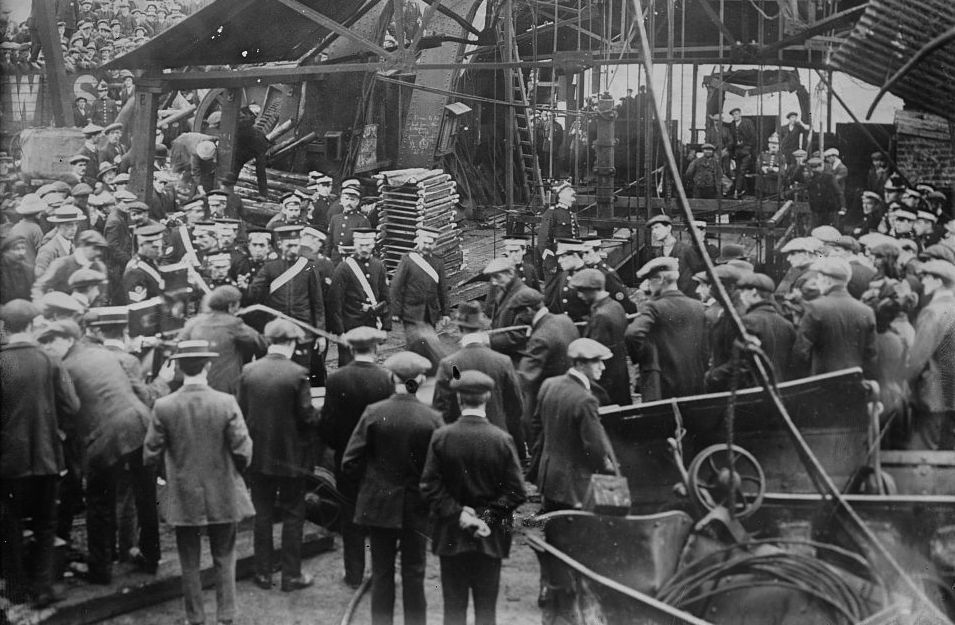
Work to clear the Lancaster shaft began at half past nine, and the first survivors were brought up at about the same time. The York pit was evacuated in good order and all 489 men in it were at the surface by two in the afternoon. By evening some 4,000 people were crowded into Senghenydd. At nine that night the mines inspectors Greenland Davies and P. T. Jenkins found fresh air entering No. 1 heading, which raised hope that the Bottanic district might have escaped the fire; a rescue party went down at quarter to ten, and at eleven eighteen men were found alive and brought out.
Rescue & recovery
Rescue teams from neighbouring collieries began arriving from 11am — the first brigade car from the Rhymney Valley at half past ten, Porth's brigade at eleven, then Aberdare's and Crumlin's — but fires severely hampered the effort: water pipes in the Lancaster shaft had fractured, forcing rescuers to fight the fires with hand extinguishers in 20-minute shifts until a new supply, piped in over 1.2km from a nearby reservoir, was ready by evening. One rescuer was killed by a roof fall. The last survivors were found around 1am the following morning. Recovery work continued until 30 November, hampered by roof falls and pockets of trapped firedamp; by 20 November officials had confirmed 439 dead with 33 still unaccounted for. Some of the bodies could be identified only by what they were wearing — one man by a new pair of boots worn for the first time that day, a boy by a patch his mother had sewn onto his jacket a few days before.
Investigation & inquiry
A formal inquiry, chaired by Chief Inspector of Mines Richard Redmayne with coal owner Evan Williams and miners' leader Robert Smillie, sat for 13 days between 2 January and 21 February 1914, putting 21,837 questions to 50 witnesses. It found that management had failed to fit ventilation fan upgrades required under the Coal Mines Act 1911, that coal dust removal and air-quality monitoring were inadequate, that firefighting water supplies were insufficient for a colliery already devastated by one explosion, and that respirators on site were inadequate. The report noted pointedly that a colliery this gassy, already once devastated by explosion, should have had water supplies adequate for exactly the emergency that occurred.
Legal & regulatory aftermath
Colliery manager Edward Shaw faced 17 charges under the Coal Mines Act and was convicted on two — failing to keep proper records and failing to replace a broken lamp locker — and fined £24. The colliery company was convicted on four charges and fined £10 plus costs. The Merthyr Pioneer newspaper calculated the fines worked out at little over a shilling per life lost, a comparison that became notorious. William Lewis, the colliery's owner, died in August 1914; Edward Shaw remained manager until the colliery closed in 1928.
The colliery itself was back at work by the end of November 1913, six weeks after the explosion, and at full production again by 1916. It was closed in March 1928 on one day's notice to the men and staff; Powell Duffryn later took the site over to ventilate their Windsor Colliery, and the Senghenydd shaft was finally filled in 1979. It was estimated that over a thousand people in the district had been bereaved.
Memorials & commemoration
A National Coal Board memorial — a 20-foot replica of the colliery's winding gear — was erected in 1981 outside Nant-y-Parc Primary School, built on the former colliery site. A further monument to both the 1901 and 1913 victims was unveiled in 2006, and on the centenary, 14 October 2013, Welsh First Minister Carwyn Jones unveiled a national memorial depicting a rescuer aiding a survivor.
Recorded claims
Individual factual claims, each attached to the source(s) that support it below. Where sources disagree, both are kept.
- The colliery manager was fined £24 and the company £10 plus costs — a total the Merthyr Pioneer newspaper calculated at little over a shilling per life lost. 1
- 945 men and boys descended for the day shift at 6am on 14 October 1913; the explosion came at 8.10am, and the Lancaster pit cage was blown up the shaft and through the headgear. 2
- All 489 men in the York pit were evacuated in an orderly fashion and brought to the surface by 2pm; at 11pm a further 18 men were found alive in the Bottanic district and brought out. 2
- The Durham Mining Museum records the official cause as an explosion of firedamp, 'ignition caused by sparking from electric signalling apparatus or from falling rocks', with 439 lives lost. 3
- Universal Colliery was back in use by the end of November 1913 and at full production by 1916; the men and staff were given one day's notice of closure in March 1928, and the shaft was filled in 1979. 4
Related terminology
Mining terms this disaster is structurally linked to, with the nature of the relationship.
- Afterdamp (contextual relationship)
Named in this record’s narrative: “…itself along the workings; the fires that followed filled them with afterdamp, and men who had survived the blast were suffocated by it. Work to…” - Banksman (contextual relationship)
Named in this record’s narrative: “…up the shaft and jammed in the winding gear at the pithead, and a banksman standing nearby was killed outright by a piece of flying timber.…” - Coal Mines Act 1911 (contextual relationship)
Prosecuted under this Act: the manager was convicted on eight charges and fined £24, the company on one and fined £10. - Firedamp (contextual relationship)
The inquiry's most likely explanation was a spark from underground signalling gear lighting a pocket of firedamp — a small ignition that accumulated coal dust then carried across the workings. - Roof Fall (contextual relationship)
Named twice in this record, first in the rescue and recovery: “…nearby reservoir, was ready by evening. One rescuer was killed by a roof fall. The last survivors were found around 1am the following morning.…”
Sources
- (secondary) Senghenydd colliery disaster — Wikipedia
- (secondary) Timeline of events on 14th October 1913 — Aber Valley Heritage Group
- (primary) Senghenydd Colliery (also known as Universal Colliery) — colliery record and names of those killed — Durham Mining Museum
- (secondary) 1913 Universal Colliery Disaster — Aber Valley Heritage Group / BBC Wales History
Record created: 22 August 2026 · Last researched: 5 September 2026