 MineArchive
Llanbradach Colliery
| Location | Llanbradach, Rhymney Valley, Caerphilly — 51.6100, -3.2311 (exact) |
|---|---|
| Commodity | Coal |
| Type | Coal |
| Worked | 1893–1961 |
| Maximum depth | No. 2 pit, 1,752 feet (584 yards). |
| Operators | Cardiff Collieries Company (1893–1947), National Coal Board (1947–1961) |
Overview
A large steam-coal colliery in the Rhymney Valley, sunk by the Cardiff Collieries Company from 1893 and worked through three shafts on a take that eventually reached 4,200 acres. It employed over 2,300 men before the First World War and reached peak output of 700,000 tons in 1935. An explosion in the No. 2 pit in September 1901 killed eight men and forty-one horses. The colliery closed in December 1961 despite having raised half a million tons of coal two years earlier.
History
The No. 1 pit, 1,711 feet deep and 17 feet in diameter, was completed in 1893 by the Cardiff Collieries Company; the No. 2 pit, 20 feet in diameter and 1,752 feet deep, followed in 1894. Ventilation was by a Guibal fan 40 feet in diameter and 12 feet wide, and by 1896, under the management of G. Bradford, the colliery was working the No. 3 Rhondda, Upper Four Feet, Six Feet and Nine Feet seams. A third shaft, sunk between November 1923 and May 1925 to 260 yards at a cost of £73,000, was added to work the Nos. 2 and 3 Rhondda seams as the colliery's house-coal pit.
Employment reached 2,330 by the outbreak of the First World War. A 1923 return records 757 men at the No. 1 pit working the Nine Feet and Four Feet seams, 1,297 at the No. 2 working the Four Feet and Six Feet, and 366 on the surface. Output peaked at 700,000 tons in 1935, and 1,506 men were still employed in 1945.
An explosion in the Pretoria district of the No. 2 pit on the evening of 10 September 1901 killed eight men — mostly ostlers and firemen preparing for a shift due down at six o'clock — and forty-one pit ponies (see Disasters, below). The Cardiff Collieries Company held the colliery until nationalisation in 1947, after which it passed to the National Coal Board. Although it produced 500,000 tons in 1959 it was placed on the closure list, and it closed in December 1961; the workforce was dispersed to other pits in the valley, including Wyllie.
Geology
The colliery worked the productive Coal Measures of the South Wales Coalfield on the eastern side of the field, where the steam-coal seams of the Middle Coal Measures — the Nine Feet, Six Feet and Four Feet — lie beneath the house-coal Rhondda seams of the Pennant succession. Both groups were reached from the same site, which is why the shallower No. 3 shaft could be sunk decades later for a different class of coal.
Workings
Three shafts on a take of some 4,200 acres. The No. 1 and No. 2 pits worked the steam coals — the Nine Feet, Four Feet, Six Feet and Upper Four Feet seams — while the No. 3 pit, sunk in the 1920s, worked the Nos. 2 and 3 Rhondda (Big and Little Rock) house-coal seams. The No. 2 pit served as the upcast, ventilated by a 40-foot Guibal fan.
Closure
Placed on the closure list despite an output of 500,000 tons in 1959, and closed in December 1961. Men were transferred to other collieries in the district, Wyllie among them.
What remains
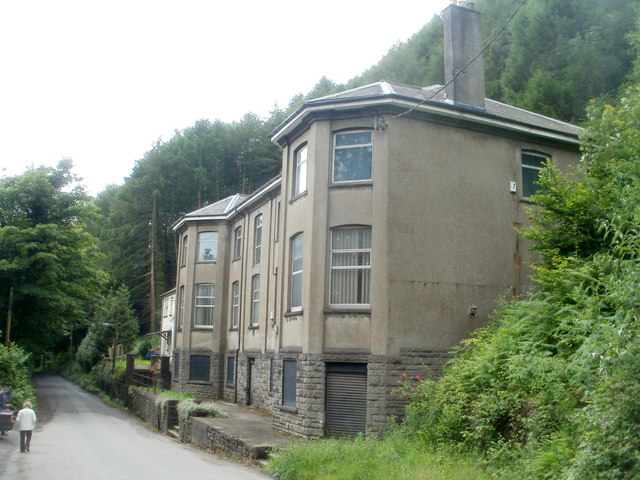
The colliery site has been cleared. Some of the former colliery offices survive in other use, a stretch of spoil remains above the village, and a memorial cairn to the men who worked and died there stands nearby.
Former colliery offices, colliery waste tips, and a memorial cairn.
Related mines
- Wyllie Colliery — When Llanbradach closed in December 1961 its workforce was dispersed to other pits in the Rhymney Valley, Wyllie among them.
Nearby mines
- Llanbradach Quarry — 0.9 miles (1.4 km) S
- Bryngwyn Colliery — 1.3 miles (2.1 km) SE
- Windsor Colliery — 1.7 miles (2.7 km) W
- Bedwas Navigation Colliery — 2.1 miles (3.3 km) SE
- Universal Colliery — 2.1 miles (3.4 km) W
Straight-line distance, within 9 miles (15 km). Show on the map.
Disasters & major incidents
-
Llanbradach Colliery cage accident, 1898
28 September 1898 · Winding / Shaft Accident · 2 fatalities
Two men were thrown out and killed at Llanbradach Colliery on 28 September 1898 when a cage of fifteen struck staging left jutting into the shaft at the Four Feet seam. -
Llanbradach Colliery roof fall, 1900
30 August 1900 · Collapse / Roof Fall · 2 fatalities
A collier and his fifteen-year-old boy were killed at Llanbradach Colliery on 30 August 1900 when the stone they were about to prop with a cog fell on them. -
Llanbradach Colliery Explosion, 1901
10 September 1901 · Explosion · 8 fatalities
An explosion in the Pretoria district of the No. 2 pit at Llanbradach Colliery on the evening of 10 September 1901 killed eight men and forty-one pit ponies. Only fourteen men were underground at the time — ostlers, firemen and repairers preparing for a shift due down at six o'clock. The inquest jury found that coal dust had been ignited by shot-firing at a place that had not been sufficiently watered.
What's uncertain
Points where sources disagree or the record could not be settled; both accounts are kept. All open questions in the archive.
- Welsh Coal Mines records 2,330 men employed at the outbreak of the First World War. A folklore account gives 2,832 by 1913; the two are not reconciled here. (uncertain) 1,2
Recorded claims
Individual factual claims, each attached to the source(s) that support it below. Where sources disagree, both are kept.
- The No. 1 pit was completed in 1893 at 1,711 feet deep and 17 feet in diameter; the No. 2 pit followed in 1894 at 1,752 feet and 20 feet in diameter. 1
- Output reached its peak in 1935 at 700,000 tons. 1
- Welsh Coal Mines records 2,330 men employed at the outbreak of the First World War. A folklore account gives 2,832 by 1913; the two are not reconciled here. (uncertain) 1,2
- The colliery produced 500,000 tons in 1959 but was nonetheless placed on the closure list, and closed in December 1961. 1
- The mineral take eventually reached 4,200 acres. 1
- The BGS and Mining Remediation Authority mine plans catalogue holds abandonment plans for Llanbradach, including a separate entry for Llanbradach No. 3. 3
Photographs & further reading
Shaft dimensions, seams worked, employment returns and output figures for the colliery, with a list of those killed in the 1901 explosion.
View sourceThe national monuments record entry for the colliery site, with grid reference and administrative details.
View sourceSources
- (secondary) Llanbradach Colliery — Welsh Coal Mines
- (observational) The Llanbradach Colliery and 'The Evil Omen' — Mysterious Britain & Ireland
- (primary) BGS mine plans catalogue: Llanbradach — British Geological Survey
Record created: 3 September 2026 · Last researched: 3 September 2026