 MineArchive
Horsekeeper
| Also known as | Fettler, Horse Fettler, Colliery Fettler, Ostler, Groom |
|---|---|
| Category | Labour & Roles |
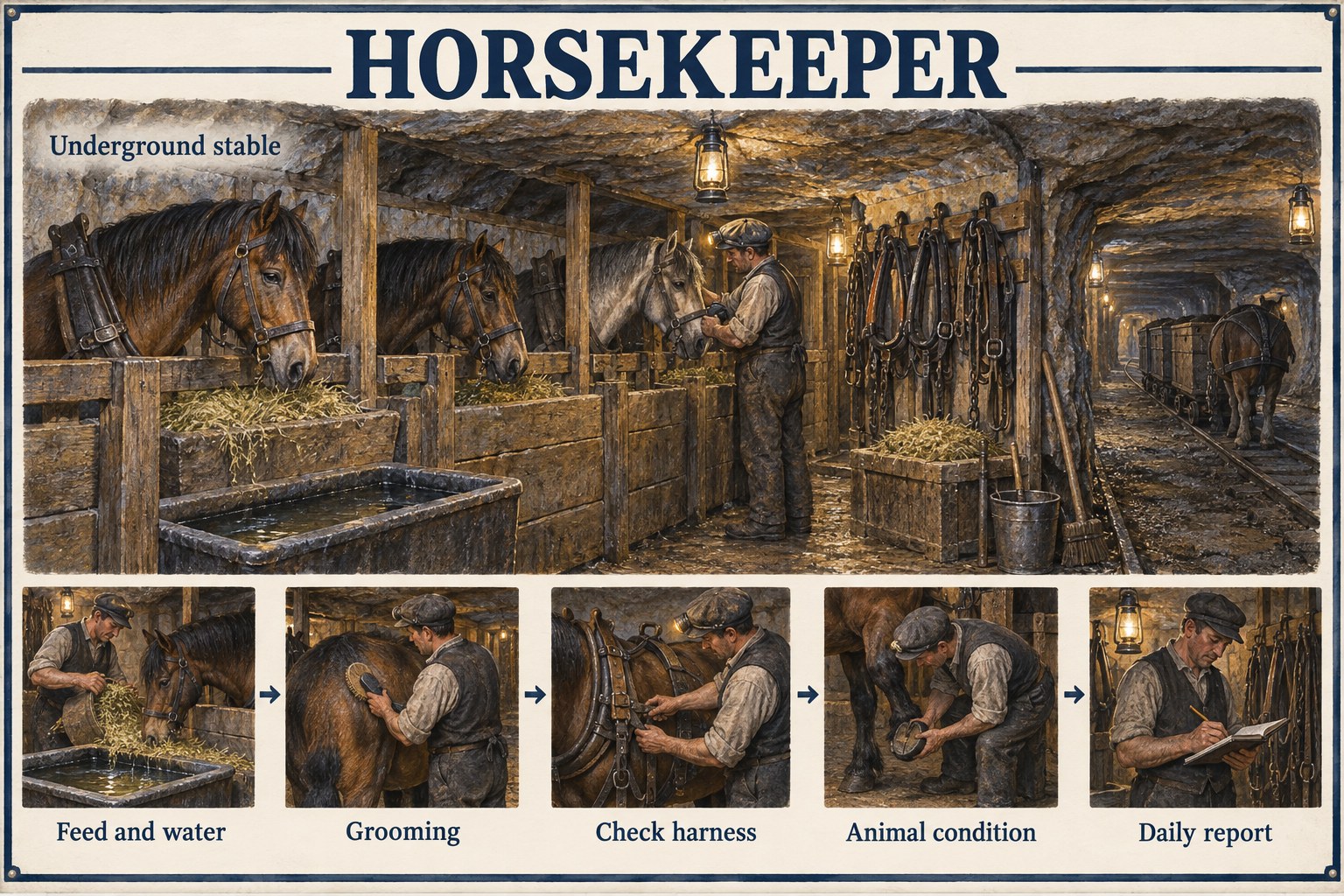
The worker responsible for feeding and grooming a mine's horses and ponies, above or below ground, and for keeping their harness in good repair and properly fitted.
Historical usage
The job is as old as underground haulage by animal and outlasted most of the rest of the hand-worked pit: ponies were still being used in British collieries into the 1990s. The glossaries record it under several names at once. Healey Hero gives hostler or ostler as the horsekeeper in charge of all the animals, borrowing the word straight from the coaching inn, and the North East glossaries separate the keeper from the driver, who took the horse and its train of tubs from the crane to the shaft, and from the driver on branches, who worked the stretch between the pit top and the engine plane. The Coal Mines Acts made the keeper's daily report on the animals a statutory return, so the role appears in colliery records in a way that most underground jobs of comparable rank do not.
How it worked
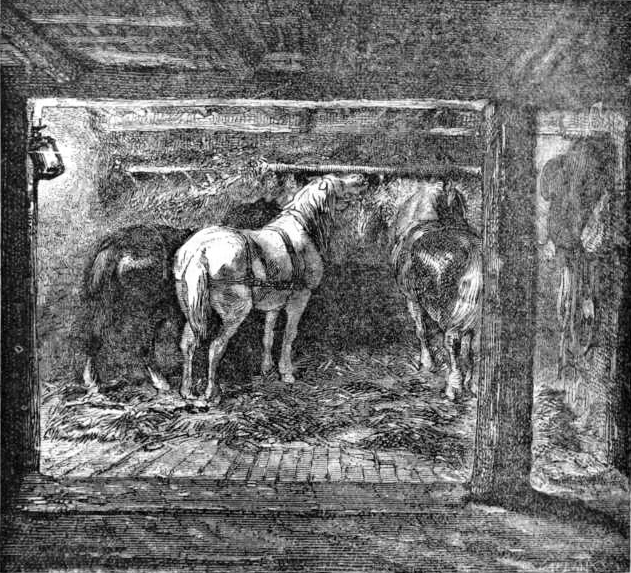
A horsekeeper fed and groomed the pit's horses and ponies, checked that harness was sound and correctly fitted before each shift, and made the formal reports on the animals' condition required under the Coal Mines Act. Where ponies were kept below ground rather than brought up at the end of each shift, the horsekeeper's workplace was an underground stable: a chamber cut in the rock with stalls along it, harness hung to hand, and fodder and water brought down the shaft like any other material. Keeping it clean and dry was part of the job, and so was noticing before anyone else did when an animal was going lame or off its feed.
Why it was used
Horses and ponies remained a mine's principal means of underground haulage long after steam and later electric winding had taken over on the main shafts, and their proper care -- both for the animals' own welfare and because an unfit or badly harnessed horse was a hazard to the men working with it -- was significant enough to be a statutory reporting duty, not just good practice.
Risks & limitations
An underground stable was a fire risk in a way little else below ground was: dry fodder, bedding straw and oil lamps in a confined chamber, sometimes near the shaft bottom where the intake air would carry smoke straight into the workings. The keeper also worked with animals in the dark, in roadways barely higher than the horse, and much of the routine injury in the job came from being crushed between a horse and the side, or caught by a run of tubs the horse had started. And the work was at its worst in an emergency: horses were difficult to get out of a pit quickly and were often left below when men were withdrawn.
Regional variation
Horse fettler is the North East and Shropshire word, ostler or hostler the more general one, and in Scottish pits the man was usually simply the stableman. The animals themselves were gallowas in the Durham glossaries, a word taken from the Galloway breed and applied to any pit pony.
Mines associated with this term
Included only where MineArchive's own research gives a reasonable evidential basis — not every mine where this might plausibly apply.
- Llanbradach Colliery — Caerphilly (well documented example)
Named in this record’s history: “…2 pit on the evening of 10 September 1901 killed eight men — mostly ostlers and firemen preparing for a shift due down at six o'clock — and…” - Prudhoe Colliery — Northumberland (well documented example)
Named in this record’s workings: “…repeatedly on it working loose. Ponies were used in-bye, with a horsekeeper on the strength. Shot firing was done with gunpowder charged into…” - Shipcote Colliery — Tyne and Wear (well documented example)
Named in this record’s history: “…killed holds eight names between 1860 and 1876, all single deaths: a horsekeeper run over by waggons on the incline, boys killed by tubs and by a…” - Waunllwyd Colliery — Blaenau Gwent (well documented example)
Named twice in this record, first in the summary: “…the underground stables in September 1879 killed a fireman and two ostlers, a father and his son, and sixteen horses, after an air door left…”
Disasters associated with this term
5 examples chosen from 9 linked records, most direct relationship first.
- Dunraven Colliery cage collision, 1918 (contextual relationship)
Named twice in this record, first in the summary: “…shaft at Treherbert on 10 March 1918, throwing a fireman and an ostler some 150 yards to the bottom.” - Fochriw Colliery explosion, 1870 (contextual relationship)
Named 3 times in this record, first in the summary: “…men were in the pit; the inquest found that doors left open by the ostlers had let gas collect and then carried it to the stable light.” - Llanbradach Colliery Explosion, 1901 (contextual relationship)
Named 3 times in this record, first in the narrative: “…having started there. The dead were William Henry Probert, ostler, 52; David William Evans, fireman, 31; Alfred Kemp, ostler, 33;…” - Llanerch Colliery Explosion, 1869 (contextual relationship)
Named in this record’s narrative: “…blown behind some timbers and had given himself up for lost when an ostler named James came past with a light and got him out. John Mitchell…” - Senghenydd colliery disaster, 1901 (contextual relationship)
Named twice in this record, first in the narrative: “…found no one alive. Among the bodies was that of William Harris, an ostler, lying beside his dead horse and burned about the head, face and…”
Sources
- (secondary) 047 — Other Workers Below Ground — Dictionary of Old Occupational Terms (DOOT)
- (secondary) A Glossary of Mining Terms — Coal Mining History Resource Centre
- (secondary) Kemberton Colliery Shaft Accident - Shifnal - 1901 — Northern Mine Research Society
- (secondary) Mining Terms — Scottish Mining Website
- (secondary) Pit Terminology — Healey Hero
- (secondary) Stable in a mine, from Bolles, Industrial History of the United States (1879) — Wikimedia Commons

Record created: 31 August 2026 · Last researched: 11 September 2026