 MineArchive
Senghenydd colliery disaster, 1901
Three underground explosions killed 81 miners at Universal Colliery as the night shift was leaving — an earlier disaster at the same colliery that struck again, far more severely, in 1913.
| Date | 24 May 1901 |
|---|---|
| Mine | Universal Colliery |
| Region | Caerphilly |
| Type | Explosion |
| Fatalities | 81 |
| Context | During active mining |
Cause
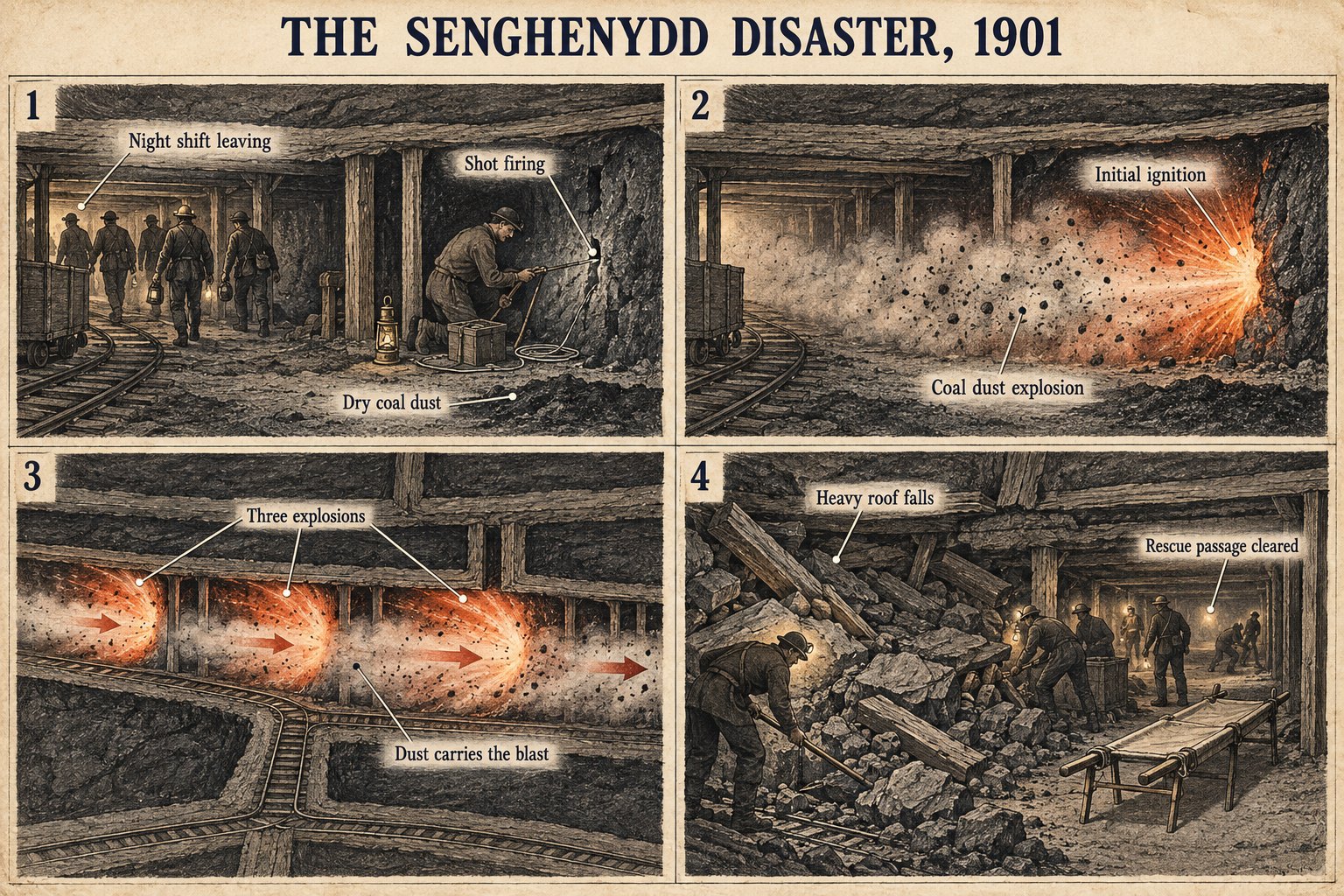
An inquiry led by mining engineer William Galloway found that excessive airborne coal dust had aggravated the initial ignition, propagating a chain of three explosions. The Durham Mining Museum records the official attribution as an explosion of coal dust, ignition caused by shot firing.
What happened
At about ten past five on the morning of 24 May 1901, as the night shift was making its way out of Universal Colliery, three explosions in quick succession swept through the workings, killing 81 men.
Rescue parties fought through heavy roof falls into the workings and found no one alive. Among the bodies was that of William Harris, an ostler, lying beside his dead horse and burned about the head, face and hands; the party took him for dead until Dr Burke, medical officer to Llanbradach Colliery, bent to examine him and he moved his arm and groaned. He was carried up, cleaned and treated in the lamp room and taken home swathed in bandages, with little expectation that he would live. The discovery electrified the rescuers, but no one else was found alive. Harris was the only survivor brought out of the pit.
Rescue & recovery
Rescue parties reached the workings through massive roof falls. Only one man, the ostler William Harris, was brought out alive. He recovered physically but was left badly disfigured about the hands and head and mentally confused, convinced for the rest of his life that he alone had had an accident underground and that no other men had been involved. He eventually went back to surface work at the nearby Windsor Colliery, bought a house in Senghenydd in 1908 with his wife Amy, raised six children, and died in 1936; he is buried at Penyrheol Cemetery, where the Aber Valley Heritage Group and his descendants unveiled a kneeler in his honour on the 121st anniversary of the disaster in 2022.
Investigation & inquiry
William Galloway's inquiry concluded that inadequate watering of the mine had allowed dangerous coal dust to accumulate, which propagated and intensified the explosions beyond what the initial ignition alone would have caused — the same underlying hazard, unaddressed, that contributed to the far larger 1913 disaster at the same colliery.
Recorded claims
Individual factual claims, each attached to the source(s) that support it below. Where sources disagree, both are kept.
- The Durham Mining Museum records the disaster as an explosion of coal dust at 5.10 a.m. on 24 May 1901, ignition caused by shot firing, with 81 lives lost. 1
- William Harris, an ostler, was found beside his dead horse, burned about the head, face and hands, and was taken for dead until Dr Burke of Llanbradach Colliery saw him move; he was the only man brought out of the pit alive. 2
- Harris recovered but was disfigured and mentally confused, convinced that he alone had suffered an accident underground and that no other men had been involved; he later returned to surface work at Windsor Colliery and died in 1936. 2
Related terminology
Mining terms this disaster is structurally linked to, with the nature of the relationship.
- Coal (contextual relationship)
Galloway's inquiry found excessive airborne coal dust had aggravated the first ignition and carried it on through a chain of three explosions. - Colliery (contextual relationship)
Named 4 times in this record, first in the summary: “Three underground explosions killed 81 miners at Universal Colliery as the night shift was leaving — an earlier disaster at the same…” - Horsekeeper (contextual relationship)
Named twice in this record, first in the narrative: “…found no one alive. Among the bodies was that of William Harris, an ostler, lying beside his dead horse and burned about the head, face and…” - Roof Fall (contextual relationship)
Named twice in this record, first in the narrative: “…the workings, killing 81 men. Rescue parties fought through heavy roof falls into the workings and found no one alive. Among the bodies was that…” - Shot-firing (contextual relationship)
Named in this record’s cause: “…attribution as an explosion of coal dust, ignition caused by shot firing.”
Sources
- (primary) Senghenydd Colliery (also known as Universal Colliery) — colliery record and names of those killed — Durham Mining Museum
- (secondary) William Harris — the sole survivor of the 1901 Universal Colliery disaster — Aber Valley Heritage Group
- (secondary) Senghenydd colliery disaster — Wikipedia
Record created: 22 August 2026 · Last researched: 5 September 2026