 MineArchive

Welsh National Mining Memorial, Senghenydd
| Category | Art |
|---|---|
| Dates | 1901: 81 killed at Universal Colliery. 14 October 1913: 439 killed. 1928: the colliery closes. 1981: first memorial. 2006: second memorial. 14 October 2013: National Mining Memorial unveiled. March 2024: registered by Cadw. |
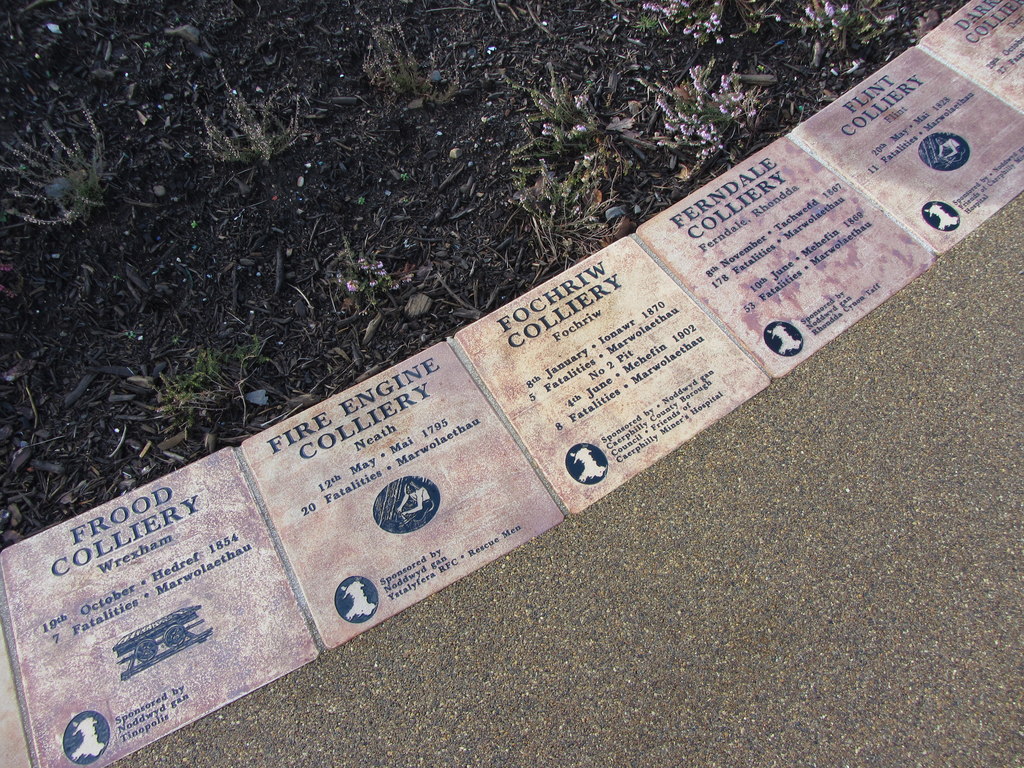
The Welsh National Mining Memorial at Senghenydd, unveiled on 14 October 2013, a hundred years after 439 men and boys died at the Universal Colliery. A bronze of one miner leading another to safety stands in a garden whose path of memory has a ceramic tile for each of Wales's 152 mining disasters.
The mining history in this record
The Universal Colliery at Senghenydd worked from 1893 to 1928. An explosion there in 1901 killed 81 men, and the explosion of 14 October 1913 killed 439, the worst disaster in British mining history. A memorial to both was unveiled at the gates of Nant-y-Parc Primary School in 1981, and another followed in 2006.
For the centenary the village made a national memorial. The project was led by the Aber Valley Heritage Group, formed in 2009, with Caerphilly Council, GAVO and Groundwork Caerphilly, and part-funded by villagers sponsoring the tiles of a memorial wall that gives the name, age and address of each of the Universal's dead. The tiles were made at community and school workshops in November 2012, led by the Chepstow ceramic artists Ned Heywood and Julia Land with every primary school in the valley. The bronze sculpture by Les Johnson, 'The Rescue', shows a miner leading another to safety. Around it Stephanie Wilkins laid out a garden with a wall of remembrance and a path of memory, in which a ceramic tile records each of the 152 mining disasters in Wales, its date and its dead. It was unveiled on 14 October 2013.
People
Les Johnson, sculptor. Stephanie Wilkins, landscape architect. Ned Heywood and Julia Land, ceramic artists.
Legacy today
In March 2024 Cadw registered the garden at Grade II as a park and garden of special historic interest, describing it as an important site of public commemoration and memory. The same month the Welsh Government recognised it as the National Mining Disaster Memorial Garden of Wales.
Recorded claims
Individual factual claims, each tagged with how solidly it's grounded and attached to the source(s) that support it. Where sources disagree, both are kept.
- The National Mining Memorial was unveiled at Senghenydd on 14 October 2013, the centenary of the Universal Colliery disaster. (documented fact) 1,2,3
- It commemorates the 439 killed at Universal Colliery in 1913 and the 81 killed in 1901, and the dead of all 152 mining disasters in Wales. (documented fact) 1,3
- Its bronze sculpture by Les Johnson shows a miner leading another to safety; the garden, by Stephanie Wilkins, has a remembrance wall and a path of memory with a ceramic tile for each disaster. (documented fact) 1,3
- Earlier memorials to the Universal Colliery disasters were unveiled in 1981, at the gates of Nant-y-Parc Primary School, and in 2006. (documented fact) 1,2
- In March 2024 Cadw added the garden at Grade II to its Register of Parks and Gardens of Special Historic Interest in Wales. (documented fact) 1
- The central bronze, 'The Rescue', was designed and made by Les Johnson; the ceramic name tiles of the memorial wall were made at community and school workshops in November 2012 led by Ned Heywood and Julia Land of Chepstow, with all the Aber Valley primary schools, and the pavers recording each Welsh colliery disaster were made in their workshop. (documented fact) 4,5
- The memorial was developed by the Aber Valley Heritage Group, formed in 2009, with Caerphilly Council, GAVO and Groundwork Caerphilly; tiles on the Universal Memorial Wall give the name, age and address of each victim, and the community sponsored them to match-fund the landscaping. (documented fact) 5
- In March 2024 the Welsh Government recognised the garden as the National Mining Disaster Memorial Garden of Wales. (documented fact) 4
Mines
- Universal Colliery — Caerphilly
The memorial garden stands at Senghenydd for the 1901 and 1913 Universal Colliery disasters and for every mining disaster in Wales.
Disasters
- Senghenydd colliery disaster, 1901 — 24 May 1901
- Senghenydd colliery disaster, 1913 — 14 October 1913
Real-world mining concepts used here
Sources
- (secondary) Welsh National and Universal Mining Disaster Memorial Garden — Wikipedia
- (secondary) National Mining Memorial, Senghenydd — People's Collection Wales
- (secondary) Welsh National and Universal Mining Memorial Garden, Senghenydd — Visit Caerphilly
- (secondary) Welsh National and Universal Mining Disaster Memorial Garden, Senghenydd — Aber Valley Heritage Group
- (secondary) National Mining Memorial and Memorial Garden (Aber Valley Heritage, Caerphilly County Borough Council; Internet Archive capture of 23 July 2019) — Caerphilly County Borough Council
Record created: 4 October 2026 · Last researched: 4 October 2026