 MineArchive
Snaefell Mine disaster
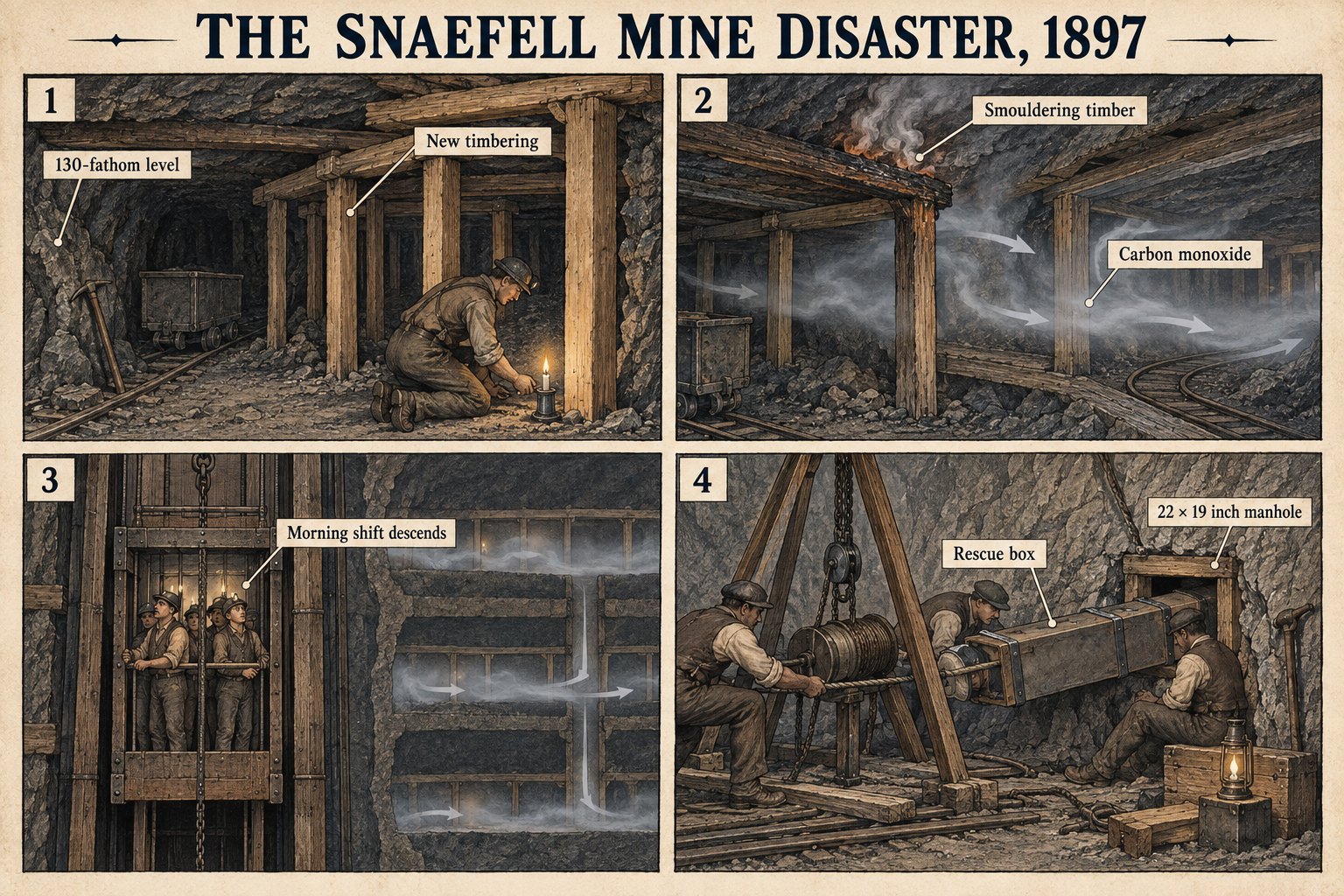
Timber left smouldering underground filled the mine's shafts with carbon monoxide; miners descending on the morning shift were overwhelmed before they realised the danger. Sources give the death toll as 19-23.
| Date | 10 May 1897 |
|---|---|
| Mines involved | Snaefell Mine, Foxdale Mines (related workings) |
| Region | Isle of Man |
| Primary type | Gas / Asphyxiation |
| Associated types | Fire, Rescue |
| Fatalities | 20 (Wikipedia's detailed account, drawing on named victim records, gives 20 dead; some secondary accounts (e.g. oldminer.co.uk) instead say 19 — kept here as the better-sourced figure rather than silently picking a round number.) |
| Context | During active mining |
Cause
New support timbers had been installed at the 130-fathom level; candles left burning nearby are thought to have set them smouldering. The smoke produced was rich in carbon monoxide, an odourless gas that gave victims no warning before it overcame them — contemporary investigator Dr Haldane found the concentration in the mine could disable a person within seven to eight minutes.
What happened
On the morning of 10 May 1897, a shift of 35 men descended into Snaefell Mine unaware that timber left smouldering underground had filled the workings with carbon monoxide. Several men managed to climb back out, exhausted and reporting foul air, but many more were overcome before they could escape. Rescue efforts continued through the day, using a specially built box to haul survivors out through manholes only 22 by 19 inches across. Recovering the dead took several more days and proved extremely dangerous: one rescuer, Mr Williams, lost consciousness while collecting gas samples at 115 fathoms. Captain W.H. Kitto and a party of volunteers from the Foxdale Mines arrived to help with the recovery; another Foxdale man, Mr H. Wynne-Finch, also lost consciousness during the operation. The disaster left fourteen widows, thirty orphans, and two widowed mothers who had depended on sons among the dead.
Investigation & inquiry
The inquest could not establish exactly how the timber caught alight, but its jury recommended using non-flammable timbers underground, mechanical lifting systems, inspections before each shift, and permanent improvements to ventilation.
What's uncertain
Points where sources disagree or the record could not be settled; both accounts are kept. All open questions in the archive.
- The Northern Mine Research Society gives a death toll of 23; other secondary accounts give 19-20. (disputed) 1
Recorded claims
Individual factual claims, each attached to the source(s) that support it below. Where sources disagree, both are kept.
- The Northern Mine Research Society gives a death toll of 23; other secondary accounts give 19-20. (disputed) 1
- Captain W.H. Kitto led a party of volunteers from the Foxdale Mines to assist with body recovery; one of them, H. Wynne-Finch, also lost consciousness during the operation. 1
Related terminology
Mining terms this disaster is structurally linked to, with the nature of the relationship.
- Afterdamp (direct cause)
Smouldering support timbers filled the workings with carbon monoxide; investigator Dr Haldane — later responsible for introducing mine-rescue canaries against exactly this gas — examined the disaster and measured how quickly it could disable a person. - Bad Air (contextual relationship)
Several men climbed back out exhausted, reporting foul air, but the shift below them was already being overcome — carbon monoxide from smouldering timber, invisible and without warning. - Captain (contextual relationship)
Captain W.H. Kitto led the volunteer recovery party from the Foxdale Mines during the 1897 disaster, a direct example of a captain's role in an emergency. - Fathom (contextual relationship)
The smouldering timbers that filled the mine with carbon monoxide were at the 130-fathom level, depth on the Isle of Man being reckoned in fathoms as in Cornwall. - Level (contextual relationship)
New support timbers had just been installed at the 130-fathom level, and candles left burning beside them are thought to have set them smouldering.
Sources
- (secondary) Snaefell Lead Mine Accident - Laxey - 1897 — Northern Mine Research Society
- (secondary) Snaefell Mining Disaster 1897, Isle of Man — Transceltic
Record created: 20 August 2026 · Last researched: 20 August 2026