 MineArchive
Udston Colliery explosion, 1887
| Date | 28 May 1887 |
|---|---|
| Mine | Udston Colliery |
| Region | South Lanarkshire |
| Primary type | Explosion |
| Associated types | Rescue |
| Fatalities | 73 (The dead are listed by section in Moore's report: the Blantyre, Rise, Horse Road and Horse Road Stoops sections, the stables, the sump and the Dook. Among them were fathers and sons: the McCullochs, the Shanks, the Cooks and the Lawsons.) |
| Injuries | The Splint oversman was slightly burned in the shaft; the number of other injured is not recorded in the sources read. |
| Context | During active mining (A Saturday morning shift at the Udston Coal Company's pit near Hamilton: 184 men and boys had gone down, 73 of them into the Splint Coal.) |
At about nine o'clock on Saturday 28 May 1887, as men were breaking for food, an explosion swept through the Splint Coal workings of Udston Colliery near Hamilton, sending flame up both shafts. Seventy-three men and boys died, 53 burned and 20 suffocated; only two men and a pony driver in the Splint survived. H.M. Inspector Ralph Moore blamed a shot fired in secret that ignited gas and then coal dust. It is said to be Scotland's second worst coal mining disaster, and Keir Hardie called the deaths murder.
Cause
A small quantity of firedamp ignited, most probably by an unauthorised shot or an open light, which raised and fired coal dust so that flame traversed the whole Splint seam. Moore and the formal inquiry differed on where it began.
Contributing factors
The formal inquiry criticised the safety lamps, some unable to withstand the air currents, and their perfunctory examination; the failure to replace an assistant fireman; stoppings placed in the middle of the horse road workings; and rooms left uncompleted with brattice contracting the air. Open lights were used near the downcast shaft; illegal shot firing had been prosecuted months before; lamp keys and matches were found on the dead.
What happened
The three seams, the Ell, Main and Splint, were worked stoop and room from two oblong shafts 45 yards apart, ventilated by a 20-foot Guibal fan. A cloud of dust and smoke shot out of the downcast and, a second later, flame came up the upcast and set the pithead shed alight; it was put out with the hose in about ten minutes, and the fan kept running. One cage stuck in the downcast; the other came up with the assistant pit-bottomer McGuirk dead in it. The Ell and Main were undamaged and everyone in them was out by three in the afternoon, but four men were found suffocated near the shaft in the Main. The sound was heard in neighbouring Greenfield Colliery, and at Blantyre, where some two hundred had died ten years earlier, men were blinded by the dust.
Rescue & recovery
James Gilchrist of Earnock, the manager James Gavin and others brought up men who had climbed the buntons, and a joiner's party repaired the shaft down to the Ell and Main. Below the Main the shaft was too damaged for the cage, so Daniel McPhail, John McBride and Boyd were lowered in an iron kettle and crept over debris into the Splint; neighbouring managers followed. McLean, a pony driver, was found alive in the lamp cabin and the bottomer James Lang at the third opening on the west level; everyone else in the seam, and all the horses, were dead. By 31 May all but three bodies, later found under falls, had been recovered.
Investigation & inquiry
Ralph Moore reported to the Home Secretary that it was a dust explosion begun by a surreptitious shot, 'another argument in favour of the abolition of the use of explosives in all fiery and dusty mines'. A formal inquiry by J. Dickinson, H.M. Inspector, and C. C. Maconochie, advocate, criticised the management on several points, found some miners had contravened the Act by carrying lamp keys and matches and opening lamps, and found no contravention proved against the officials.
Legal & regulatory aftermath
Keir Hardie, then secretary of the Scottish Miners' Federation, denounced the deaths as murder.
Memorials & commemoration
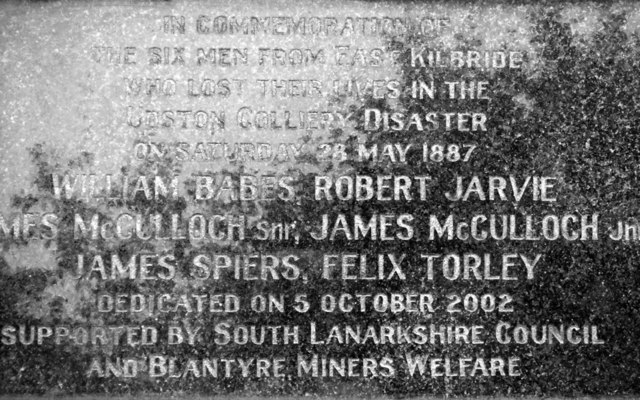
In December 2001 South Lanarkshire Council placed a plaque on the miner's statue outside the Brandon Gate offices in Hamilton, and in 2002 a plaque to the six East Kilbride men who died was unveiled in the memorial garden at Priestknowe roundabout, East Kilbride.
Recorded claims
Individual factual claims, each attached to the source(s) that support it below. Where sources disagree, both are kept.
- Seventy-three died: one in the downcast shaft, four in the Main Coal near the shaft and the rest in the Splint; Dr Robertson certified 53 burned and 20 suffocated. 1,2
- A watch on the body of the fireman Alexander Torley had stopped at 9.07 a.m., and Wikipedia gives the explosion as about 9.07. (disputed) 1,2
- The NMRS account gives the time as about 9.15 a.m. (disputed) 1
- H.M. Inspector Ralph Moore concluded it was a coal dust explosion started when a shot fired surreptitiously ignited a little gas, probably in the Rise section at Dennison's place. (disputed) 1,2
- The inquiry by J. Dickinson and C. C. Maconochie found it most likely began in the stooping of the West or Blantyre section, or at Harkness's shot in the east, from firedamp ignited at an open light, a match or through a Scotch lamp gauze, reinforced by gas and dust. (disputed) 1
- Keys and nails for opening safety lamps, and matches, were found in the pockets of several of the dead, and the inquiry found some miners guilty of contravening the Act by opening lamps. 1
- Keir Hardie, secretary of the Scottish Miners' Federation, denounced the deaths as murder a few days later. 2
- A plaque dedicated on 5 October 2002 commemorates six East Kilbride men killed: William Babes, Robert Jarvie, James McCulloch senior and junior, James Spiers and Felix Torley. 2,3
Related terminology
Mining terms this disaster is structurally linked to, with the nature of the relationship.
- Brattice (contributing factor)
Uncompleted rooms with brattice contracted the air. - Chokedamp (hazard involved)
Men in the Main Coal died of chokedamp from the Splint. - Firedamp (direct cause)
A small quantity of gas fired first. - Naked Light (contributing factor)
Open lights were used near the downcast shaft. - Room and Pillar (contextual relationship)
The seams were worked stoop and room. - Safety Lamp (contributing factor)
Lamp keys were found on the dead; some lamps could not withstand the currents. - Shot-firing (direct cause)
Moore blamed a shot fired surreptitiously.
Photographs & further reading
This page doesn't try to reproduce everything — these are the best original sources found for this disaster.
Overview with Moore's conclusion, Keir Hardie's reaction and the memorials.
View sourceSources
- (secondary) Udston Colliery Explosion - Hamilton - 1887 — Northern Mine Research Society (information supplied by Ian Winstanley and the Coal Mining History Resource Centre)
- (secondary) Udston mining disaster — Wikipedia
- (observational) Udston Colliery Disaster Memorial in East Kilbride (Geograph 905283, Willie Mair) — Geograph Britain and Ireland
Record created: 10 September 2026 · Last researched: 13 September 2026