 MineArchive
Checkweighman
| Also known as | Check Weigher (The form the Midlands pit glossaries use.), Checkweigher (A common spelling of the same office.), Checkmeasurer (Used where the men were paid by measure rather than weight.), Justiceman (Scottish) |
|---|---|
| Category | Labour & Roles |
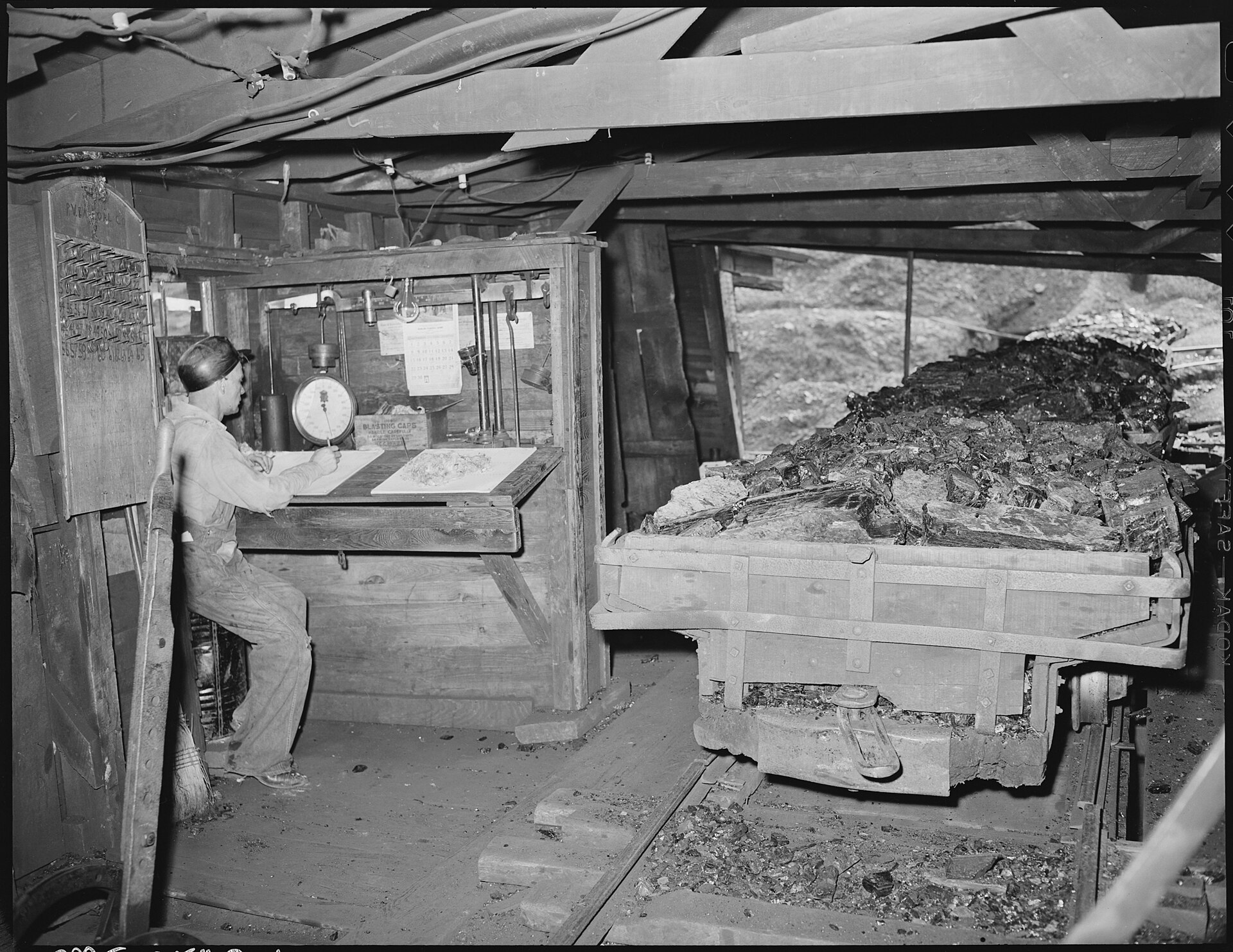
A weigher employed and paid by the workmen themselves to stand at the colliery weighing machine beside the company's weigher and keep his own account of every tub, so that men paid by the weight of coal they sent out were paid for what they had actually sent.
Historical usage
Where men are paid by weight and the weighing happens out of their sight, the whole wage rests on trust. Coal was filled underground and could not be weighed until it reached the surface, and company weighers were accused of weighing light and of working scales they knew to be wrong. Some companies simply redefined the unit: one account from the Nottinghamshire coalfield records miners being made to produce up to three thousand pounds to the 'ton' against the 2,240 pounds a ton actually holds, the company arguing that wet coal would weigh lighter once it dried. From the middle of the nineteenth century the miners' unions pressed for the weigher to be their own man, elected and paid by them. The right was won in the United Kingdom, and later strengthened so that a company could no longer simply dismiss a checkweighman it disliked. It was work for a man who was literate and good at reckoning, usually a union man, and because he was elected and trusted the post became a route into union office and politics: Herbert Smith at Glass Houghton, Robert Smillie at Summerlee, Noah Ablett and Arthur Horner at Mardy, William Lunn at Middleton. British checkweighmen were also given the right to act as inspectors of mines, which added to the power of the office. In the larger pits there were several checkweighmen, able to check each other as well as the company. The post died with piece work. As coal cutting was mechanised in the 1950s and both coal and dirt were loaded out together by trepanner and shearer, and as men came onto fixed wages rather than tonnage, there was nothing left for a checkweighman to check.
How it worked
Tubs came off the cage at the surface and were run onto the weighing machine before going to the tippler and the screens. Each tub carried its owner's mark — a chalked number or a metal tally — and two men sat in a cabin at the weighing machine, one for the workmen and one for the company, each entering the weight against that number in his own book. At the end of the shift the two books were compared and a total agreed. The weight of the empty tub was deducted to give the coal. Only coal was paid for: dirt was not, and a tub found to contain any could be confiscated outright — before nationalisation a tub was occasionally tipped and examined for the purpose.
Why it was used
It was cheaper for the men to pay a wage out of their own pockets than to accept the company's arithmetic. The checkweighman is one of the few pieces of industrial machinery the workforce bought and installed itself, and the only one whose entire function was to watch the employer.
Risks & limitations
Until the law protected the post, an elected checkweighman could be discharged by a company that disliked him, which undercut the independence the election was supposed to give. The office also depended on the tub being identifiable: the same chalked marks and tallies that told the weigher whose coal he was weighing could be switched, and the Scottish coalfield had a word for doing it — 'hutch pinning', substituting one's own tally for another man's on a better-loaded hutch.
Regional variation
Called a check weigher in the Midlands glossaries, and a 'justiceman' in Scotland. The landlord had his own mirror-image official in Scotland, the 'check grieve', who checked the weight of mineral on behalf of the lessor rather than the men, as the English 'check viewer' watched the terms of the lease.
Mines associated with this term
Included only where MineArchive's own research gives a reasonable evidential basis — not every mine where this might plausibly apply.
- Maerdy Colliery — Rhondda Cynon Taf (well documented example)
Named in this record’s history: “…resume until late 1927. The Communist Arthur Horner was elected checkweighman at the pit in absentia while imprisoned for refusing conscription in…” - Gelli Colliery — Rhondda Cynon Taf (well documented example)
Colliers at Gelli were paid by the tram, each chalking his own mark on it before it was weighed at the surface and a numbered ticket issued. - Speedwell Colliery, Staveley — Derbyshire (well documented example)
Named in this record’s history: “…as a door-trapper, later becoming a driver; he went on to be checkweighman at Ireland Colliery and president of the Derbyshire Miners'…”
Sources
- (secondary) Checkweighman — Wikipedia
- (secondary) Glossary of mining terms (C) — Apedale Heritage Centre / North Staffordshire Mining Group
- (secondary) Pit Terminology - Glossary — Sutton-in-Ashfield (pit terminology glossary)
Record created: 24 September 2026 · Last researched: 24 September 2026