 MineArchive
Maerdy Colliery
| Location | Maerdy, Rhondda Fach, Rhondda Cynon Taf — 51.6874, -3.5001 (exact) |
|---|---|
| Commodity | Coal |
| Type | Coal |
| Worked | 1875-76–21 December 1990 |
| Maximum depth | 1,155ft (Nos. 1 and 2 pits) |
| Operators | Locket's Merthyr Steam Coal Company (1879–1932) |
Overview
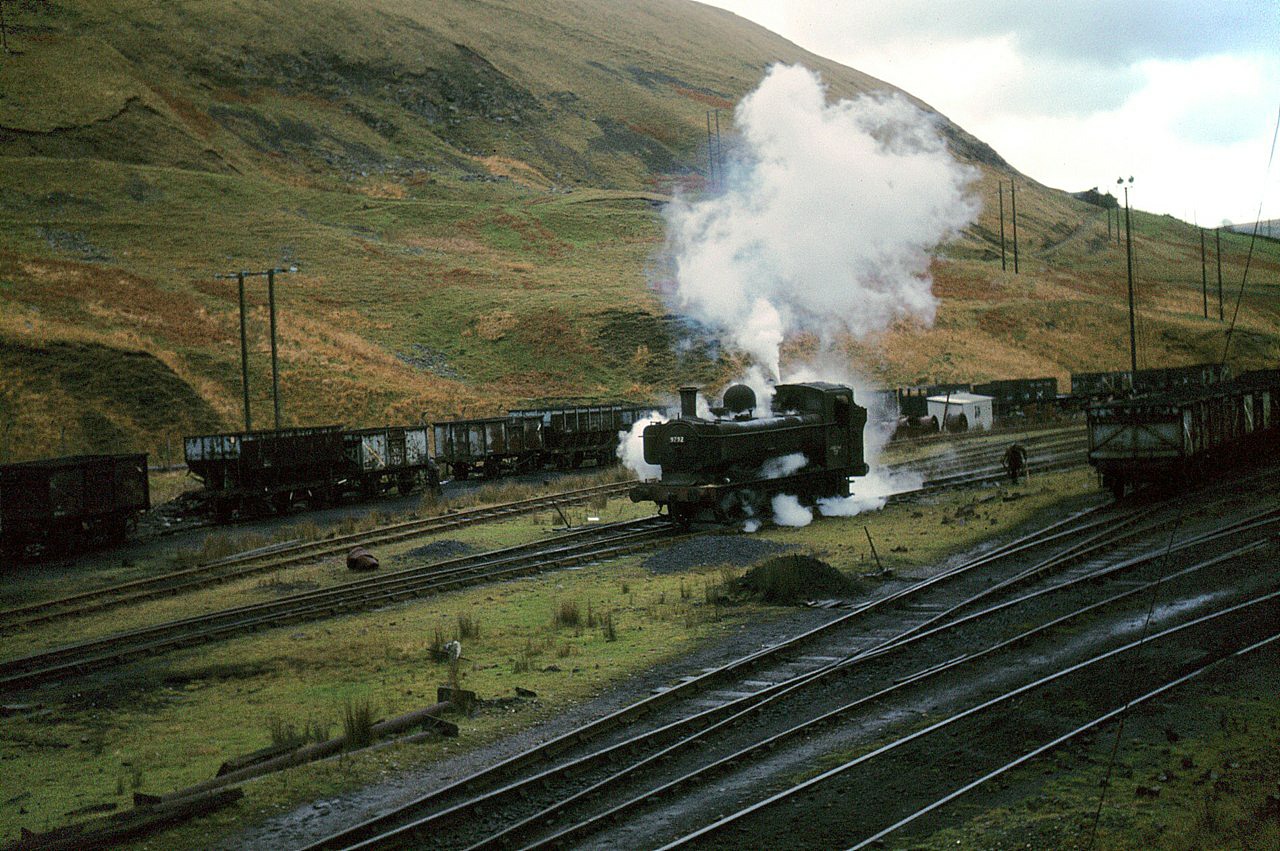
A colliery at the head of the Rhondda Fach valley, sunk 1875-76 and worked for 115 years until closure in December 1990, the last working deep colliery in the Rhondda. It became nationally known as 'Little Moscow' for the communist and militant politics of its miners' lodge from the late 1920s onward, and suffered a major explosion in December 1885 that killed around 76-81 men.
History
The mineral rights, 999 acres, were bought in 1873 by Mordecai Jones and J. R. Wheatley Cobb for £122,000. Nos. 1 and 2 pits were sunk 1875-76, reaching the Abergorchi seam in 1876 at a depth of 1,155ft, and first raised commercial coal in 1877, carried out on a new branch of the Taff Vale Railway. The pits were deepened in 1878 to reach steam coal, and the colliery was leased to Locket's Merthyr Company around 1879-80, under which it prospered; the company was formally incorporated as Locket's Merthyr Steam Coal Company in 1894. Electric pumps were installed underground in 1881, possibly the first in South Wales. No. 3 pit was sunk in 1893 and No. 4 alongside it in 1914, initially as an upcast shaft before being deepened to the Bute seam. A major explosion struck the colliery in December 1885 — see Disasters, below.
Ownership passed from Locket's Merthyr Company through Bwllfa and Cwmaman Collieries Ltd/Welsh Associated Collieries (from 1932), Powell Duffryn Associated Collieries Ltd (from 1935), and finally the National Coal Board on nationalisation in 1947. The colliery became famous nationally as 'Little Moscow' after its miners' lodge, radicalised by the 1926 General Strike and lock-out, was suspended from the South Wales Miners' Federation and then expelled in 1930; production did not fully resume until late 1927. The Communist Arthur Horner was elected checkweighman at the pit in absentia while imprisoned for refusing conscription in the First World War, a detail that fed directly into the village's reputation. That radicalism carried through to the 1984-85 miners' strike, when the pit was shut for the full year of the dispute — only two token picket lines were ever needed at Maerdy itself, since no Maerdy miner would cross a picket line — and Maerdy miners' wives organised the first women's support groups in South Wales, running food distribution and picketing. Workers returned to work on 5 March 1985, marching behind their union banners and the colliery band.
By the time of closure the workforce had fallen from a 1963 peak of 1,576 to just 300 men, of whom only 17 transferred to other pits. The final shift went down on 21 December 1990: miners collected souvenir coal samples, carols were sung in the canteen, and a wake was held at Maerdy Welfare Hall with the Tylorstown silver band playing The Internationale, a deliberate final note on the colliery's political identity. Maerdy's closure ended 115 continuous years of deep mining in the Rhondda Fach, making it the last working colliery in the Rhondda. The site was cleared in March 1996 and a factory was built on it, later operated by the Avon Group producing rubber components.
Geology
Coal of the South Wales field at the head of the Rhondda Fach: the Abergorchi seam at 1,155 feet in 1876, with a later shaft deepened to the Bute seam.
Workings
Seams worked over the colliery's life included the Abergorchi, Bute, Gorllwyn, Gellideg, Yard, Nine-Feet, Seven-Feet, Six-Feet, Four-Feet, Two-Feet-Nine and Five-Feet; the Five-Feet seam was the target of a major 1949 National Coal Board investment aimed at an estimated 100 million tons of reserves. No. 3 pit was sunk to 500 yards, originally wound from the Bute seam at 428 yards. From 30 June 1986 Maerdy operated as an integrated system with the neighbouring Tower Colliery.
Closure
The pit was shut for the full year of the 1984-85 dispute and closed in 1990.
What remains
No deep-mine structures survive on the colliery site itself, cleared in March 1996 and now occupied by a factory. A colliery memorial stands in Maerdy Park.
Related mines
- Tower Colliery — Maerdy operated as an integrated system with Tower Colliery from 1986.
Nearby mines
- Fforchwen Colliery — 1.5 miles (2.5 km) E
- Bwllfa Dare Colliery — 1.7 miles (2.7 km) N
- Ynysfeio Colliery — 1.7 miles (2.7 km) SW
- Abergorki Colliery — 1.8 miles (2.9 km) S
- Cwmaman Colliery — 1.8 miles (2.9 km) E
Straight-line distance, within 9 miles (15 km). Show on the map.
Disasters & major incidents
-
Maerdy Colliery explosion, 1885
23 December 1885 · Explosion · 76 fatalities
An explosion in the North West dip workings at Maerdy Colliery on 23 December 1885 killed around 76-81 men, with roughly 750-961 men underground at the time.
Culture
- Little Moscow: Maerdy (Labour)
The name 'Little Moscow' came from the communist politics of the Mardy Colliery miners' lodge from the 1920s to the 1984-85 strike.
Recorded claims
Individual factual claims, each attached to the source(s) that support it below. Where sources disagree, both are kept.
- The mineral rights were bought in 1873 for £122,000; Nos. 1 and 2 pits were sunk 1875-76 to 1,155ft, reaching the Abergorchi seam in 1876 and raising first commercial coal in 1877. 1
- The miners' lodge was suspended from the South Wales Miners' Federation and expelled in 1930 after militancy following the 1926 lock-out; Communist Arthur Horner was elected checkweighman in absentia while imprisoned, and the pit was fully shut throughout the 1984-85 strike with only two token picket lines ever needed. 2
- The final shift went down on 21 December 1990 with only 300 miners remaining, of whom just 17 transferred to other pits, ending 115 continuous years of deep mining in the Rhondda Fach as the last working colliery in the Rhondda. 2,1
- The colliery site was cleared in March 1996 and a factory, later operated by the Avon Group producing rubber components, was built on it. 2,1
Sources
- (secondary) Mardy Colliery — Northern Mine Research Society
- (secondary) Mardy Colliery — Wikipedia
Record created: 26 August 2026 · Last researched: 26 August 2026