 MineArchive
Bwllfa Dare Colliery
| Location | head of Cwmdare, Rhondda Cynon Taf — 51.7111, -3.4921 (exact) |
|---|---|
| Commodity | Coal |
| Type | Coal |
| Worked | 1853–1977 |
| Maximum depth | Two shafts, each around 200 yards (180 metres) deep. |
| Operators | Sam and Joseph Thomas (1853–1857), Ebenezer Lewis (1857–1873), Brogden and Sons (1871–1891), Bwlfa and Merthyr Dare Coal Company (1876–1935), Powell Duffryn (1935–1977) |
Overview
A Cwmdare colliery sunk in 1853 by Sam and Joseph Thomas, worked through six operator changes over more than a century, and retained as an escape shaft for the neighbouring Mardy Colliery for over a decade after its own 1977 closure.
History
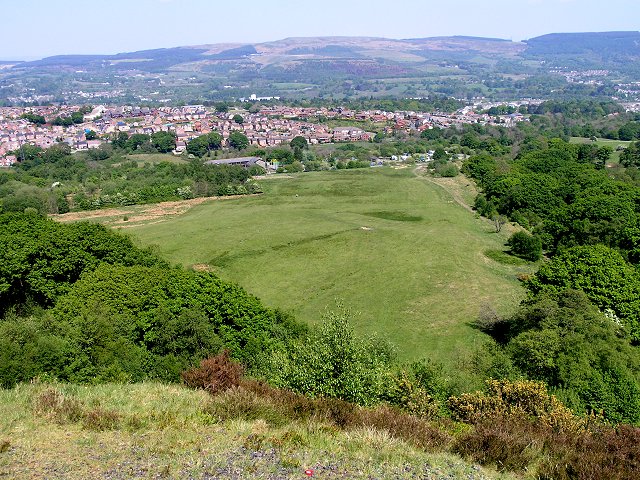
Bwllfa Colliery, also recorded as Bwllfa Dare or Bwllfa No. 1, was sunk at the head of Cwmdare in 1853 by Sam and Joseph Thomas, a remote farming community at the top of the Dare Valley at the time. Two shafts were sunk to a depth of some 200 yards (180 metres), initially worked with water-balance winding and ventilated by a furnace. Production began in 1856, and by 1857 Ebenezer Lewis, Thomas's business partner, had become sole owner. Brogden and Sons took over in 1873; in 1876 the colliery was merged, under combined ownership, with the neighbouring Merthyr Dare pit as the Bwlfa and Merthyr Dare Coal Company, though the two remained physically separate workings. Powell Duffryn bought the company in 1935, and the colliery closed in the late 1930s, though it is believed to have been retained afterwards for ventilation purposes; by 1948 the surface site was recorded as disused and largely demolished. The colliery nonetheless continued in some capacity until 1977, when it finally ceased working, and was then retained as an escape shaft for the nearby Mardy Colliery until 1989. By 1991 the site had been demolished and landscaped, forming part of today's Dare Valley Country Park. The colliery's abandonment plans, seventeen of them including the Nine Feet seam of the Six Feet Pit, are held by the Mining Remediation Authority.
Geology
Coal of the South Wales field in the Dare valley; the seams worked are not recorded.
Workings
Two shafts around 200 yards deep, originally worked with water-balance winding and furnace ventilation; merged operationally with the neighbouring Merthyr Dare pit from 1876 as the Bwlfa and Merthyr Dare Coal Company, though the workings themselves remained separate.
Closure
Closed as a working colliery in the late 1930s, though retained afterwards for ventilation; continued in some capacity until finally ceasing in 1977, after which it served as an escape shaft for Mardy Colliery until 1989.
What remains
Demolished and landscaped by 1991, the site now forms part of Dare Valley Country Park.
No original colliery structures survive; the site is now parkland.
Related mines
- Merthyr Dare Colliery — Worked by the same Bwllfa and Merthyr Dare companies from 1876.
- Nantmelyn Colliery — Renamed Bwllfa No. 2 in 1898 and worked with Bwllfa No. 1 by the same company.
- Ysguborwen Colliery — Both opened by the same Samuel Thomas and Joseph Thomas partnership -- Ysguborwen around 1849, Bwllfa Colliery in 1853 -- before the partnership dissolved.
Nearby mines
- Windber Colliery — 0.3 miles (0.4 km) N
- Nantmelyn Colliery — 0.3 miles (0.6 km) NE
- Merthyr Dare Colliery — 0.7 miles (1.1 km) E
- Llwynhelig Colliery — 1.2 miles (1.9 km) E
- Rhydwain Colliery — 1.2 miles (1.9 km) NW
Straight-line distance, within 9 miles (15 km). Show on the map.
Disasters & major incidents
-
Bwllfa Colliery Fire (1867)
27 December 1867 · Fire · 5 fatalities
A ventilation-system fire at Bwllfa Colliery filled an underground drift with smoke during a shift change on 27 December 1867, killing five of the eleven men working there. -
Bwllfa Dare Colliery Sinking Explosion (1874)
18 May 1874 · Explosion · 2 fatalities
Two sinkers were killed and a third badly injured when they ignited gas blowers while sinking a new shaft at Bwllfa Dare Colliery, Cwmdare, on 18 May 1874. -
Bwllfa Colliery cage accident, 1878
8 November 1878 · Winding / Shaft Accident · 3 fatalities
Three men going down Bwllfa Colliery, Cwmdare, for the night shift on 8 November 1878 were thrown out and killed when their cage caught the side of the shaft and turned over, about halfway down a pit some 150 feet deep. -
Bwllfa Dare Colliery roof fall, 1906
14 December 1906 · Collapse / Roof Fall · 2 fatalities
A collier and his fourteen-year-old boy were killed at Bwllfa Dare Colliery on 14 December 1906 when coal he was pulling down knocked out two props and the roof fell.
Recorded claims
Individual factual claims, each attached to the source(s) that support it below. Where sources disagree, both are kept.
- Bwllfa Colliery was sunk in 1853 by Sam and Joseph Thomas; ownership passed to Ebenezer Lewis (1857), Brogden and Sons (1873), the combined Bwlfa and Merthyr Dare Coal Company (1876) and Powell Duffryn (1935). 1
- The colliery closed in the late 1930s but was retained for ventilation; it continued in some capacity until 1977, after which it served as an escape shaft for Mardy Colliery until 1989, before demolition and landscaping into Dare Valley Country Park by 1991. 2
- The Mining Remediation Authority holds abandonment plan SWR2058 for the Nine Feet seam of Bwllfa Dare's Six Feet Pit, one of seventeen catalogue entries naming the colliery. 3
Photographs & further reading
Further detail on the colliery's working history and closure.
View sourceSources
- (secondary) Bwllfa Colliery — Wikipedia
- (secondary) Bwllfa Dare Colliery — Northern Mine Research Society
- (primary) BWLLFA DARE /SIX FEET PIT (Mine Remediation Authority abandonment plan SWR2058, BGS mine plans catalogue) — British Geological Survey / Mining Remediation Authority
Record created: 1 September 2026 · Last researched: 24 September 2026