 MineArchive
Huskar Pit Flooding, 1838
A thunderstorm burst a stream into the ventilation drift at Huskar Pit as 40 children tried to leave the mine, drowning 26 of them aged 7 to 17 — a disaster whose scale of child deaths directly shaped the Mines and Collieries Act 1842.
| Date | 4 July 1838 |
|---|---|
| Mine | Huskar Pit |
| Region | South Yorkshire |
| Primary type | Flooding / Inundation |
| Associated types | Entrapment |
| Fatalities | 26 (26 dead: 15 boys and 11 girls, aged between 7 and 17. All individually named on the Silkstone churchyard memorial.) |
| Context | During active mining |
Cause
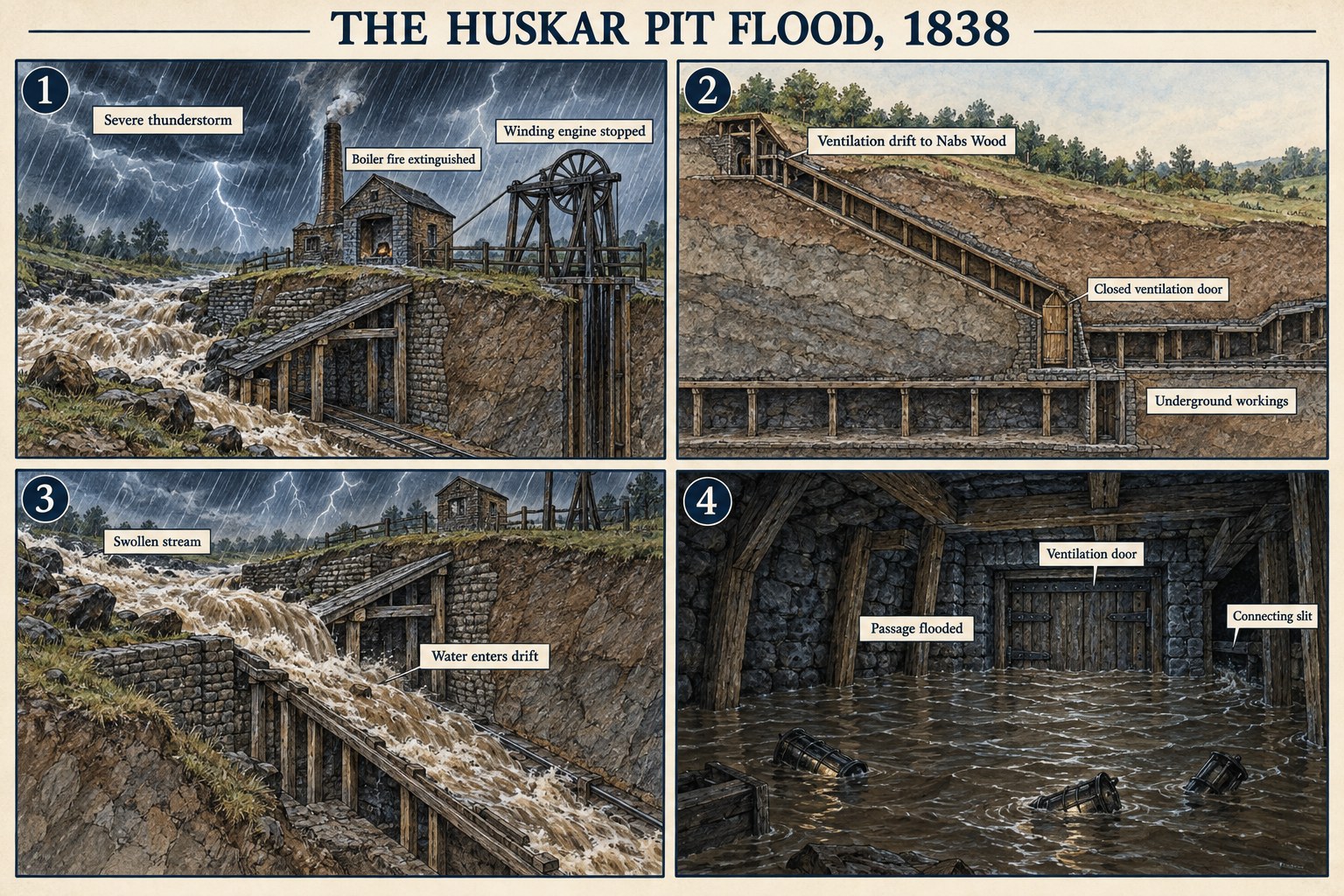
A severe thunderstorm on the afternoon of 4 July 1838 disabled the winding engine's boiler, and around 40 children chose to leave via the ventilation drift to Nabs Wood rather than wait at the pit bottom. A nearby stream, swollen by the storm, broke into the drift and swept them against a closed ventilation door at its foot.
What happened
The colliery, owned by R. C. Clarke of Noblethorpe, was connected underground to the neighbouring Moorend Colliery for ventilation. On 4 July 1838 a violent thunderstorm dropped over two inches of rain and hail in under two hours, extinguishing the boiler fire that powered the winding engine on Huskar's shaft. With the engine out of action, word was sent below for the workforce to make for the pit bottom and wait to be wound up once repairs were made. A group of about 40 boys and girls, having already been underground for nine hours, grew impatient and instead made for the surface via the familiar ventilation drift into Nabs Wood. The stream running alongside that drift had by then become a torrent; it burst into the passage, swept the children off their feet and carried them down against a ventilation door at the drift's foot, where the rising water drowned 26 of them — 15 boys and 11 girls, aged between 7 and 17, several of them siblings. The remainder either scrambled clear before the water rose or escaped through a connecting slit into Moorend Colliery, whose workers raised the alarm at the surface. James Garnett, father of one victim, was among those who went below once the water subsided to help recover the bodies, which were taken to nearby Thostle Hall to be washed before being returned to families in Silkstone, Silkstone Common, Dodworth and Thurgoland.
Investigation & inquiry
Evidence given to the Royal Commission on Children's Employment in 1841 by Benjamin Mellor, underground steward at four of Clarke's pits, described the accident as the only serious one in his experience there, directly attributing it to the storm overwhelming the engine house sough. The disaster, alongside wider evidence gathered by the Commission on child labour underground, was a significant contributor to the Mines and Collieries Act 1842, which prohibited women and girls of any age, and boys under ten, from working underground in Great Britain.
Memorials & commemoration
The 26 victims are buried together at All Saints' Church, Silkstone, beneath a Grade II listed pyramid-capped memorial (mason Edward Bailey, erected April 1841) naming every child and their age. A separate community memorial was erected in Nabs Wood in 1988, the disaster's 150th anniversary, depicting child mineworkers.
Recorded claims
Individual factual claims, each attached to the source(s) that support it below. Where sources disagree, both are kept.
- 26 children drowned, aged 7 to 17, 15 boys and 11 girls, all individually named on the Silkstone memorial. 1,2
- A thunderstorm disabled the winding engine's boiler; children leaving via the ventilation drift were swept by floodwater against a closed door at its foot. 3,1
- The disaster contributed directly to the Mines and Collieries Act 1842, which barred women, girls, and boys under ten from underground work. 3
Related terminology
Mining terms this disaster is structurally linked to, with the nature of the relationship.
- Drift (contextual relationship)
Named 6 times in this record, first in the summary: “A thunderstorm burst a stream into the ventilation drift at Huskar Pit as 40 children tried to leave the mine, drowning 26 of…” - Engine House (contextual relationship)
Named in this record’s investigation: “…there, directly attributing it to the storm overwhelming the engine house sough. The disaster, alongside wider evidence gathered by the…” - Royal Commission (contextual relationship)
Named in this record’s investigation: “Evidence given to the Royal Commission on Children's Employment in 1841 by Benjamin Mellor, underground…” - Sough (contextual relationship)
Named in this record’s investigation: “…directly attributing it to the storm overwhelming the engine house sough. The disaster, alongside wider evidence gathered by the Commission…” - Winding Engine (contextual relationship)
Named twice in this record, first in the cause: “A severe thunderstorm on the afternoon of 4 July 1838 disabled the winding engine's boiler, and around 40 children chose to leave via the ventilation…”
Sources
- (primary) Huskar Colliery, Moorend Pit Flooding — Barnsley — 1838 — Northern Mine Research Society
- (primary) Memorial to Huskar Pit Disaster, Silkstone (list entry 1151741) — Historic England
- (secondary) Huskar Pit — Wikipedia
Record created: 3 September 2026 · Last researched: 3 September 2026