 MineArchive
Huskar Pit
| Location | Nabs Wood, Silkstone Common, South Yorkshire — 53.5297, -1.5578 (exact) |
|---|---|
| Commodity | Coal |
| Type | Coal |
| Worked | from c. 1831 |
| Maximum depth | Unknown. |
| Operators | R. C. Clarke of Noblethorpe |
Overview
A drift and shaft mine at Nabs Wood near Silkstone Common, working the Silkstone seam and connected underground to the neighbouring Moorend Colliery for ventilation. Huskar is remembered almost entirely for a single event: on 4 July 1838, floodwater from a burst stream drowned 26 children as they tried to leave via the ventilation drift during a thunderstorm, a disaster that fed directly into the Mines and Collieries Act 1842.
History
Huskar and the adjoining Moorend pit were opened around 1831 by R. C. Clarke of Noblethorpe, who laid a private waggonway branch into the Dove Valley to work coal south of his existing Silkstone collieries. Huskar's shaft was used for winding coal to the surface by steam engine, while a drift or 'dayhole' driven into Nabs Wood provided ventilation and was linked underground to Moorend. On the afternoon of 4 July 1838 a violent thunderstorm broke over the valley, dropping over two inches of rain and hail in under two hours. The downpour extinguished the boiler fire powering the winding engine, and word was sent below for the workforce to make for the pit bottom to await rescue. Around forty boys and girls, tired of waiting after nine hours underground, chose instead to leave by the familiar ventilation drift to Nabs Wood. A stream running alongside the drift had by then become a torrent; it broke into the passage, swept the children off their feet and pinned them against a ventilation door at the foot of the drift. Twenty-six drowned, aged between 7 and 17; the rest scrambled clear or escaped along a connecting slit into Moorend Colliery. The dead were carried to nearby Thostle Hall to be washed and identified before being taken home to Silkstone, Silkstone Common, Dodworth and Thurgoland.
Geology
Coal of the South Yorkshire field: the Silkstone seam, worked by drift and shaft at Nabs Wood.
Workings
A vertical winding shaft plus a drift ('dayhole') driven into Nabs Wood for ventilation, linked underground to the neighbouring Moorend Colliery — the connection that let some of the trapped children escape into Moorend's own workings on the day of the disaster.
Closure
The closure date for Huskar itself is not known; the site had certainly ceased working long before deep mining ended on this part of the coalfield.
What remains
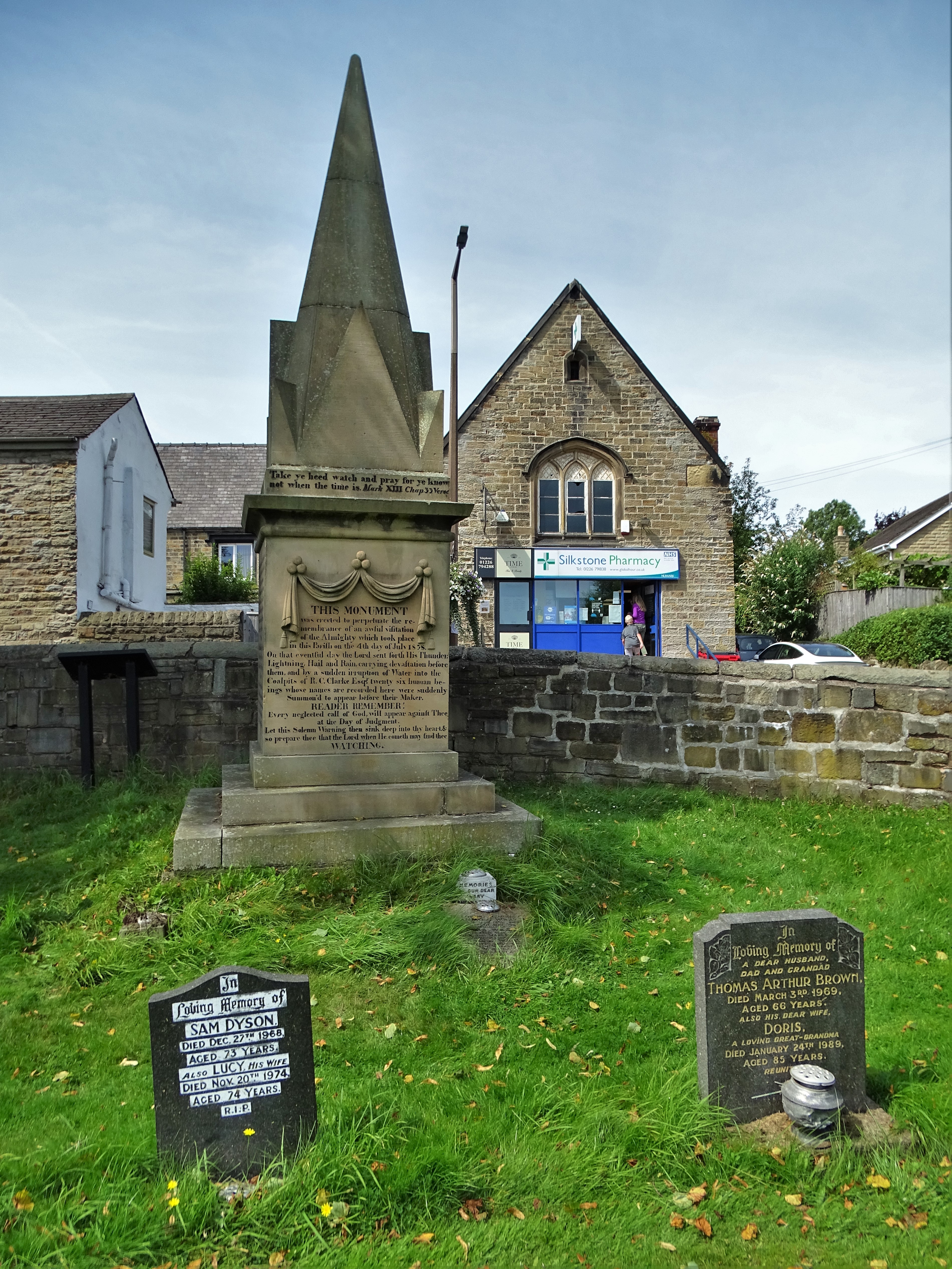
Nothing of the colliery survives above ground; the site lies within Nabs Wood, now a public amenity woodland. The 26 victims are buried together in the churchyard of All Saints' Church, Silkstone, beneath a pyramid-capped memorial (mason Edward Bailey, erected April 1841) listing every name and age — a Grade II listed structure. A separate community memorial was erected in Nabs Wood itself in 1988, the disaster's 150th anniversary, depicting child mineworkers.
No colliery structures survive; the site is wooded amenity land.
Nearby mines
- Wentworth Silkstone Colliery — 1.1 miles (1.8 km) E
- Dodworth Colliery — 1.7 miles (2.7 km) NE
- Higham Colliery — 2.3 miles (3.7 km) NE
- Stocksbridge Colliery — 3.5 miles (5.7 km) SW
- Wharncliffe Silkstone Colliery — 3.6 miles (5.8 km) SE
Straight-line distance, within 9 miles (15 km). Show on the map.
Disasters & major incidents
-
Huskar Pit Flooding, 1838
4 July 1838 · Flooding / Inundation · 26 fatalities
A thunderstorm burst a stream into the ventilation drift at Huskar Pit as 40 children tried to leave the mine, drowning 26 of them aged 7 to 17 — a disaster whose scale of child deaths directly shaped the Mines and Collieries Act 1842.
Culture
- The Huskar Pit disaster memorials (Art)
The memorials commemorate the 26 children drowned in the Huskar Pit dayhole in 1838; the Nabs Wood memorial stands near the dayhole's entrance.
Recorded claims
Individual factual claims, each attached to the source(s) that support it below. Where sources disagree, both are kept.
- Twenty-six children aged 7 to 17 drowned on 4 July 1838 when floodwater from a thunderstorm broke into the ventilation drift they were using to leave the pit, pinning them against a door at its foot. 1,2
- The scale of child fatalities at Huskar was a direct spur to the Royal Commission on Children's Employment and the Mines and Collieries Act 1842, which barred all women and girls, and boys under ten, from underground work. 1
- The 26 victims are buried together at All Saints' Church, Silkstone, beneath a memorial listing every name and age; a second community memorial was erected in Nabs Wood in 1988. 2,3
- Located at about 53.530 N, 1.558 W. 1
Sources
- (secondary) Huskar Pit — Wikipedia
- (primary) Huskar Colliery, Moorend Pit Flooding — Barnsley — 1838 — Northern Mine Research Society
- (primary) Memorial to Huskar Pit Disaster, Silkstone (list entry 1151741) — Historic England
Record created: 3 September 2026 · Last researched: 3 September 2026