 MineArchive
Cwmorthin Back Vein collapse
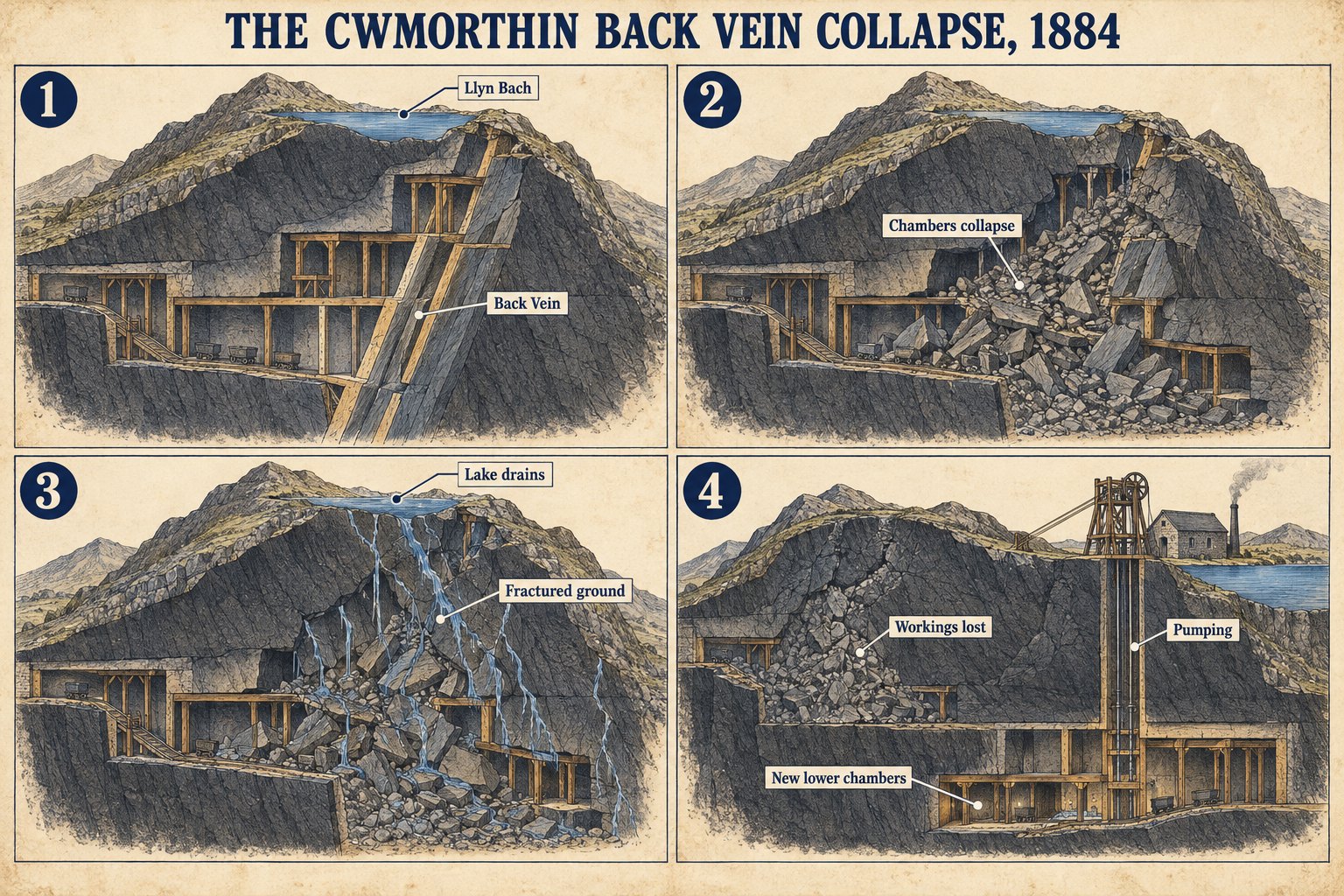
Most of Cwmorthin's workings in the Back Vein collapsed in 1884, fracturing the ground all the way to the top of Allt-fawr and draining a lake on the summit ridge. About half the mine was left inaccessible, production nearly halved, and the company was wound up within four years.
| Date | 1884 |
|---|---|
| Mine | Cwmorthin Slate Mine |
| Region | Gwynedd |
| Type | Collapse / Roof Fall |
| Fatalities | Unknown. |
| Context | During active mining |
What happened
In 1884 most of the Cwmorthin workings in the Back Vein collapsed. The fall broke the ground above them right up to the top of Allt-fawr, where Llyn Bach — the lake that supplied water to Holland's workings on the far side of the ridge — drained away through the fractures. Casualty figures are not established.
About half the mine became inaccessible. Production fell from 11,600 tons in 1884 to 6,900 tons in 1886. To go on working at all the company had to open new chambers below the level of Llyn Cwmorthin, which meant development work that produced little saleable slate and left them paying to pump water out and to raise rock up to the mills. Between 1876 and 1888 the company shipped 132,866 tons of slate, but the burden of that development was too great, and it was wound up in 1888.
It was a bad year on that mountain: on the other side of Allt-fawr the Welsh Slate Company's workings were already in a poor state, and 1884 also brought the collapse there still known as the Great Fall, in which some 6.25 million tons of rock came down into the workings.
Legal & regulatory aftermath
The consequences outlived the company. The Oakeley Company, working the same veins from the other side of the ridge, had been uneasy about the western end of its mine since 1889, because many of the pillars left between the chambers by the Cwmorthin workings were thinner than normal practice, and they feared a second collapse that might let the water of Llyn Cwmorthin into the workings. To protect themselves they bought the Cwmorthin operation outright for £10,000 in 1900, with little intention of working it; in 1902 they stripped it of its machinery and let it flood.
Recorded claims
Individual factual claims, each attached to the source(s) that support it below. Where sources disagree, both are kept.
- A catastrophic collapse in the Back Vein in 1884 roughly halved production and made about half the workings inaccessible, forcing the operating company into liquidation by 1888. 1
- Most of the Cwmorthin workings in the Back Vein collapsed in 1884; the ground above was fractured right up to the top of Allt-fawr, where Llyn Bach, which supplied water to Holland's workings, was drained as a result, and about half the mine became inaccessible. 1
- Production fell from 11,600 tons in 1884 to 6,900 tons in 1886; the company shipped 132,866 tons between 1876 and 1888 but was wound up in 1888 under the cost of developing new chambers below the level of Llyn Cwmorthin. 1
- The Royal Commission's record for the quarry notes a major underground collapse in 1884 closing half the workings. 2
- The Oakeley Company had been concerned since 1889 that the pillars left between the Cwmorthin chambers were thinner than normal practice and that a further collapse might admit the water of Llyn Cwmorthin; it bought the Cwmorthin operation for £10,000 with little intention of working it, and in 1902 stripped out the machinery and allowed the workings to flood. 1
Related terminology
Mining terms this disaster is structurally linked to, with the nature of the relationship.
- Level (contextual relationship)
Named in this record’s narrative: “…go on working at all the company had to open new chambers below the level of Llyn Cwmorthin, which meant development work that produced little…” - Slate (contextual relationship)
Named twice in this record, first in the narrative: “…which meant development work that produced little saleable slate and left them paying to pump water out and to raise rock up to the…” - Vein (contextual relationship)
The Back Vein was the slate vein the mine depended on; its collapse halved production, put about half the workings out of reach, and eventually took the company into liquidation.
Sources
- (secondary) Cwmorthin quarry — Wikipedia
- (primary) Cwmorthin Slate Quarry (NPRN 40594) — Royal Commission on the Ancient and Historical Monuments of Wales
Record created: 20 August 2026 · Last researched: 5 September 2026