 MineArchive
Dorothea Quarry landslip and flood, 1884
Late on 29 December 1884 the side of a pit at Dorothea Quarry in the Nantlle valley gave way on the side next to the lake and came down on eight men of the night gang working at the bottom. Seven died. Water from Llyn Nantlle followed the fall into the pit, and it was weeks before the bodies could be reached.
| Date | 29 December 1884 |
|---|---|
| Mine | Dorothea Quarry |
| Region | Gwynedd |
| Primary type | Collapse / Roof Fall |
| Associated types | Flooding / Inundation |
| Fatalities | 7 (Seven killed. Owen Williams, 27, of Talysarn, was dug out alive and died within a quarter of an hour; the other six lay buried under the fall and then under water. The inquest heard their names as Robert Thomas, Hugh Thomas, John Lewis, John Williams, Henry Roberts and Hugh Jones; a local report that week named Charles Davies and Richard Jones in place of Lewis and Hugh Jones.) |
| Injuries | Henry Griffiths of Penygroes, the eighth man in the pit, was dug out alive with internal injuries. |
| Context | During active mining |
Location
Plotted at Dorothea Quarry. Recorded location. The large pin is the mine; the small round markers are the nearest mines on record. Click one for its page. View on full map
Cause
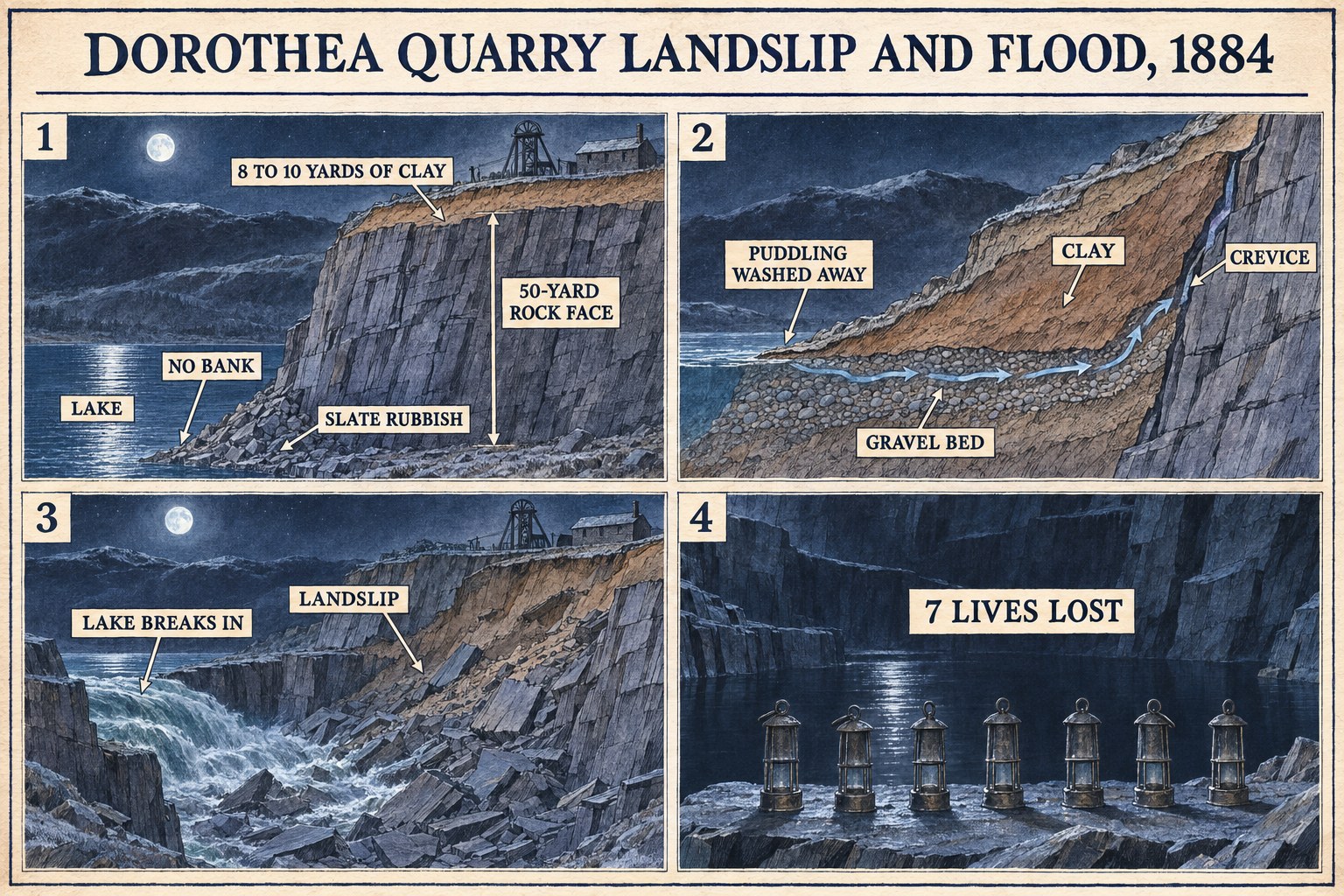
The working manager put the slip down to water from the lake finding its way through a gravelly bed into the clay that capped the rock, and from there into a crevice behind the face. A puddling of clay at the lake's edge had washed away. Slate rubbish was tipped straight into the lake, and there was no bank between the water and the pit.
What happened
Eight men were working overtime on the night shift, clearing rubbish at the bottom of the pit known as the Fire Hole. It was a clear, frosty, moonlit night. At 11.35 Robert Williams, landing rubbish at the top, heard a rushing noise and one loud report from the side between the bank and the lake, saw the face going and heard the men below cry out. He stopped the engine and ran down with the others.
The rock face stood some fifty yards high, with eight or ten yards of clay on top of it. The fall began at the far end and ran along the bank. The men underneath had no time to move. The rescuers found the side of a man's head showing through the debris and got Henry Griffiths out alive; Owen Williams, three yards off, died within a quarter of an hour without regaining consciousness. Only a little water came with the fall, but by daylight the lake was pouring in.
Rescue & recovery
Relays of men built a dam to turn the water into another channel while the pumps ran, but within three days the bodies lay under some twenty-two yards of water as well as the fallen rock, and recovery was expected to take three weeks or a month. The flow from the lake was not stopped until about 12 January.
Investigation & inquiry
Dr Hunter Hughes, the coroner for South Carnarvonshire, opened an inquest on Owen Williams at the quarry offices on 1 January 1885 and adjourned it to the 13th so that the government inspector could attend; a Mr Pearson watched for the Home Office. The manager, O. T. Owen, said that about a week before the fall men had reported clay coming down from the top of the part that fell. He had found one small crack, wide enough to admit a little finger, and the place a little moister than usual. The jury found that Williams died by a pure accident which could not have been foreseen, and recommended that the bed of the river be deepened to lower the lake and prevent the like again.
Legal & regulatory aftermath
On 19 March 1885 Love Jones-Parry asked the Home Secretary whether the Inspector of Mines for North Wales had reported on the floodings and loss of life at Dorothea and at Llanengan, and whether an inspector competent in quarries would be appointed. Sir William Harcourt replied that it was not thought expedient to place them under Home Office inspection.
Changes to practice & legislation
In 1895 the Afon Llyfni was realigned and deepened to run south of the slate workings.
Recorded claims
Individual factual claims, each attached to the source(s) that support it below. Where sources disagree, both are kept.
- At 11.35 pm on Monday 29 December 1884 a fall at Dorothea Quarry buried eight men of the night gang; seven were killed. 1,2,3
- Nantlle lake broke into the quarry after the fall, and the bodies lay under twenty-two yards of water within days. 1,3
- The manager attributed the slip to lake water working through a gravelly bed into the clay above the rock and into a crevice behind it. 2
- The inquest jury found the death a pure accident which could not have been foreseen and recommended deepening the bed of the river to lower the lake. 2
- On 19 March 1885 an MP asked the Home Secretary whether the Inspector of Mines had reported on the floodings and loss of life at Dorothea. 4
- In 1895 the Afon Llyfni was realigned and deepened to flow south of the slate workings. 5
Related terminology
Mining terms this disaster is structurally linked to, with the nature of the relationship.
- HM Chief Inspector of Mines (contextual relationship)
Named in this record’s aftermath: “…19 March 1885 Love Jones-Parry asked the Home Secretary whether the Inspector of Mines for North Wales had reported on the floodings and loss of life at…” - Slate (contextual relationship)
Named twice in this record, first in the cause: “…the face. A puddling of clay at the lake's edge had washed away. Slate rubbish was tipped straight into the lake, and there was no bank…”
Further reading
This page doesn't try to reproduce everything — these are the best original sources found for this disaster.
The first full report of the fall, with the opening of the inquest and the evidence of the man working at the top of the pit.
View sourceThe adjourned inquest: the manager's evidence on the lake, the clay and the crack seen a week before, and the jury's verdict.
View sourceSources
- (secondary) Terrible Disaster near Carnarvon (North Wales Chronicle, 3 January 1885) — Welsh Newspapers Online, National Library of Wales
- (secondary) The Dorothea Quarry Accident: The Inquest (North Wales Express, 16 January 1885) — Welsh Newspapers Online, National Library of Wales
- (secondary) Nantlle (Llangollen Advertiser, 2 January 1885) — Welsh Newspapers Online, National Library of Wales
- (primary) Mines, &c — The Dorothea Slate Quarry (Nantlle), HC Deb 19 March 1885 — Hansard
- (secondary) Dorothea Quarry, Nantlle Valley — Pugh family genealogy (grantonline.com)
Record created: 9 November 2026 · Last researched: 18 November 2026