 MineArchive
Leadhills (Minehill) suffocation, 1817
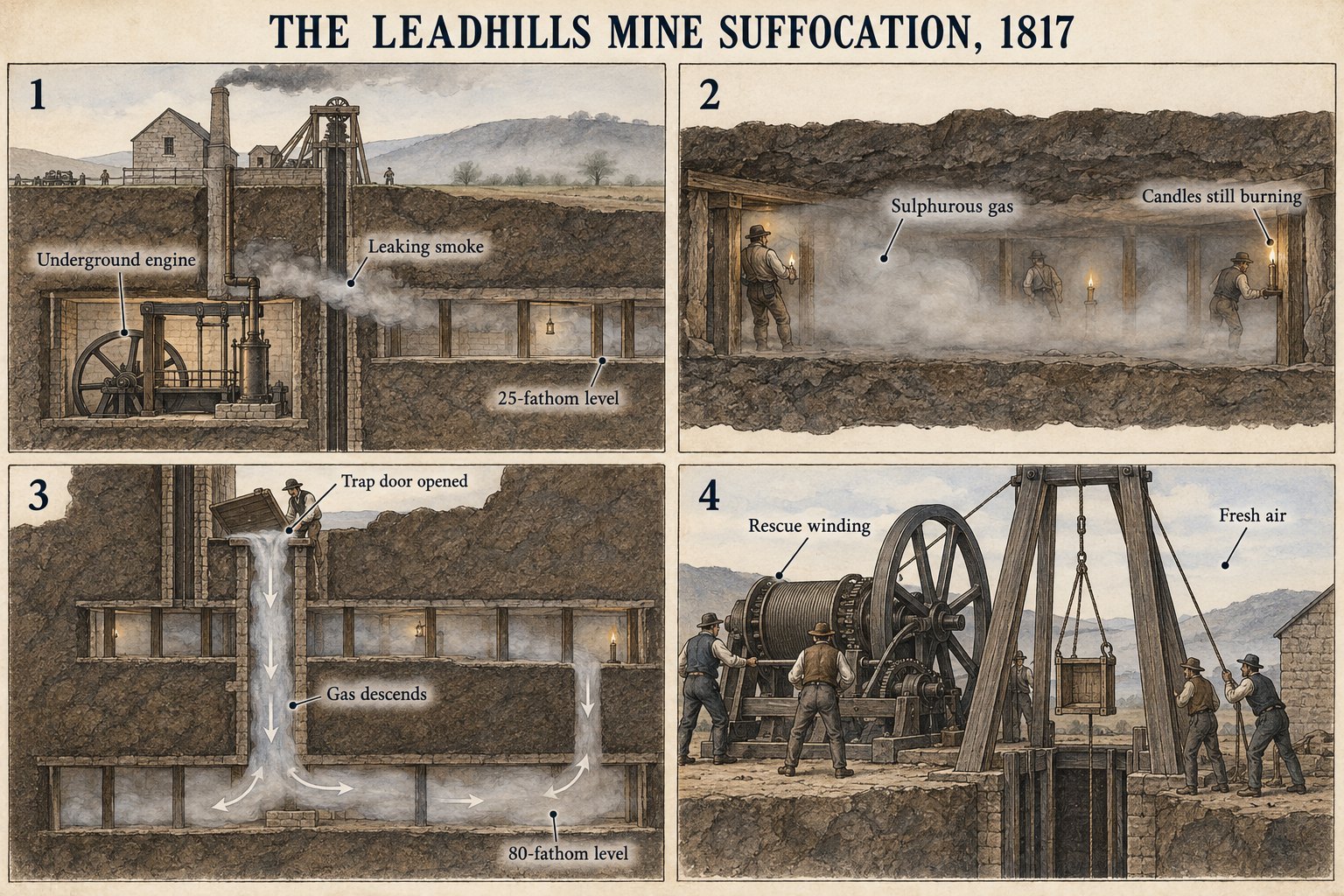
Seven men died in the Leadhills Company's mines on 1 March 1817, poisoned by smoke from an underground engine that had filled the workings with sulphurous gas — four who had gone down early to get their shift over sooner, and three more at the 80 fathom level, two of whom died going to help the others.
| Date | 1 March 1817 |
|---|---|
| Mine | Leadhills |
| Region | South Lanarkshire |
| Type | Gas / Asphyxiation |
| Fatalities | 7 (Seven died: four at the 25 fathom level and three at the 80 fathom level, two of the latter having gone down to help others. The surgeon's own account names none of them, and no list of the seven is recorded.) |
| Context | During active mining |
Cause
Smoke escaping from the chimney of the underground engine into the way-gates at about the 25 fathom level, contaminating the workings with sulphurous acid gas. The atmosphere outside was foggy that morning and there was no proper current of air in the workings, so the gas stagnated where it escaped.
Contributing factors
The engine had a troubled installation history: it was a Watt-type engine reassembled at Minehill in 1788 by Robert Muir on behalf of the Leadhills Mining Company, a job later judged poor enough that William Symington (later known for early steam navigation experiments) was brought in to “put her to rights”.
The air had been giving trouble for months. On 30 December 1816 a young man who kept a fire-engine nearly 600 feet below the surface was found dead where the air was 'not to be at all agreeable', and attempts to revive him failed; on 24 February 1817, five days before the disaster, several men were severely affected by bad air and took days to recover. Four of the seven who died had gone down before the regular six o'clock shift — two before four in the morning and two shortly after — to get their work over sooner, a practice the company did not sanction. Meeting the bad air, they tried to push through it expecting better below.
What happened
James Braid, surgeon at Leadhills, was sent for at about seven on the morning of 1 March 1817 to see what could be done for a number of men found suffocated in the Leadhills Company's mines. He arrived to find almost no one yet brought to bank. As men were raised from the 25 fathom level their state was extraordinary: most were furious, some ready to fight, some convinced everyone they saw meant to lay hands on them and struggling to escape in terror, others listless and taking no notice of anything; some were singing and some praying. Many behaved, Braid wrote, as though intoxicated with ardent spirits, and those who had seen drunk men said the resemblance was exact. The survivors described what it had felt like: first difficulty breathing and involuntary deep inspirations, then violent pain and beating in the head with ringing in the ears, then weakness and pain in the legs above the knees until they could barely stand, the heart pounding, and finally giddiness and loss of all recollection.
Four men at the 25 fathom level were beyond help. They had gone in before the shift, met the bad air, and tried to force their way through it; unable to go on or turn back, they had fallen and lain in it until help came. They had been down not less than four hours, and Braid judged they had been dead two or three of them.
The rescue itself killed three more. A trap door was opened to reach the men still alive at 25 fathoms and to let others go to them safely — and the bad air went straight down to the lower workings, onto the men at 80 fathoms who were escaping by another shaft. Everything below 40 fathoms became too foul to enter. Three died there, two of them men who had gone down to save others.
One detail stayed with the men who saw it: the candles went on burning, faintly, in the very places where the miners had died. It was 'generally considered as an extraordinary thing' — a warning system that gave no warning at all, ninety years before Haldane established the same point about carbon monoxide after a colliery explosion.
Rescue & recovery
The men at the 80 fathom level were drawn up by an engine. The last of them to get on the rope fell from it about 20 fathoms from bank — either the others were by then too far gone to secure him properly or he gave the signal too soon — and was thrown into the landing-box of the water engine at the 50 fathom level, which sent that water 40 fathoms down the shaft. The falling water stirred a circulation of air and absorbed much of the gas, and the air improved so far that a man who had lain insensible at the side of the shaft for more than an hour was revived. Two others, a little further from the shaft and so beyond the reach of the improvement, were brought up immediately after him and could not be restored.
Braid treated the survivors with emetics of sulphate of zinc for those who wanted to vomit and could not, laxative enemas for those with tenesmus, and a brisk purgative once the pulse had risen; most were well again within days. He bled one man of a florid countenance from the jugular vein, and noted that the plethoric were affected sooner and more violently than the spare — wondering in print whether men sent into such air ought to be bled beforehand as a precaution.
What's uncertain
Points where sources disagree or the record could not be settled; both accounts are kept. All open questions in the archive.
- One local account records that after the disaster “work never went on with spirit” at the Minehill workings. (uncertain) 1
- The pumping engine involved was a Watt-type engine originally reassembled at Minehill in 1788 by Robert Muir for the Leadhills Mining Company, a job judged poor enough that William Symington was later engaged to correct it. (uncertain) 1
Recorded claims
Individual factual claims, each attached to the source(s) that support it below. Where sources disagree, both are kept.
- Seven men were suffocated by fumes from an underground pumping engine at the Minehill workings at Leadhills in 1817. 1
- One local account records that after the disaster “work never went on with spirit” at the Minehill workings. (uncertain) 1
- The pumping engine involved was a Watt-type engine originally reassembled at Minehill in 1788 by Robert Muir for the Leadhills Mining Company, a job judged poor enough that William Symington was later engaged to correct it. (uncertain) 1
- The accident is presumed to have happened from smoke escaping from the chimney of the underground engine into the way-gates at about the 25 fathoms, contaminating the workings with sulphurous acid gas; the atmosphere was foggy and there was no proper current of air in the workings. 2
- Four men were lost at the 25 fathom level having gone down before the regular six o'clock shift — two before four in the morning and two a little after — in order to finish sooner; meeting the bad air they tried to force their way through it, fell, and had been underground not less than four hours when they were brought up. 2
- Opening a trap door to reach those still alive at 25 fathoms sent the bad air down into the lower workings, where three more men died at the 80 fathom level — two of them having gone down to save others — as everything below 40 fathoms became impossible to enter. 2
- The candles burned, though faintly, in the places where the men perished, which was generally considered an extraordinary thing at the time. 2
- On 30 December 1816 a young man who kept a fire-engine nearly 600 feet below surface was found dead in air that was 'not to be at all agreeable', and on 24 February 1817 several men were severely affected by the bad state of the air and took some days to recover. 2
Related terminology
Mining terms this disaster is structurally linked to, with the nature of the relationship.
- Atmospheric Engine (contextual relationship)
Named in this record’s contributing factors: “…trouble for months. On 30 December 1816 a young man who kept a fire-engine nearly 600 feet below the surface was found dead where the air was…” - Bad Air (contextual relationship)
Named 4 times in this record, first in the contributing factors: “…five days before the disaster, several men were severely affected by bad air and took days to recover. Four of the seven who died had gone down…” - Fathom (contextual relationship)
Named 11 times in this record, first in the summary: “…down early to get their shift over sooner, and three more at the 80 fathom level, two of whom died going to help the others.” - Pithead (contextual relationship)
Named twice in this record, first in the narrative: “…Company's mines. He arrived to find almost no one yet brought to bank. As men were raised from the 25 fathom level their state was…” - Pumping Engine (contextual relationship)
Named 3 times in this record, first in the summary: “Seven miners were suffocated by fumes from a pumping engine at the Minehill workings at Leadhills in 1817 — a disaster local…”
Sources
- (secondary) Leadhills Mine History — Leadhills Mines (Kenneth Ledger)
- (primary) Account of the fatal Accident which happened in the Leadhills Company's Mines, the 1st March 1817 — James Braid, Surgeon, Leadhills; read before the Wernerian Society 7 June 1817, printed in The Scots Magazine and Edinburgh Literary Miscellany, vol. 79 (June 1817), 414-416
Record created: 20 August 2026 · Last researched: 5 September 2026