 MineArchive
Godolphin Mine
| Also known as | Wheal Dolphin, Godolphin Bridge Mine |
|---|---|
| Location | Godolphin Woods, north of Godolphin Cross, Breage, Cornwall — 50.1419, -5.3523 (approximate) |
| Commodities | Copper, Tin |
| Type | Metal |
| Worked | By the 1600s–After 1861 |
| Maximum depth | 90 fathoms (165 m) by 1788 |
| Operators | Godolphin family (?–1786), Richard Tyacke (1810–?) |
Overview
A copper and tin mine in Godolphin Woods, across the road from Godolphin House, already 90 fathoms deep and steam-pumped by 1788, joined with Wheal Dolphin in 1804 and worked with New Great Work from 1861.
History
Godolphin Mine lies in the woods just north of Godolphin Cross, across the road from Godolphin House. Its records begin in the 1600s, but the mine is older: in 1540 John Leland noted that the Godolphin tin works had served Sir Francis Godolphin and his ancestors 'many years as a minte'. Gunpowder was first used to break rock in Cornish mining in 1686, and it is thought this happened at Godolphin.
A 48-inch Boulton and Watt pumping engine was moved here from Wheal Crenver in 1786, and by 1788 the mine was already 90 fathoms deep. Three groups of adventurers worked the valley, as Godolphin Bridge Mine, Godolphin Mine and Wheal Dolphin. Wheal Dolphin, which raised copper, closed in 1790 and was absorbed into the Godolphin sett in 1804 so that the two could share the cost of pumping. By 1808 five engines and two waterwheels, of 44 and 48 feet, were draining the workings, and in 1810 a new tenant, Richard Tyacke, opened the mines. Old Mine was added in 1821 and more than 480 people worked here ten years later. In 1836 Captain Teague took both setts and spent about £40,000 on new engines, but although a rich lode was cut the mine closed in 1846. In the 1840s the ground around one engine house was so worked out that the shaft sides collapsed and the engine house slid straight down. A shaft was being sunk for a Sims engine by 1849, and from 1861 Godolphin was worked with New Great Work, taking in lodes to the south, until running costs and low tin prices ended it.
Output figures vary: about 9,000 tons of copper ore was sold between 1815 and 1846 by one account, while another puts nearly 9,000 tons and a profit of £70,000 in 1805 to 1810. Dines gives 8,425 tons of copper and 10 tons of tin for the years he could trace.
Geology
Copper and tin lodes: the Orchard, North and South New Discovery, North and South Godolphin Adit, Wheal Dolphin, Hemming's and Bawden's.
Workings
About twenty-five named shafts, the deepest recorded at 80 fathoms, drained by up to five pumping engines and two waterwheels.
Closure
Closed in 1846, worked again from 1849, and joined with New Great Work from 1861 until costs and low tin prices ended it.
What remains
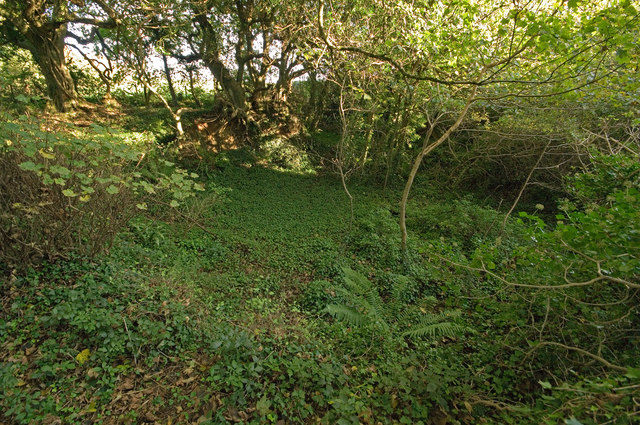
Overgrown shaft hollows and ditches in Godolphin Woods, on the National Trust's Godolphin estate.
Shaft hollows, leats, the remains of Polglase's Shaft and the count house.
Redevelopment
The count house is a National Trust education centre.
Related mines
- Great Work Mine — Both on the Godolphin estate; Godolphin was worked with New Great Work from 1861.
Nearby mines
- Great Work Mine — 1.1 miles (1.8 km) SW
- Tregonning Hill China Clay Pits — 1.5 miles (2.4 km) S
- Crenver & Wheal Abraham — 1.9 miles (3.0 km) NE
- Wheal Vor — 2.0 miles (3.2 km) SE
- Wheal Grey Mine — 2.1 miles (3.4 km) S
Straight-line distance, within 9 miles (15 km). Show on the map.
What's uncertain
Points where sources disagree or the record could not be settled; both accounts are kept. All open questions in the archive.
- Gunpowder was first used in Cornish mining in 1686, and it is thought this happened at Godolphin. (uncertain) 1
- 9,000 tons of copper ore was sold between 1815 and 1846. (disputed) 1
- Wheal Dolphin and Godolphin produced nearly 9,000 tonnes of copper ore between 1805 and 1810, for a profit of £70,000. (disputed) 1
Recorded claims
Individual factual claims, each attached to the source(s) that support it below. Where sources disagree, both are kept.
- In 1540 Leland noted that the Godolphin tin works had served Sir Francis Godolphin and his ancestors for many years. 1
- Gunpowder was first used in Cornish mining in 1686, and it is thought this happened at Godolphin. (uncertain) 1
- A 48-inch Boulton and Watt pumping engine came from Wheal Crenver in 1786; the mine was 90 fathoms deep by 1788, and by 1808 five engines and two waterwheels were at work. 2
- Wheal Dolphin closed in 1790 and was absorbed into the Godolphin sett in 1804 to share the cost of pumping. 2
- In 1810 a new tenant, Richard Tyacke, opened the mines. 1
- Captain Teague took both setts in 1836 and spent about £40,000 on new engines; the mine closed in 1846 and was working again by 1849. 2
- From 1861 Godolphin was worked with New Great Work. 2
- 9,000 tons of copper ore was sold between 1815 and 1846. (disputed) 1
- Wheal Dolphin and Godolphin produced nearly 9,000 tonnes of copper ore between 1805 and 1810, for a profit of £70,000. (disputed) 1
- In the 1840s the ground around one engine house was so worked that the shaft sides collapsed and the engine house slid down. 1
Sources
- (secondary) Godolphin Mine, Cornwall — Cornwall Calling
- (secondary) Godolphin Mine — Explore Cornwall
Record created: 18 October 2026 · Last researched: 18 October 2026