 MineArchive
Fowey Consols
| Also known as | Fowey Consuls, Lanescot Mine |
|---|---|
| Location | Between Tywardreath and St Blazey, near Par, Cornwall — 50.3731, -4.6982 (approximate) |
| Commodities | Copper, Zinc |
| Type | Metal |
| Worked | 1813–1867 |
| Maximum depth | Unknown. |
| Operators | Joseph Treffry (1822–1850) |
Overview
A group of copper mines between Tywardreath and St Blazey, gathered by Joseph Treffry from the 1810s into one of the deepest, richest and most important copper mines in Cornwall. At its height it employed well over a thousand people, worked its engines and waterwheels from a leat and aqueduct across the Luxulyan Valley, and sent its ore to Treffry's own harbour at Par; it closed with the collapse of the copper market in 1867.
History
Wheal Treasure, Wheal Fortune and Wheal Chance began working in 1813, and in 1814 Joseph Austen of Fowey, who later took the name Treffry, bought a share in each; other shareholders included the Rev. Robert Walker of St Winnow, John Colman Rashleigh of Prideaux and a John Vivian. Wheal Treasure's captain, John Hitchens, advised him to buy two more shares in 1817, and in the year to June 1818 Wheal Treasure alone raised 1,202 tons of copper ore. Cornwall Calling has Treffry taking control of the group, as Fowey Consols, in 1819; Wikipedia has the mines stopping in 1819 and Treffry buying and consolidating them in 1822, with Lanescot added in 1836, though Cornwall Calling counts Lanescot among the five from the start. The mines employed 1,680 people in 1822, making Treffry the largest employer in the district, and the ore was carried four miles to Fowey by 100 mules and 30 horses until he linked the mine to his new port at Par by a canal in the late 1820s. In 1831 miners at the setting day, when tribute and tutwork pitches went to the lowest bidder, tried to hold the prices up; when two men refused to join them the Riot Act was read and seven were arrested and tried at Launceston, but discharged. The shaft for the 80-inch Austen's engine was sunk that winter, and William West's Henrietta's engine of 1839, the first long-stroke engine in Cornwall, worked from 1840 to 1843. By the 1840s some 1,800 people worked there, with seven large engines and thirteen waterwheels fed from Molinnis Moors more than four miles away by a leat and Treffry's aqueduct at Luxulyan. West Fowey Consols came into production in 1845. Treffry died on 29 January 1850, and work stopped at the mines for his funeral. The Prince and Princess of Wales visited on 22 July 1865, but in 1867 the copper market collapsed and the mine closed, having raised over 315,000 tons of copper ore averaging 8 per cent since 1822, or 382,910 tonnes with Lanescot by another count.
Geology
Copper lodes that also yielded much smaller amounts of zinc ore, pyrites and nickel. Fowey Consols is the type locality for two minerals, langite and rhabdophane-(Ce), and 34 valid mineral species have been reported from it.
Geological setting: Veins and Lodes (well documented example)
Workings
Deep shafts worked by at least ten Cornish beam engines over the mine's life, among them the 80-inch Austen's engine, whose perpendicular shaft was sunk in the winter of 1831-32, and Henrietta's 80-inch engine, built by Harvey and Company in 1839 to William West's design. Contemporary counts give six steam engines and seventeen waterwheels, or seven engines and thirteen waterwheels in the 1840s, driven by water brought more than four miles by leat and aqueduct. Ore went by canal and tramway to Par harbour.
Closure
The collapse of the copper market closed the mine in 1867, after which only a couple of smaller mines nearby, at Pembroke and East Crinnis, carried on. Cornwall Calling's summary gives the working life as 1813 to 1868.
What remains
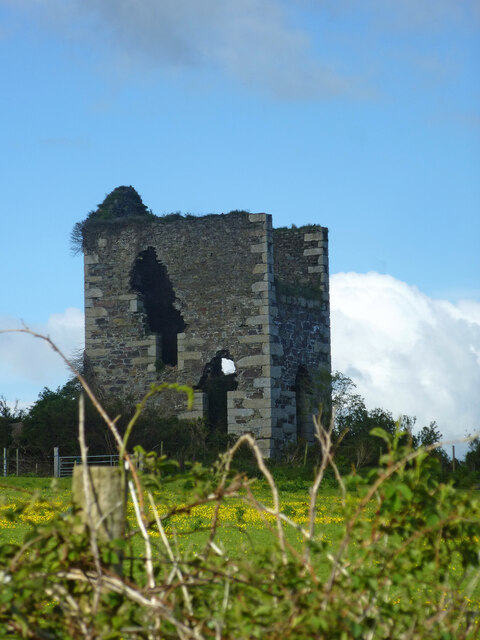
The site has suffered badly from dump removal and demolition, but significant remains survive. The ruined Austen's engine house at the northern end is one of the few visible buildings; a 2021 photograph shows it roofless and overgrown. Henrietta's engine house was converted to a dwelling in 1996, and the leat for West Fowey Consols can still be seen beside St Blazey Road. The mines cannot be separated from the Luxulyan Valley and the canal that tied them to Par.
The ruined Austen's engine house, Henrietta's engine house (now a house), the West Fowey Consols leat and the leat and aqueduct system in the Luxulyan Valley.
Redevelopment
Henrietta's engine house was converted to a dwelling in 1996.
Nearby mines
- Wheal Martyn China Clay Works — 3.8 km W
- Great Crinnis Mine — 4.9 km SW
- Carclaze Pit — 6.2 km W
- South Polgooth Mine — 11.1 km SW
- Belowda Mine — 12.7 km NW
Straight-line distance, within 15 km. Show on the map.
People
- John Hitchens · manager, 1817 — Captain at Wheal Treasure, of Par, who advised Austen to buy two more shares in 1817.
- William Polkinghorne · official, 1850 — Purser's deputy and general pay clerk, a bearer at Treffry's funeral in 1850.
- William Powne · official, 1850 — Storekeeper and general clerk, a bearer at Treffry's funeral in 1850.
- John Colman Rashleigh · shareholder, 1814 — Of Prideaux, a shareholder in the first three mines in 1814.
- Thomas Thomas · surveyor, 1850 — Mapper and dialer at Fowey Consols, a bearer at Treffry's funeral in 1850.
- Joseph Treffry (1782–1850) · proprietor, 1822–1850 — via the operator record
- Robert Walker · shareholder, 1814 — The Rev. Robert Walker of St Winnow, a shareholder in the first three mines in 1814.
What's uncertain
Points where sources disagree or the record could not be settled; both accounts are kept. All open questions in the archive.
- Joseph Treffry took control of the group of five mines known as Fowey Consols in 1819. (disputed) 2
- The mines stopped in 1819 and were bought by Treffry in 1822 and consolidated as Fowey Consols; Lanescot was added in 1836. (disputed) 1,3
- Between 1822 and 1867 the mine produced over 315,000 tons of 8 per cent copper ore. (disputed) 6,5
- With Lanescot the mine produced 382,910 tonnes of ore from 1822 to 1867. (disputed) 3
Recorded claims
Individual factual claims, each attached to the source(s) that support it below. Where sources disagree, both are kept.
- Wheal Treasure, Wheal Fortune and Wheal Chance began working in 1813. 1,2
- Joseph Treffry took control of the group of five mines known as Fowey Consols in 1819. (disputed) 2
- The mines stopped in 1819 and were bought by Treffry in 1822 and consolidated as Fowey Consols; Lanescot was added in 1836. (disputed) 1,3
- Fowey Consols employed 1,680 people in 1822, making Treffry the largest local employer. 2
- By the 1840s about 1,800 people worked there, with seven large engines and thirteen waterwheels fed by a leat and Treffry's aqueduct at Luxulyan. 3
- In 1831 miners tried to control the bidding at a setting day; the Riot Act was read and seven were arrested, tried at Launceston and discharged. 2,4
- Henrietta's 80-inch engine, designed by William West and built by Harvey and Company in 1839, was the first long-stroke engine in Cornwall and worked at Fowey Consols from 1840 to 1843. 5
- Between 1822 and 1867 the mine produced over 315,000 tons of 8 per cent copper ore. (disputed) 6,5
- With Lanescot the mine produced 382,910 tonnes of ore from 1822 to 1867. (disputed) 3
- The mine closed in 1867 with the collapse of the copper market. 2,3,6
- Fowey Consols is the type locality for langite and rhabdophane-(Ce). 1
Photographs & further reading
A local history project's page on the mine; not read for this record.
View sourceSources
- (secondary) Fowey Consols mine — Wikipedia
- (secondary) Fowey Consols Mine, Cornwall — Cornwall Calling
- (secondary) Lanescot — Wikipedia
- (secondary) Fowey Consols — Grace's Guide
- (observational) Fowey Consols, Henrietta's pumping engine house (photograph) — Geograph Britain and Ireland
- (observational) Austen's 80-inch pumping engine house on Fowey Consols (photograph, 2021) — Geograph Britain and Ireland
- (primary) BGS mine plans: Fowey Consols — British Geological Survey
- (secondary) Joseph Treffry — Wikipedia
Record created: 18 September 2026 · Last researched: 18 September 2026